The Method: Five Functions, the Optimisation Hierarchy and the Net-Benefit Principle
Part I asked what the evidence says about the footprint of AI (Chapter 2) and about its benefit (Chapter 3). This chapter turns those answers into a method, and it concerns all five environmental functions: E1 Measure, E2 Justify, E3 Design, E4 Operate and E5 Account. It fixes what each function is, the net-benefit principle with its three tests (Count, Compare and Cap), the optimisation hierarchy, the environmental budget with a stop path outside the system it stops, the ceiling on delegation for an agent that can spend resources and the artefacts that every later chapter fills in. Every other chapter refers to these definitions, so the chapter is plain by design: it states terms, shows records and gives rules, and leaves the evidence to Chapters 2, 3 and 5 to 8.
The method is the book's own design. It builds on the autonomy budget and observer principle of AI Operations, Chapters 4 and 17, the independence principle of AI Purple, Chapter 15, the answerability principle of AI Leader, Chapter 4, the stewardship principle of AI Developer, Chapter 4, the cost and carbon policy of AI Platform and Security, Chapter 22 and the usage modes, cost design principle and outlook labels of AI Governance, Chapters 2, 4 and 22 (26, Nordqvist, 2026) (27, Nordqvist, 2026) (33, Nordqvist, 2026) (34, Nordqvist, 2026) (35, Nordqvist, 2026) (36, Nordqvist, 2026). The sources support parts of the method, never the whole; where a rule is a matter of design, the chapter says so. Figure 4.1 shows the two rule sets, the hierarchy and the tests.
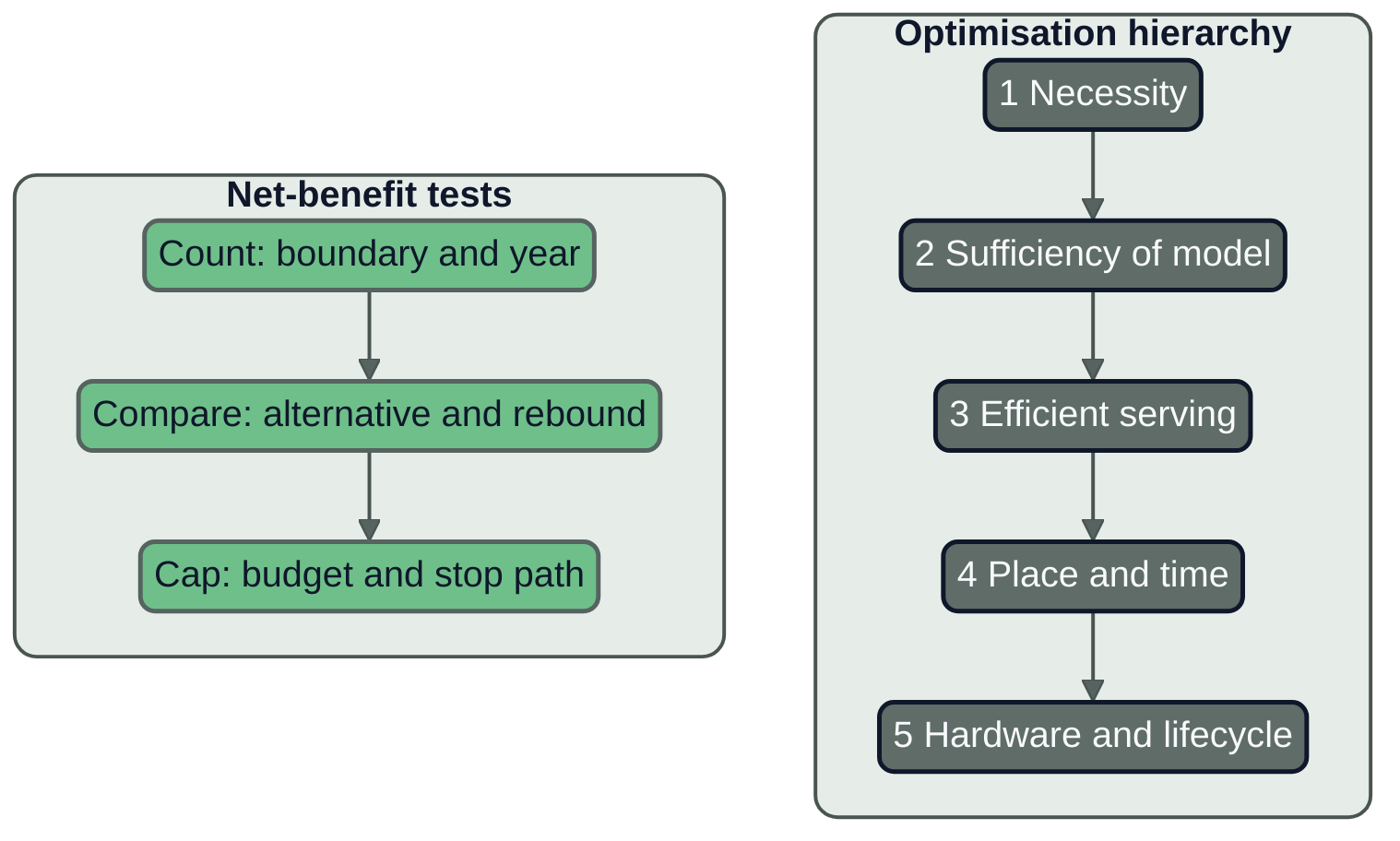
Figure 4.1: Two ordered rule sets apply to one use of AI: the five levers of the optimisation hierarchy, tried in order, and the three tests of the net-benefit principle, applied in order. The figure carries no numbers.
From principle to practice
A use of AI is justified by evidence, not by intention. The earlier volumes met the same weakness in other forms: an adoption claim nobody re-measured, a coverage claim that had expired, a restore that was never tested. A statement that AI is efficient, green or net-positive is no better unless it says what was counted, at which boundary, in which year, against which baseline and by whose check.
The questions are concrete: whether to roll an assistant out to another 800 people, which model should handle a route, where a batch job should run, whether the board can say that AI work has become more efficient. Each concerns one use at one moment, and the method answers with the same moves. Name the use and its unit of work. Count what it costs the environment. Compare what it gives with what the alternative would give. Cap what it may spend. Record the result with a date, and treat the record as expiring.
The method is a discipline for making claims, not a prediction about whether AI will turn out well or badly for the environment; the debates of Chapters 11, 19 and 25 hold each position to the same tests. It is proportionate: ambient AI that the organisation cannot meter enters the register as a supplier-reported row, with the supplier's boundary next to the figure and the gap next to the row.
The five functions
The five environmental functions are the red thread of the book. Each is a kind of work, defined by what it takes in, what it produces and where it ends, and each can be delegated, measured and governed separately. They are not the operations functions O1 to O5 of AI Operations, the leadership functions L1 to L5 of AI Leader or the developer functions D1 to D5 of AI Developer; where one person does two kinds of work, the record says which function a piece of work belongs to.
E1 Measure is counting the footprint of models, uses, agents and hardware at a stated boundary, year and method. It ends when the figure has a boundary, a period, a method, a unit of work and a date, or when the record says plainly that the figure is not available, which party will supply it and from when (Chapters 5 to 8).
E2 Justify is deciding whether a use is worth its footprint, compared with the non-AI alternative and with the rebound it causes. It ends in a decision by a named person to start, continue, scale, change or stop the use (Chapters 9 to 11).
E3 Design is choosing and shaping the solution for less: the model, the serving, training or retrieval, the budgets of agents and the hardware. It ends when the design is accepted with the saving it claims measured, not assumed (Chapters 12 to 16).
E4 Operate is placing, timing, hosting, running and observing AI under budgets and stop paths. It ends when the use is retired or handed over with its records (Chapters 17 to 20).
E5 Account is complying, reporting, claiming, procuring, governing and holding to account, with evidence that has a boundary and a date. It ends when a named person has answered for the statement and its evidence is recorded with an expiry (Chapters 21 to 25).
The functions connect through records. E1 produces the footprint record that E2 needs; E2 produces the benefit record and the decision that E3 designs against; E3 produces the budget that E4 runs under; E4 produces the measurements that E5 reports and that E1 uses to refresh its figures. The loop closes on evidence age: an expired record sends the work back to E1. Two things sit outside the loop on purpose, as in AI Operations: the meter that reads consumption independently of the system that consumes it, and the stop path that named people hold.
Table 4.1 sets the functions side by side.
Table 4.1: The five environmental functions, what each takes in and produces, and where it ends.
| Function (chapters) | Takes in | Produces | Ends when |
|---|---|---|---|
| E1 Measure (5 to 8) | Running estate, supplier disclosures | Footprint record FPR-* |
Figure has boundary, period, method, unit and date, or its absence is recorded |
| E2 Justify (9 to 11) | Footprint record, intended benefit | Benefit record BEN-*, a decision |
A named person decides to start, continue, scale, change or stop |
| E3 Design (12 to 16) | Decision to proceed, requirement | Design, environmental budget EBG-* |
The claimed saving is measured, not assumed |
| E4 Operate (17 to 20) | Accepted design | Running use inside its budget, placement policy PLC-* |
The use is retired or handed over with its records |
| E5 Account (21 to 25) | Records of E1 to E4 | Disclosure, claim CLM-*, supplier disclosure SDR-*, register entry |
A named person has answered for the statement; evidence has an expiry |
The use is the unit
Models are shared and decisions are made per use. A model that serves forty services does not set how often each calls it, with how much context, at what reasoning effort or in which region; the service owners decide, and the sum of their decisions is most of the organisation's inference footprint (AI Threat, Chapter 17, reaches the same conclusion for deployers) (29, Nordqvist, 2026). The unit that the method manages is therefore the use: one service, route or agent doing one kind of work for one purpose. Its footprint is the footprint per unit of work multiplied by the volume of units, and both factors belong to a named owner.
The unit of work, which the later chapters call the functional unit, is the same for cost, footprint and benefit. Life cycle assessment, where the term comes from, asks for goal and scope, including the system boundary and the functional unit, before anything is counted (22, ISO/IEC, 2006) (23, ISO/IEC, 2006). The Software Carbon Intensity specification applies the idea to software: SCI = ((E × I) + M) per R, where E is the energy consumed, I the carbon intensity of that energy, M the embodied emissions of the allocated hardware and R the functional unit, such as a transaction or an API call; it was adopted as ISO/IEC 21031:2024 (21, Green Software Foundation, 2024). The book uses the form of the rate without requiring an SCI score; it requires that a figure about a use names its unit: a resolved enquiry, a claim triaged, a request answered, a run, a session. Chapter 5 shows how ISO 14044 and ITU-T L.1801 apply this to AI.
The two factors move independently, which is why the method counts both. The Region's citizen-service assistant grew from 71,000 resolved enquiries in October 2026 to about 168,000 a month in September 2032, 2.4 times the volume (profile figures; illustrative). Suppose energy per resolved enquiry fell by 30 per cent through the levers of Chapters 12 and 13. Total energy would then be 2.4 times 0.7, or 1.68 times the earlier total, a rise of 68 per cent in spite of the per-unit gain. The numbers are arithmetic, not a finding. They illustrate that an efficiency figure per unit shown without the volume misleads, and that rebound, the growth in use that cheaper or better service invites, is measured and not assumed away (Chapter 10).
The net-benefit principle
The net-benefit principle states that a use of AI is justified only when its benefit per unit of environmental cost is shown with evidence. It has three tests, applied in order wherever a use is proposed, scaled or renewed. The principle is the book's own conclusion, the environmental counterpart of the earlier volumes' principles: what verifies a thing is independent of what did it (AI Operations, AI Purple), a named person answers for it (AI Leader) and a named owner can explain and reverse it (AI Developer). Chapter 8 applies Count and Cap to this book's own production.
Count
Count requires that the footprint is counted at a stated boundary, in a stated year, with a stated method. The boundary is a bundle of choices, and a figure without them cannot be compared with any other:
- whether the figure is operational (the electricity the use consumes while it runs) or lifecycle (which adds the manufacture of the hardware and, in the widest form, its disposal);
- which part of the system it covers: the accelerator only, the whole server, the whole facility including cooling and power conversion;
- for carbon, whether electricity is counted by the average emissions of the grid where it is used (location-based) or by the contracts the buyer holds (market-based), which are the two methods that the Greenhouse Gas Protocol's Scope 2 Guidance defines (24, World Resources Institute and World Business Council for Sustainable Development, 2015);
- for water, whether the figure is withdrawal or consumption and whether it covers cooling on site only or also the generation of the electricity;
- whether a statistic is a median or a mean, and whether it is per query, per task or per agent run;
- the year of the data, and for a figure taken from a source, whether it is reported by the vendor or checked independently.
Chapter 2 gives the table of boundaries and shows how two honest figures differ by an order of magnitude. This chapter turns it into the Count rule: no figure about a use enters a record, a table, a diagram or a sentence of the book without its boundary and year. The Region adopted the rule on 20 September 2032 (AIDR-1300) and Hansa Mutual on 27 September 2032 (AIDR-1350).
A count may also say "not available". A deployer cannot honestly invent a figure for a hosted model whose provider publishes no per-request energy; the entry names the boundary needed, the party who can supply it, the date it was asked for and, where the deployer estimates, the method and its limits. The Count test is passed by a footprint record in which every figure has these parts or an explicit absence with an owner.
Compare
Compare requires that the benefit is measured against the non-AI alternative and against the rebound the use causes. A benefit is a difference between two ways of doing the same work, and the other way is a real one: the phone service, the caseworker's own search, a rule-based classifier, a smaller model, no service at all. It needs a measurement of the alternative on the same functional unit. The second half of the test is rebound: if a use becomes cheaper, faster or easier, people use it more, and the extra use has its own footprint. The owner states the starting volume and measures it again. Chapter 9 gives the benefit record, including the case in which no controlled comparison is possible and the record says so; Chapter 10 treats rebound.
A benefit that is claimed and not measured is an intention. The method does not forbid acting on one; it forbids counting it as evidence, and the record says which of the two it holds (Chapter 3).
Cap
Cap requires that the use runs under an environmental budget with a stop path outside the system it stops. The budget is a limit on one or more of energy, carbon, water, cost or compute for one use or one agent over a period; the stop path is how a named person halts or reduces the use without the system's cooperation. Count and Compare describe a use at a moment; a use allowed to grow without a limit can outrun both the figure and the benefit that justified it, above all an agent that can start work of its own. The next section defines both.
Neither side pays for the other
The three tests share one rule about the two sides of the ledger. Neither side pays for the other. An unproven benefit does not offset a measured footprint, and a purchased offset does not replace reduction. Four consequences follow.
- A counted footprint is not reduced by an asserted benefit. A claim that a use avoids emissions elsewhere is a benefit record that must pass Compare at its own boundary; until it does, the footprint stands at its full value.
- A footprint is not reduced by a certificate, guarantee or offset that the organisation has bought. A contractual instrument may legitimately change a market-based figure; it does not change the energy consumed or the location-based figure, and both are reported where the method requires both (Chapter 22). The Software Carbon Intensity specification makes the same point from the other side: its page states that reducing the score is not about purchasing offsets (21, Green Software Foundation, 2024).
- A proven benefit can justify a footprint and does not reduce it. The record shows both numbers, each at its boundary, and a named person states why the first outweighs the second; a ratio supports the judgement and does not replace it.
- A saving in one place does not cancel growth in another unless the two are counted at the same boundary in the same period.
Chapters 21 and 22 read the consumer-claims rules. The method does not depend on how they develop: a claim the organisation cannot defend to itself should not be made to anyone else.
The optimisation hierarchy
The three tests above judge whether a use is worth having. The optimisation hierarchy orders the ways of making it cost less. It has five levels, and the order is the order in which the levers tend to be both larger and cheaper to pull. It is the book's design, not a measured law, and the chapters of Part IV test each level for the evidence that it saves what is claimed.
Table 4.2 gives the question, the lever and the evidence for each level. The levels are tried in order; routing to the cheapest adequate model at level 2 is treated in AI Platform and Security, Chapter 22 (27, Nordqvist, 2026).
Table 4.2: The optimisation hierarchy.
| Level (chapters) | The question | Typical lever | Evidence that the saving is real |
|---|---|---|---|
| 1 Necessity (9, 12, 25) | Is the work needed at all? | Decline unproven uses; stop unused services; use a lookup, rule or page of text | Volume and use of the service; the benefit record |
| 2 Sufficiency of model (12) | Is a smaller model adequate? | Smallest model, lowest reasoning effort, shortest context that meets a stated requirement | Evaluation at two or more sizes; energy per unit at one boundary |
| 3 Efficient serving (13, 14) | Is the chosen model served without waste? | Quantise, cache, batch, route; limit output and agent steps; retrieve rather than train | Before and after at one boundary, quality unchanged |
| 4 Place and time (17, 18) | Does the work run where and when it should? | Cleaner grid, no water scarcity, heat reuse, within floors of deadline, sovereignty, resilience | Intensity of the hours and region actually used, not an annual average |
| 5 Hardware and lifecycle (16) | Is the hardware used fully and long enough? | Utilisation, embodied impact, reuse, repair, retirement | Utilisation over a period; the allocation rule for embodied impact |
Three rules govern its use. First, a lower level is no reason to skip a higher one: a well-batched, optimally placed service that should not exist should not exist. Second, each level is tested for the saving it delivers, at the boundary of the use and with the same functional unit before and after; a lever that is applied and never measured counts as an intention, and a smaller model that sends more requests to a larger one can lose what it saved. Third, the levels re-open the tests: a change at any level alters the footprint (Count), may alter quality and so the benefit (Compare) and may alter volume (Cap).
The environmental budget and the stop path
An environmental budget is a limit on energy, carbon, water, cost or compute for one use or one agent over a period, set by someone other than the agent and measured by something outside the system it limits, with a stop path that works when the system does not. The record that holds it is the environmental budget EBG-*. Four properties distinguish it from a target.
It is set by a person who is not the agent. A limit that the agent sets, or can change, is a statement of intent. A named person with the authority sets it and, where the sponsor of a use also reports its benefits, someone other than the sponsor does: AI Leader, Chapters 15 and 20 record that where the spender also measures the value, the arrangement is adverse (35, Nordqvist, 2026).
It is measured outside the system it limits. The platform, the gateway or the provider's metering holds the meter, not the agent. This is the observer principle of AI Operations applied to resources: what verifies an action is independent of what performed it (34, Nordqvist, 2026). An agent that reports its own consumption cannot be the evidence that it stayed within budget.
It is enforced, not requested. A budget the agent is asked to respect is a request; one enforced at the gateway on a credential the agent cannot widen is a control. AI Operations, Chapter 15 sets out the layers (per call, per run, per agent per period, per service) and a quarterly drill of the stop, and AI Operations, Chapter 22 fails a stop whose drill is older than 90 days; that a stop never drilled is not counted as a cap is this book's own rule (34, Nordqvist, 2026). Two refinements carry over: a limit on consumption is paired with a measure of outcome per unit, so that a system cannot meet it by doing less, and a service that cannot simply stop moves down a ladder on breach (a cheaper model, a smaller context, the non-AI path) and is not halted.
It has a stop path outside the system it stops. Someone must be able to halt or reduce the use without asking the system. The gateway route is one such path; a switch on the public web page that replaces the assistant with a static page and the phone number is another that does not depend on the gateway. Named roles hold both, one reachable out of hours. The record carries the date of the last drill and how long a drill counts; a budget with no drill on record is shown as proposed and not counted as a cap.
Carbon intensity of electricity changes by the hour and a user of a service seldom controls it, whereas energy is what a design controls directly. Budgets in this book are therefore normally set in energy at a stated boundary, with the carbon rate per unit as a target on a stated basis.
id: EBG-NR-0001         # first version, written 2032-09-20 with the adoption of the register (AIDR-1300)
use: FPR-NR-0001          # citizen-service assistant, open-weight route (illustrative)
status: proposed          # becomes active when the stop path has been drilled
period: monthly
set_by: Henrik Dahl       # Head of IT and Digitalisation; not the agent, not the service owner of the assistant
approved_by: Elisabet Holmgren
unit: resolved enquiry
budget:
  energy_kwh_per_month: 4450      # GPU servers and host, before facility overhead, 2032 (illustrative)
  carbon_g_per_unit: 2.0          # existing target of control FIN-COST-01, SCI method (Chapter 8)
  cost_eur_per_month: 18000       # existing monthly budget; alerts 50, 80, 95 per cent, hard cap 110
basis: "FPR-NR-0001 measured period 2026-10 (aged), 27.7 Wh per resolved enquiry x 146,000 x 1.1 headroom"
measured_by:
  energy: provider metering, read by the platform team's scripts (Joakim Wester)
  volume: AI gateway counts, outside the assistant
  reviewed_by: Astrid Nyberg
stop:
  holder: [Henrik Dahl, platform on-call]
  path: gateway route switched to the published FAQ page and the phone service
  independent_of_assistant: true
  last_drill: null                # no drill yet: the budget is not counted as a cap until one is recorded
  drill_valid_days: 90
on_breach:
  80_percent: alert the service owner and the register owner
  100_percent: route deferrable requests to the FAQ page
  110_percent: stop the route; the non-AI path continues
rebound_check: monthly volume against 146,000 (September 2032); a rise of more than 20 per cent is reported to the register owner
Illustrative. The October 2026 calculation (1,970 kWh for 71,000 resolved enquiries, GPU servers and host, before the power usage effectiveness of the hosting site) gives about 27.7 Wh per enquiry (FPR-NR-0001; the 16.3 Wh of revision 1 in Chapters 6 and 10 is a different boundary, the facility's, and a different year, September 2032); at 146,000 enquiries that is about 4,044 kWh, and the budget adds 10 per cent. The figure is six years old, so the budget is provisional: Chapter 8 re-measures it, and the status stays proposed until a stop drill is recorded.
This is the first version of EBG-NR-0001, dated 20 September 2032. Chapter 20 completes it as a second version, with the ladder as numbers, the derived quota, the conversion factor and its age, and the two stop drills of 16 November and 7 December 2032, after which the budget is active; Appendix A prints the completed record.
The Region's first budget rests on an aged figure, and the record says so in its basis line: a budget built on an expired measurement is better than none, provided it says what it rests on and when it will be replaced.
The delegation ceiling
The series grades delegation in five degrees per class of action, Level 0 Advisory, Level 1 Assisted, Level 2 Supervised, Level 3 Bounded and Level 4 Autonomous, and an environmental mandate uses the same ladder. The action classes of this book are measure (read meters and estimate), recommend (a model, a placement, a budget change), schedule (move deferrable work in time or place), provision (start capacity), scale (change the capacity of a running service), stop (halt a use at its budget; a gateway control, not a delegated act, so the agent may only request the stop of its own run) and publish (make an environmental claim public). Any person named in the delegation profile may lower a level at once; raising one is a named authority's decision, and an unlisted action is undelegated, as in AI Blue, Chapter 4 and AI Operations, Chapter 4 (32, Nordqvist, 2026) (34, Nordqvist, 2026).
Level 4 Autonomous is never used for four things. The prohibitions are the book's ceiling and apply whatever the past performance.
- An agent that provisions or scales its own compute, or starts work, beyond a budget set by someone else. Within a budget the agent may schedule and scale down; above it a person decides. An agent given the goal of finishing work can acquire the resources to finish it; the budget is the one thing that is not its own.
- An action that disables the measurement, the budget or the stop path itself. An agent that can switch off its meter, raise its cap or remove its stop route has turned a control into a suggestion. AI Operations, Chapter 4 states the same prohibition for operations.
- The publication of an environmental claim. An agent may draft a claim, assemble its evidence and check the arithmetic; a named person with authority to speak for the organisation publishes it after review and answers for it (the answerability principle of AI Leader: AI may inform, draft, prepare and, within a mandate, execute, but may not answer) (35, Nordqvist, 2026).
- A decision about a named person's access to work. Environmental telemetry can become a measure of a person, such as a meter of how much AI an employee uses. A decision about a named person resting on it is never Level 4, and the telemetry is monitoring of staff, reported by team and negotiated with employee representatives before switch-on (
MBL-NR-IT-2027-01at Nordvik Region; section 87(1) no. 6 of the Works Constitution Act at Hansa Mutual).
Where an environmental agent also does operations or development work, the ceilings of AI Operations, Chapter 4 and AI Developer, Chapter 4 apply to that work as well, and a coding agent's own compute and an operations agent's own consumption are within this book's scope (34, Nordqvist, 2026) (36, Nordqvist, 2026).
The artefacts
Each artefact answers one question, belongs to one function, has a person as owner and carries a date. All are kept in version control beside the code.
Table 4.3 lists the artefacts, the question each answers and the chapters that treat it, its owner and how long its evidence is valid. Appendix A (Chapter 31) gives the fields of each record.
Table 4.3: The artefacts of the book (illustrative validity periods).
| Artefact | The question it answers (chapters) | Owner (role) | Evidence valid for |
|---|---|---|---|
Footprint record FPR-NR-*, FPR-HM-* |
What does this use cost the environment, at what boundary? (5 to 8) | Service owner, with the platform team | 90 days for a running use; sooner on change |
Benefit record BEN-NR-*, BEN-HM-* |
What does this use achieve, against what alternative? (9, 10) | The accountable owner of the benefit, not the sponsor alone | 180 days, the series' convention for a value claim |
Environmental budget EBG-NR-*, EBG-HM-* |
What may this use spend, and who can stop it? (12 to 20) | A person who is not the agent | The period, and 90 days from the last stop drill |
Placement policy PLC-NR-*, PLC-HM-* |
Where and when may this work run? (17) | Head of cloud and energy manager | Annual review; on change of region or provider |
Supplier disclosure record SDR-NR-*, SDR-HM-* |
What does the supplier say, at what boundary, and what is missing? (8, 23) | Procurement officer | 12 months, the supplier's reporting year |
Environmental claim record CLM-NR-*, CLM-HM-* |
What may the organisation say, and what supports it? (22) | The person who answers for the statement | The reporting year at most |
Hardware lifecycle record HWL-NR-*, HWL-HM-* |
What is the hardware's life and use? (16) | Data-centre manager | 90 days for utilisation; 12 months for the retirement plan |
| The environmental register | Which uses exist, who owns them, how old is the evidence? (24) | Register owner (Henrik Dahl; Anja Weiß for platform rows) | Continuous; reviewed monthly |
The reused artefacts keep the forms of the earlier volumes: the service record SVC-*, the mandate manifest MND-* (for agents of this book MND-NR-ENV-* and MND-HM-ENV-*, Chapter 15), the delegation profile DLG-*, the role charter ROLE-*, the competence record CMP-* and the runbook manifest RBK-*. Decisions are kept in AI Decision Records, in the range AIDR-1300 to AIDR-1399 (Nordvik Region AIDR-1300 to AIDR-1349, Hansa Mutual AIDR-1350 to AIDR-1399), and in Architecture Decision Records.
The footprint, benefit, supplier disclosure and hardware lifecycle records are worked in Chapters 6, 9, 8 and 16; the placement policy is in Chapter 17. Here the claim record stands for them all: its empty fields show what a record must contain before the claim can be published.
id: CLM-HM-0001
statement: "AI work at the group became more efficient in the year to August 2032"   # the board's wording, illustrative
status: not-publishable           # until the fields below are filled
claimed_by: Dorothea Keil
boundary: null                    # operational or lifecycle; location- or market-based; which entities
period: null
baseline: null
unit: null
independent_check: null           # who, when, with what result
evidence_valid_until: null        # the reporting year at most
reviewed_by: [Dr. Verena Lindner, Ulf Zimmermann]
approved_for_publication_by: null # a named person; never an agent
Illustrative. Nothing stands behind the board's statement. The record does not say that it is false; it says that it cannot be published until its empty fields have a value.
The environmental register
The register has one row per AI use and holds, for each, the owner, the footprint record, the benefit record, the budget and the age of each piece of evidence. It is the environmental counterpart of the resilience register of AI Operations and the coverage record of AI Purple: a list of what exists, what has been tested, when and with what result, in which the empty cells are visible. It is also the aspects register of an environmental management system (Chapter 24, Table 24.10).
The register is kept in version control. Two rows, one for each organisation at the baseline of September 2032, show the starting position.
# register/environment-nr.yaml and register/environment-hm.yaml (one row per AI use; illustrative)
- use: FPR-NR-0001
  organisation: Nordvik Region
  service: SVC-NR-005
  owner: Henrik Dahl
  volume_per_month: 146000        # resolved enquiries, 2032-09 (illustrative)
  footprint: {record: FPR-NR-0001, measured: 2026-10-31, boundary: "SCI: GPU servers and host, location-based, embodied allocated"}
  benefit: {record: null, measured: null}
  budget: {record: EBG-NR-0001, stop_drill: null}
- use: FPR-HM-0002
  organisation: Hansa Mutual
  service: SVC-HM-002
  owner: Anja Weiß
  volume_per_month: 140000        # claims triaged, 2032-09 (illustrative)
  footprint: {record: null, measured: null, boundary: "none per completed task"}
  benefit: {record: null, measured: null}
  budget: {record: null, stop_drill: null}
A small check turns the register from a list into a control. It computes, for each row, whether the footprint, the benefit and the stop drill are missing, expired or valid at a given date, using the validity periods of Table 4.3 (illustrative here; Chapter 24 sets the governance values).
from datetime import date
import yaml

LIMITS = {"footprint": 90, "benefit": 180, "stop_drill": 90}  # days (illustrative)

def age_days(value, today):
    return None if value is None else (today - value).days

def status(row, today):
    out = {}
    for key, limit in LIMITS.items():
        part = row["footprint"] if key == "footprint" else row["benefit"] if key == "benefit" else row["budget"]
        measured = part.get("measured") if key != "stop_drill" else part.get("stop_drill")
        age = age_days(measured, today)
        out[key] = "missing" if age is None else "expired" if age > limit else "valid"
    return out

if __name__ == "__main__":
    rows = yaml.safe_load(open("register.yaml"))
    for row in rows:
        print(row["use"], status(row, date(2032, 9, 30)))
Run on 30 September 2032, the check reports for the Nordvik row a footprint that has expired (measured on 31 October 2026, 2,161 days earlier), a benefit that is missing and a stop drill that is missing; for the Hansa Mutual row it reports all three as missing. That is the honest starting position of both organisations; Chapter 27 follows the same rows through a year. The check is blunt on purpose: it counts "missing" and "expired" alike as not evidenced, as the coverage record of AI Purple counts "not tested" in the denominator (33, Nordqvist, 2026).
Claims need evidence, and evidence expires
A claim is a statement that the organisation or a supplier makes about footprint, benefit or efficiency. Every claim in this book has four parts: a boundary, a year, a source and an independent check. Where no independent check exists, the claim is labelled vendor-reported or an estimate, with its method. Whoever gains from a figure does not alone verify it. The supplier's figure is checked against the contract and the buyer's own metering, the sponsor's benefit claim against data the sponsor does not own, and the agent's consumption against a meter the agent cannot touch.
Evidence expires by clock and by condition. By clock, the periods in Table 4.3 follow the series' convention, where a usage claim and a test of a running tool are valid for 90 days and a value claim for 180; a stop drill is held to 90 days, as the stop right is in AI Operations, Chapter 22 (34, Nordqvist, 2026). A supplier disclosure is valid for the supplier's reporting year, which for the figures under Article 12 of Directive (EU) 2023/1791 is annual (Chapters 8 and 21) (5, European Union, 2023), and a claim for the reporting year at most. By condition, a change of model, version, hardware, region, supplier or contract, or of more than a stated share in volume, expires the footprint record at once, and a change of the use itself expires the benefit record. The register shows the age so that nobody has to remember.
Every statement about the future of AI demand, energy, regulation or the technology carries one of the three labels of AI Governance, Chapter 22 (observable, expected or speculation), and the book's own projections are confined to Chapters 25 and 29 (26, Nordqvist, 2026).
Practical guide: applying the method to one use
Purpose. To apply the three tests of the net-benefit principle to any use of AI that is proposed, scaled or renewed, and to leave a record that expires.
Roles. The AI product owner, the sustainability lead (reviews the count and the claim), the head of cloud or platform engineer (meter and stop path), the FinOps or GreenOps practitioner, the procurement officer, the data protection officer and employee representatives where telemetry touches staff, and the register owner.
Inputs. The use and its service record, the volume, the supplier's disclosures, and any existing footprint record, benefit record and budget with their dates.
Steps.
- Name the use and its unit. One sentence for what it does and one unit of work. Two routes that differ in model or place are two uses (
FPR-NR-0001andFPR-NR-0002). - Necessity. State what would be lost if the use did not exist and whether a non-AI path does the work. If nothing would be lost, stop and record the decision.
- Count. Write the footprint record at a stated boundary and year. Record any gap, who can fill it and by when. Mark each figure measured, estimated (with method) or vendor-reported.
- Compare. Write the benefit record: baseline, alternative, measured effect and its limits, and the starting volume. If no controlled comparison is possible, say so and label the benefit asserted.
- Cap. Set the budget with a person who is not the agent, name the meter outside the system and the stop path with its holders, and drill the stop. Until a drill is recorded the budget stays
proposed. - Run the hierarchy. For each of the five levels record whether a lever was considered, applied or rejected, with the measured saving at the boundary of the use.
- Decide. A named person records for each test one of three results: passes, fails or not yet evidenced. A use may continue on not yet evidenced only under its cap, with a date for the evidence, and never with a published claim resting on it.
- Date and enter. Enter the register row and set the review date at the shortest expiry.
Artefact. A register row with links to the footprint record, the benefit record and the budget, and a decision entered as an AI Decision Record where the decision is consequential.
Across the modes and the organisations
Across the usage modes
The usage modes (named as in AI Governance, Chapter 2) set what an organisation can count for itself, and so how the method applies.
Table 4.4 shows what each mode lets the organisation meter.
Table 4.4: The method across the usage modes.
| Mode | The unit that costs | What the organisation can meter itself | How the budget is set |
|---|---|---|---|
| Mode 0 Ambient AI | Inference inside licensed software | Nothing; the supplier's figure, if any, with its boundary | A supplier-reported register row; a clause or a question at renewal |
| Mode 1 Conversational assistants | Session or seat | Seats and, through the enterprise tier, sometimes usage | Who receives a seat; per-team, not per-person, reporting |
| Mode 2 Embedded workplace assistants | Seat and request | Seats; requests where the supplier provides them | Who receives a seat; the supplier's disclosure |
| Mode 3 Agentic work tools | Session and run | Tokens and calls through the gateway; sandbox compute | A budget in the mandate manifest, enforced by the sandbox host |
| Mode 4 Built AI applications | Request, per route | Gateway telemetry, own metering where it hosts | An environmental budget per use, enforced at the gateway |
| Mode 5 Autonomous production agents | Run, with many calls each | Tokens, calls and cost per run; energy only where the platform is metered | A budget per call, per run and per period in the mandate manifest, with a stop path outside the agent |
AI Governance, Chapter 4 made the same distinction for cost: in Modes 1 and 2 cost is a licence, so the decision is who receives one; in Modes 3 to 5 cost follows consumption, so the budget belongs in the manifest (26, Nordqvist, 2026). For Modes 0 to 2 the footprint is the supplier's, and the buyer's lever is the question it asks and the clause it writes.
Across the degrees of delegation
Table 4.5 gives the starting ceiling for each class of environmental action. The ceilings are the author's recommendation, not a measured result: they are the lowest that the argument of this chapter supports, and an organisation raises one by a named authority's decision, with the evidence of the earlier level.
Table 4.5: Starting ceilings by action class.
| Action class | Starting ceiling | What stays outside the agent | Level 4 |
|---|---|---|---|
| Measure | Level 3 Bounded | The meter and the right to change what it reads | Never for an action that disables the measurement |
| Recommend | Level 3 Bounded | Acceptance of the recommendation by a named owner | No default home |
| Schedule | Level 3 Bounded, within the placement policy | The floors (deadline, sovereignty, resilience) and the policy itself | No default home |
| Provision | Level 2 Supervised, within the budget | The budget and its setter | Never beyond a budget set by someone else |
| Scale | Scale down Level 3 Bounded; scale up Level 2 Supervised | The spend ceiling in the delegation profile | Never beyond the budget, or for its own compute |
| Stop | A gateway control, not a delegated act; the agent may request a stop of its own run at Level 3 | The stop path and its holders | Never for an action that disables the stop path |
| Publish | Level 1 Assisted (drafting) | The named approver and the evidence | Never |
No environmental class includes a decision about a named person's access to work; where telemetry could support one, the fourth prohibition applies.
Nordvik Region and Hansa Mutual
Both organisations start from the baseline of September 2032. Nordvik Region recorded on 20 September 2032 AIDR-1300, the adoption of the environmental register and of the Count rule for every AI use, with the owner Henrik Dahl, who answers for it to the regional director, Elisabet Holmgren. Hansa Mutual recorded on 27 September 2032 AIDR-1350, the same adoption, with the method for counting AI inside Scope 2 and Scope 3 delegated to Dr. Verena Lindner and the platform rows owned by Anja Weiß; the group AI governance board, chaired by Dr. Annette Krämer, approves every environmental budget above a threshold and every environmental claim before publication. All figures of the two organisations are illustrative.
Their starting registers differ in kind. The Region has one aged footprint figure (1.90 g CO2e per resolved enquiry, October 2026, location-based factor of 32 g CO2e per kWh) for the open-weight route of one assistant, a hosted route with no energy figure, no records for other uses, a cost budget but no environmental budget, and one uncontrolled one-month measurement of an AI use's effect. The group has a monthly report under RP-HM-CLAIMS-2026-02 with a partial boundary, rack-level metering of the Frankfurt accelerators, a triage agent that averages nine model calls per claim with no energy per completed task, and a board statement with no claim record. Neither has measured rebound.
Table 1.7 sets out the opening question of each organisation for each function. Parts II to VI answer them in order, and Chapter 27 follows both organisations through the year.
Observable, expected, speculation
The principle and the hierarchy are the book's own conclusions, design rules and not findings. Evidence that organisations which count, compare and cap do no better on footprint or benefit than those which do not would show them wrong; the author knows of no such study.
- Observable. The AI Act places duties that touch energy on providers of general-purpose AI models and on the AI Office and the Member States. Article 53(1)(a) requires providers to keep technical documentation with at least the information of Annex XI, for provision on request to the AI Office and the national competent authorities, and Article 95(2)(b) provides that the AI Office and the Member States facilitate codes of conduct, voluntary and including for deployers, on assessing and minimising the impact of AI systems on environmental sustainability. The text read is the consolidated version of 27 July 2026, which includes Regulation (EU) 2026/1744 (1, European Union, 2024) (2, European Union, 2026). The documentation is addressed to authorities, so a buyer who wants energy figures for a hosted model writes that into the contract (Chapter 23).
- Expected. Environmental disclosure by hosting providers continues at the pace of the decided instruments (Chapters 21 and 22), and an organisation with a register of this form can answer a tender question with a dated record.
- Speculation. That one comparable per-request energy disclosure becomes standard among providers is plausible and unevidenced. The method plans for neither its arrival nor its absence, and a record that says "not available, requested on this date" is valid either way.
Summary
This chapter defined the method that the rest of the book applies. The five environmental functions are E1 Measure, E2 Justify, E3 Design, E4 Operate and E5 Account, each a kind of work with an input, an output and an end, connected by records and closed by evidence age. The use is the unit: the footprint of a use is the footprint per unit of work times the volume of units.
The net-benefit principle has three tests. Count asks for the footprint at a stated boundary, year and method, or an honest statement that it is not available. Compare asks for the benefit against the non-AI alternative and the rebound. Cap asks for an environmental budget set by someone other than the agent, measured outside the system it limits and enforced by a stop path outside the system it stops. Neither side pays for the other. The optimisation hierarchy (necessity, sufficiency of model, efficient serving, place and time, hardware and lifecycle) orders the levers and never lets a lower level excuse a higher one. Level 4 Autonomous is never used for an agent that provisions or scales its own compute or starts work beyond a budget set by someone else, for an action that disables the measurement, the budget or the stop path, for the publication of an environmental claim or for a decision about a named person's access to work.
The artefacts are the footprint, benefit, budget, placement, supplier disclosure, claim and hardware lifecycle records and the environmental register, with decisions in AIDR-1300 to AIDR-1399. Nordvik Region and Hansa Mutual each adopted the register and the Count rule in September 2032 and each begins with a register whose empty cells are visible. Part II, which concerns E1 Measure, begins with the footprint of a model in Chapter 5. The reader can start on Monday by writing the register row of one AI use, with a boundary and a year on every figure and an honest "missing" where there is none.
Sources
- European Parliament and Council of the European Union. (2024). Regulation (EU) 2024/1689 laying down harmonised rules on artificial intelligence (Artificial Intelligence Act). Official Journal of the European Union, 12 July 2024; articles read in the consolidated text of 27 July 2026. (1, European Union, 2024)
- European Parliament and Council of the European Union. (2026). Regulation (EU) 2026/1744 amending Regulations (EU) 2024/1689, (EU) 2018/1139 and (EU) 2023/1230 as regards the simplification of the implementation of harmonised rules on artificial intelligence (Digital Omnibus on AI). Official Journal of the European Union, 24 July 2026. (2, European Union, 2026)
- European Parliament and Council of the European Union. (2023). Directive (EU) 2023/1791 of 13 September 2023 on energy efficiency (recast). Official Journal of the European Union, 20 September 2023. (5, European Union, 2023)
- Green Software Foundation. (2024). Software Carbon Intensity (SCI) specification, adopted as ISO/IEC 21031:2024. Retrieved November 2026. (21, Green Software Foundation, 2024)
- Nordqvist, G. (2026). AI Governance: Governing Artificial Intelligence in European Enterprises and Public Authorities. The Transformed Architecture, Book 2. (26, Nordqvist, 2026)
- Nordqvist, G. (2026). AI Platform and Security: Building and Securing AI Platforms in European Enterprises and Public Authorities. The Transformed Architecture, Book 3. (27, Nordqvist, 2026)
- Nordqvist, G. (2026). AI Threat: Are the Dystopias Coming True? Evidence, Risk and Response for European Enterprises and Public Authorities. The Transformed Architecture, Book 5. (29, Nordqvist, 2026)
- Nordqvist, G. (2026). AI Blue: How Artificial Intelligence Transforms the Blue Team in European Enterprises and Public Authorities. The Transformed Architecture, Book 8. (32, Nordqvist, 2026)
- Nordqvist, G. (2026). AI Purple: How Red and Blue Learn Together When AI Joins the Loop in European Enterprises and Public Authorities. The Transformed Architecture, Book 9. (33, Nordqvist, 2026)
- Nordqvist, G. (2026). AI Operations: How Artificial Intelligence Transforms IT Operations in European Enterprises and Public Authorities. The Transformed Architecture, Book 10. (34, Nordqvist, 2026)
- Nordqvist, G. (2026). AI Leader: How Leadership Roles Change When AI Is Used Broadly in European Enterprises and Public Authorities. The Transformed Architecture, Book 11. (35, Nordqvist, 2026)
- Nordqvist, G. (2026). AI Developer: How the Developer Role Changes When AI Is Used Broadly in European Enterprises and Public Authorities. The Transformed Architecture, Book 12. (36, Nordqvist, 2026)
- International Organization for Standardization. (2006). ISO 14040:2006 Environmental management. Life cycle assessment. Principles and framework. (22, ISO/IEC, 2006)
- International Organization for Standardization. (2006). ISO 14044:2006 Environmental management. Life cycle assessment. Requirements and guidelines. (23, ISO/IEC, 2006)
- World Resources Institute and World Business Council for Sustainable Development. (2015). GHG Protocol Scope 2 Guidance: An amendment to the GHG Protocol Corporate Standard. Retrieved November 2026. (24, World Resources Institute and World Business Council for Sustainable Development, 2015)