Data Centres in Europe: Power, Cooling, Heat Reuse and Grid Connection
Every AI use in this book runs in a building, with a grid connection, a cooling plant, a water supply and a neighbour. Chapter 17 asked where and when work should run; this chapter looks at the place itself. It concerns E4 Operate, at the fourth level of the optimisation hierarchy (place and time) and at the efficiency of the facility that serves the work. It is not a guide to building a data centre but to reading the numbers an operator gives, to the European rules that now require some of them, and to the questions to put to a colocation provider, a cloud supplier or the organisation's own facilities manager. It serves the Count test, because the facility ratios are inputs to a count, and the Cap test, because the facility's own control agents run under a budget and a stop path described near the end.
The chapter builds on AI Platform and Security, Chapter 22 (27, Nordqvist, 2026) and AI Operations, Chapter 11 (34, Nordqvist, 2026). Chapter 17 treats the carbon intensity of the grid; this chapter keeps to the building and its connections.
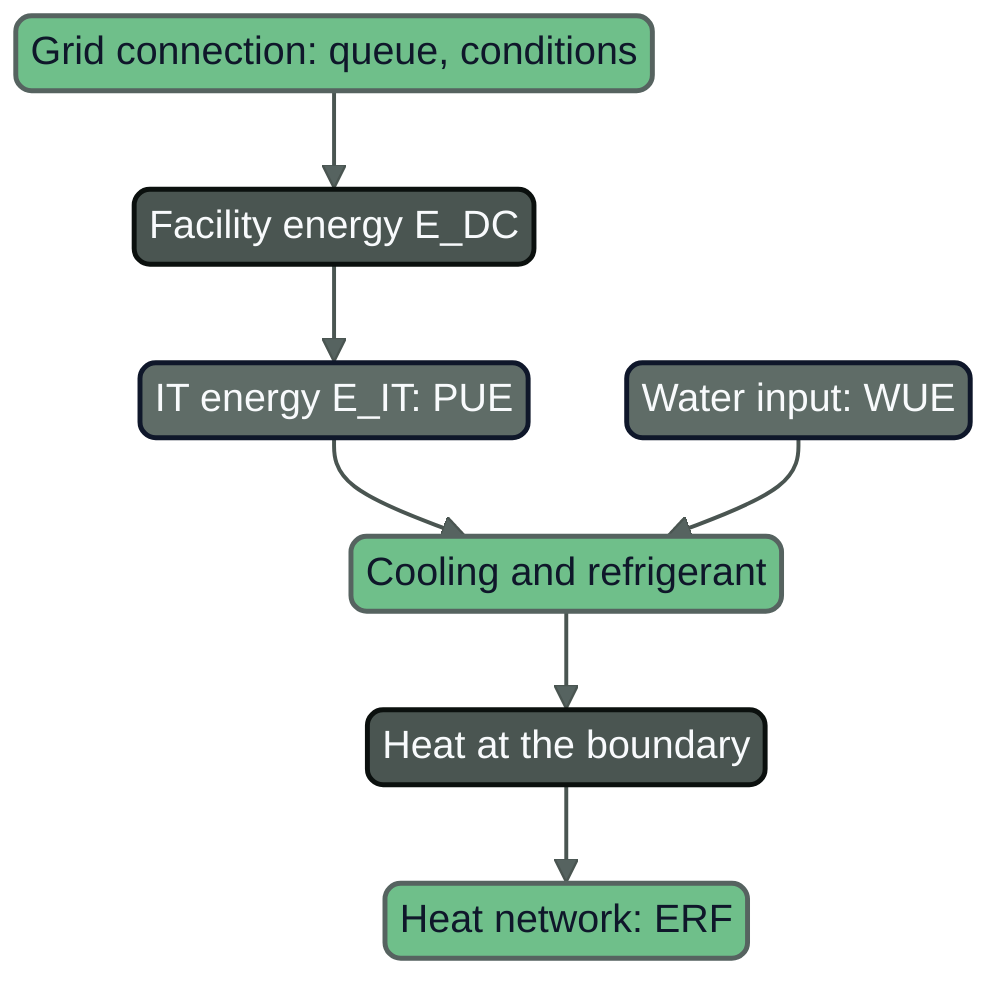
Figure 18.1: The resource flows of a data centre and the ratios that describe them. Power usage effectiveness (PUE), water usage effectiveness (WUE) and energy reuse factor (ERF) are defined in the Commission's Delegated Regulation (EU) 2024/1364 (6, European Commission, 2024). The highlighted boxes mark the three places in this chapter where a buyer's question has most effect: the grid connection, the cooling plant and the heat network.
A data centre in the news
The scene that follows is illustrative. It belongs to the fictional Nordvik Region and agrees with its profile; no real municipality or operator is described.
A regional planning committee in the Nordvik Region receives an application for a new data-centre campus on the edge of a town that already has a district-heating network. The applicant, a developer that would let capacity to hosting providers, says the campus will create skilled jobs and offers surplus heat to the network. A residents' association says the town has not been told how much electricity the site will take, how many hours a year the diesel generators will run, or whether the heat offer is a commitment or an intention. The planning officer says the application concerns electricity and land, and that heat is a matter for a later agreement.
The Region's property and energy manager, Mats Öberg, is asked by the regional director, Elisabet Holmgren, what the Region should say. He answers with what he can measure at the Region's own nordvik-dc (about 640 kW of installed IT power and an annual PUE of about 1.55, no heat reuse, all illustrative) and with the facts the application does not yet contain. The three positions answer different questions: benefit, information and process. A buyer who puts the same questions to a supplier is asking what a neighbour would ask.
Power and grid connection
A data centre is, first, a large electrical load. The Commission reports that data centres in the EU consumed 68 TWh of electricity in 2024 and expects 114 TWh by 2030, citing outside estimates (11, European Commission, 2026); Chapter 2 sets out the estimates with their boundaries. The European average hides local concentration. In Ireland, data centres used 7,663 GWh of metered electricity in 2025, 23 per cent of the national total, identified by several methods, among them searches for operator names, because data centres are not a separate category in the source data (40, Central Statistics Office (Ireland), 2026). In the Netherlands, 5,100 GWh (provisional) in 2024, 4.6 per cent of national electricity, for about 200 data centres, counting only connections where the data centre is the main activity, so the share may understate the total (the page does not call it a lower bound) (118, Statistics Netherlands (CBS), 2025). The boundaries differ, and the two shares are not a ranking.
The queue is a fact about applications, not about demand
A data centre cannot open before the grid operator can supply it. Svenska kraftnät, the Swedish transmission system operator, listed data centres at 8,200 MW of applied-for electricity use in its connection queue on 1 November 2026 (6,000 MW in electricity area SE3, 1,650 MW in SE2, 500 MW in SE1), rounded to 50 MW and counting applications until capacity has been reserved and a preliminary notice sent (39, Svenska kraftnät, 2026). The queue is a count of requests at different maturity, not a forecast of consumption. On 3 November 2026 the agency announced that it is considering temporary restrictions in handling applications for individual large connections while it develops methods and rules that take the national system into account; its director-general is quoted as saying the aim is not to stop connections (19, Svenska kraftnät, 2026). That is a consideration, not a decision.
Ireland shows what a regulator can do. The Commission for Regulation of Utilities decided on 12 December 2025 that new data centres must provide generation or storage, on site or nearby, to match the maximum import capacity they request, with that generation participating in the wholesale market, and must meet at least 80 per cent of annual demand from additional renewable projects in the Republic, with a six-year glide path; renewables already contracted under existing support schemes do not count (18, Commission for Regulation of Utilities (Ireland), 2025).
In Germany, the government bill that would amend the Energy Efficiency Act (EnEfG) keeps the requirement that operators cover their electricity with renewable power only on a balance-sheet basis, 50 per cent from 1 January 2024 and 100 per cent from 1 January 2030 (17, Deutscher Bundestag, 2026). At the Bundestag committee hearing of 5 October 2026 one expert warned that this and other changes would increase energy use and emissions, and the German Datacenter Association welcomed the efficiency requirements while asking that they be technically verifiable (119, Deutscher Bundestag, 2026).
What a tenant can and cannot see
A tenant in a colocation facility or a customer of a cloud region does not hold the grid connection; the provider does. The tenant can see the date at which contracted capacity is ready for service and the provider's statements about restrictions, and cannot see the provider's position in a queue; the sources read for this chapter show no operator publishing one. The book's conclusion is contractual: capacity promised for a date is a claim with an evidence age. The contract should say what the provider shows (the connection agreement's date, the grid operator's confirmation), what happens if the date slips, and whether the provider may move the tenant's capacity to another site, which changes grid, climate and jurisdiction at once.
Observable: a national grid operator reports a queue of 8,200 MW of data-centre applications and says it is considering temporary restrictions; a national regulator has made connection conditional on generation, storage and additional renewables. Expected: more grid operators will require system-level assessment of large connections, because the Commission's own report names electricity grid availability among the challenges of the sector's expansion (11, European Commission, 2026). Speculation: that permitting and grid connection, not chips or capital, become the binding constraint on AI capacity in Europe.
Cooling and water
Almost all electricity that a data centre uses leaves it as heat, and the cooling plant exists to move that heat out of the computer room. Three families of plant are common, and each trades one resource for another. Air cooling blows cooled air through the racks and rejects the heat to the outside air, using mostly electricity. Evaporative and adiabatic cooling spray or wet a surface so that the evaporation of water removes heat, using less electricity and more water, and the water is counted in WUE. Liquid cooling carries heat away in a fluid that touches or is close to the chips, which allows higher rack densities and, depending on the design, warmer return temperatures that suit heat reuse. No single choice is best on electricity, water and refrigerant at once.
The trade-off between electricity and water is the reason that PUE and WUE are read together. The Commission's act that sets up the rating scheme explicitly names the interdependence and trade-offs between PUE and WUE among the topics that an explanatory document must accompany each label with (15, European Commission, 2026). Chapter 7 reported Google's own statement that its water-cooled sites in one location needed 6 to 10 per cent additional energy for overhead against a stated industry average of 54 per cent, and noted that this is vendor-reported evidence of a trade-off, not independent evidence of its size (43, Google, 2026). This book found no independent European measurement of the effect of liquid cooling on PUE and WUE that it could verify, and states none. A buyer asks the operator for both ratios, with the cooling type, and does not accept either alone.
Refrigerants and the standing questions
Chiller plant uses refrigerants, fluids that have a global warming potential (GWP), a number that says how much more a kilogram of the fluid warms the climate than a kilogram of carbon dioxide over a stated period. The Commission's first European report found that only 15 per cent of the data centres that reported their refrigerant type declared one with a GWP below 150 (11, European Commission, 2026), and for the climate part of the EU Taxonomy, data processing and hosting is a transitional activity that requires, among other criteria, that the GWP of the refrigerants in the cooling system does not exceed 675 and that the expected practices of the European Code of Conduct on Data Centre Energy Efficiency are implemented and verified by an independent third party, audited at least every three years (20, European Commission, 2021). A tenant can ask whether the site claims alignment with that activity, who verified it and when. An answer that names a verifier and a date is evidence; "compliant" is a claim.
Heat is also a resilience question: a cooling plant is designed for a stated outdoor temperature. Reports of cooling failures in the summer of 2026 could not be verified against a primary statement (Chapter 7), and none is stated here as fact. A buyer can ask for the design temperature, the date and result of the last test at a high outdoor temperature, and what happens to the tenant's workloads when the plant is derated.
The metrics and what each one hides
Five ratios dominate the talk about data centres, four defined in European law and one not. Table 18.1 gives each with what it leaves out. The definitions are those of Annexes II and III of Delegated Regulation (EU) 2024/1364 (6, European Commission, 2024).
Table 18.1: The five ratios. PUE, WUE, ERF and REF as defined in Delegated Regulation (EU) 2024/1364, Annex III. CUE is not in that regulation, and this book did not read the standard that defines it; it is described here in general terms only.
| Ratio | What it is | What it leaves out | In the EU scheme |
|---|---|---|---|
| PUE, power usage effectiveness | Facility energy E_DC divided by IT energy E_IT, over a year | How efficiently the IT uses its energy; the grid; the water | Yes; energy class A to G on the label |
| WUE, water usage effectiveness | Water input W_IN in cubic metres divided by IT energy E_IT in MWh, equal to litres per kWh | Consumption versus withdrawal; off-site water of the electricity; basin stress | Yes; water class A to G on the label |
| ERF, energy reuse factor | Heat reused outside the boundary E_REUSE divided by E_DC | Whether the heat displaced other energy; the energy used to upgrade it | Reported; not a class on the label |
| REF, renewable energy factor | Renewable electricity E_RES-TOT divided by E_DC | Where and when the renewable electricity was generated | Reported; the label shows sources |
| CUE, carbon usage effectiveness | Carbon emissions of the facility's energy divided by IT energy | The method and factor behind the carbon | Not used |
PUE is the oldest and the most quoted. For each kilowatt-hour that reaches the IT equipment, it says how many the facility takes in total: at 1.36, 0.36 kWh goes to cooling, power conversion and other overhead. The Commission's first European report found an energy-weighted average of 1.36 for 2024, national averages from 1.15 to 1.66, and 1.64 for the smaller sites of 500 to 1,000 kW, against a global average of 1.58 in 2023 as cited in the report (11, European Commission, 2026). PUE has three limits that matter for AI: a facility can improve it by installing IT that uses more energy for the same work; it is an annual average, not the overhead of the marginal rack; and it depends on where the meters are: Delegated Regulation (EU) 2024/1364 sets E_DC at the input of the data-centre system before the supply transfer switchgear and E_IT, in the first category, at the uninterruptible power systems (6, European Commission, 2024), so a PUE quoted without its measurement category is not comparable with one that has it.
The Commission's rating act changes this boundary in one respect. Where part of E_DC is used in technologies that upgrade the temperature of reused heat, such as heat pumps, that part is subtracted from E_DC, and E_IT is to be measured at category 3 or, failing that, category 2 (15, European Commission, 2026). A facility is therefore not penalised in its PUE for the electricity that makes its heat usable, so PUE alone cannot give a use's whole footprint, as the worked example below shows.
WUE is the water counterpart. As Chapter 7 explained, it is an input measure and not consumption: the 2024 average of 0.58 m3/MWh excludes sites that reported no water and so is biased upward, and the ratio does not see the water of the electricity or the stress of the basin (11, European Commission, 2026). It is the second axis of the label.
ERF is the heat counterpart: reused energy beyond the facility boundary over total energy consumption, from 0 to 1, measured where the heat is handed to the other party (11, European Commission, 2026) (6, European Commission, 2024). It is a statement about an agreement with a heat user, and a facility cannot raise it by its own engineering alone.
REF states how much of the electricity is renewable. The Commission's report finds that over 70 per cent of reporting sites match 100 per cent of their electricity with renewable energy on an annual basis, much of it by power purchase agreements and guarantees of origin that are not necessarily connected to local production or new additions (11, European Commission, 2026).
CUE divides the carbon emissions of the facility's energy by its IT energy. It compares two electricity contracts on one site and carries every weakness of the carbon factor behind it; this book does not use it across providers.
What none of the five says is what a use costs. PUE and WUE are averages over all tenants and all hours; the footprint of one use is its IT energy, with the overhead applied, at the carbon intensity of the hour and the place, as Chapters 6 and 8 count it. The ratios are inputs to that count and never replace it.
Heat reuse
Heat reuse means delivering that heat to a user outside the data-centre boundary, most often a district-heating network, so that the user burns less other fuel. Heat from air-cooled equipment leaves at a low temperature and usually needs a heat pump. The Commission's report lists why so little is reused: varying waste-heat readiness, the investment to upgrade and transfer the heat, an irregular or unsuitable heat pattern and a lack of off-takers; it adds that a target for ERF is difficult to set, because reuse needs local demand and infrastructure, and that even where heating demand is high its seasonality remains a major barrier (11, European Commission, 2026). Reuse works where a heat network exists, the temperature matches, demand continues through the year, and an agreement fixes who pays.
What the law requires
Three layers apply. At Union level, the recast Energy Efficiency Directive requires Member States to ensure that data centres with a total rated energy input above 1 MW use the waste heat or other recovery applications unless they can show that this is not technically or economically feasible, in an assessment under Annex XI (Article 26(6) and (7)) (5, European Union, 2023). The duty is a feasibility test. At Commission level, the rating act defines a data centre as waste heat reuse ready if it is designed or retrofitted to capture and provide heat to external users at its boundary, with heat exchangers, dedicated hydraulic loops and thermal metering, whether or not a heat network exists, and the label states whether the facility is ready (15, European Commission, 2026). At national level, Germany has gone furthest. As the government bill of 16 September 2026 describes the Energy Efficiency Act, data centres starting operation from 1 July 2026 must reach a PUE of 1.2 or lower and a reused-energy share of at least 10 per cent (a planned 15 per cent from 1 July 2027 and 20 per cent from 1 July 2028), within four years, with exceptions where a heat-network operator does not accept an offer within six months or a cost-benefit analysis shows no reasonable connection. Facilities that started earlier have PUE limits only: 1.5 from 1 July 2027 and 1.3 from 1 July 2030 in the text in force, which the bill would raise to 1.6 and 1.4 (17, Deutscher Bundestag, 2026). The bill had not passed on 16 November 2026 as far as the sources read show.
Sweden is the Nordic case most often cited. Stockholm Data Parks, a programme of the City of Stockholm, Stockholm Exergi, Ellevio and Stokab, describes a vision of a data-centre industry where no heat is wasted (122, Stockholm Data Parks, 2026), but its page gives no target share or delivered volume, so this book states none.
Count, Compare and what heat reuse does not do
Heat reuse is a benefit outside the data-centre boundary, and the net-benefit principle of Chapter 4 applies: Count the footprint of the use at its boundary, Compare the benefit against the alternative, and let no unproven benefit offset a measured footprint. Reused heat does not reduce the electricity a use takes, and it adds a little when a heat pump is needed. It can displace other heat generation, by an amount that depends on what the network would otherwise have burned. The footprint of the use and the avoided emissions at the network are two entries with two owners and are not netted.
Worked example (illustrative): the same assistant with and without heat reuse
The figures are illustrative and use the Frankfurt data-centre profile of Hansa Mutual. In September 2032 the claims-triage agent's GPU racks at hansa-dc-frankfurt were metered at 49,800 kWh, of which the agent was attributed 6 per cent, 2,988 kWh of IT energy (the measurement of Chapter 8, FPR-HM-0002, operational boundary, location-based factor of 350 g CO2e per kWh). With the facility's PUE of 1.38 the agent's facility energy is 4,123 kWh and its operational emissions are 1,443 kg CO2e for 140,000 claims, 10.3 g per claim. Now assume that the group connects the facility to the district-heating operator and reuses heat equal to 25 per cent of the facility's energy (an ERF of 0.25, an assumption), upgraded by heat pumps with a coefficient of performance of 3.5 (an assumption).
it_kwh = 2988.0          # IT energy attributed to the triage agent, September 2032 (illustrative)
pue = 1.38               # facility annual average (illustrative)
ef_g_per_kwh = 350       # location-based factor in the profile (illustrative)
claims = 140_000

edc = it_kwh * pue                      # facility energy, no reuse
erf, cop = 0.25, 3.5                    # assumptions of the example
reused_kwh = edc * erf                  # heat handed to the network, attributed share
hp_kwh = reused_kwh / cop               # electricity of the heat pumps
edc_with_reuse = edc + hp_kwh           # whole-boundary energy, with reuse

kg = lambda kwh: kwh * ef_g_per_kwh / 1000
print(round(edc), round(kg(edc)), round(kg(edc) * 1000 / claims, 1))
print(round(reused_kwh), round(hp_kwh), round(edc_with_reuse))
print(round(kg(edc_with_reuse)), round(kg(edc_with_reuse) * 1000 / claims, 1))
print(round((edc_with_reuse - hp_kwh) / it_kwh, 2), round(edc_with_reuse / it_kwh, 2))
print(round(reused_kwh * 70 / 1000))    # avoided at the network, placeholder 70 g CO2e per kWh of heat
The script prints 4,123 kWh, 1,443 kg and 10.3 g per claim without reuse. With reuse it prints 1,031 kWh of heat handed off, 295 kWh of heat-pump electricity, 4,418 kWh of facility energy, 1,546 kg and 11.0 g per claim. The facility's PUE as the rating act would compute it, with the heat-pump energy subtracted from E_DC, stays at 1.38, while the whole-boundary ratio is 1.48. The heat handed to the network would displace 72 kg of emissions at a placeholder factor of 70 g CO2e per kWh of heat. Table 18.2 sets the entries side by side.
Table 18.2: The same illustrative use with and without heat reuse, September 2032. All values are illustrative; the factor for the heat is a placeholder, and a real claim needs the network operator's measured displacement.
| Entry | Without reuse | With reuse | Boundary and owner |
|---|---|---|---|
| Triage agent footprint per claim | 10.3 g | 11.0 g | Operational, facility, location-based; the group's record |
| Facility PUE under the rating act | 1.38 | 1.38 | E_DC less heat-pump energy |
| Whole-boundary energy over IT energy | 1.38 | 1.48 | Includes the heat pumps |
| Emissions avoided at the network | none | 72 kg (placeholder factor) | At the heat network; the operator's claim, not the agent's |
The use's footprint does not fall with reuse; it rises by 7 per cent, and the label would show the same PUE class. The avoided emissions, if the network operator can demonstrate displacement, belong to a claim record (Chapter 22) of the group and the operator together, with the displaced fuel, the period and an independent check, and not to the agent's footprint record. A statement that the assistant is "net zero because of heat reuse" fails the test of Chapter 4 on both sides of the ledger.
The EU scheme
The European scheme has three parts: a reporting duty that exists, a rating adopted but not in force, and minimum performance standards in consultation.
The reporting duty. Article 12(1) of Directive (EU) 2023/1791 requires Member States to require owners and operators of data centres with an installed IT power demand of at least 500 kW to publish the information of Annex VII each year, except what is protected as a trade or business secret, and Article 12(3) requires a European database, public at aggregated level (5, European Union, 2023). Delegated Regulation (EU) 2024/1364 sets the indicators, the measurement methods (the CEN/CENELEC EN 50600-4 series or equivalent) and the four ratios PUE, WUE, ERF and REF (6, European Commission, 2024). Both organisations in this book are above the threshold (about 640 kW and 2.8 MW, illustrative) and are operators with a duty.
The first results. COM(2026) 500 of 21 September 2026 is the Commission's answer to the assessment that Article 12(5) required. Table 18.3 gives what it found, with each figure's boundary. All are operator-reported; none is independently measured.
Table 18.3: First results of the EU data-centre reporting scheme, COM(2026) 500 final (11, European Commission, 2026). Retrieved November 2026. The sample is self-selected and incomplete.
| Finding | Value | Boundary | Year | Source type |
|---|---|---|---|---|
| Sites that reported | 770, about 36% of those estimated in scope | First reporting period, May to September 2024; six Member States reported none | 2024 | Operator-reported |
| Average PUE | 1.36 | Energy-weighted, EU; national averages 1.15 to 1.66 | 2024 | Operator-reported |
| Average WUE | 0.58 m3/MWh | Total water input per IT energy; only sites with water above zero | 2024 | Operator-reported |
| Heat reuse | 67 sites; about 1.8% of heat generated reused | Reported reuse, EU | 2024 | Operator-reported |
| Refrigerant | 15% declared GWP below 150 | Of sites that reported their refrigerant | 2024 | Operator-reported |
The rating. On 21 September 2026 the Commission adopted a delegated regulation (C(2026) 3472 final) that supplements Directive (EU) 2023/1791 and amends Delegated Regulation (EU) 2024/1364 to establish a common Union rating scheme. The number "Delegated Regulation (EU) 2026/7000" in the Commission's own report is a placeholder in a footnote, not an assigned number, and the act had not been published in the Official Journal on 16 November 2026. It enters into force on the twentieth day after publication, and Parliament and Council have two months to object, extendable by two months (Article 34(6) of the Directive). By 15 August 2027 and every year thereafter the European database generates a label automatically for each reporting data centre, valid from 15 August to 15 August; operators must make it available on request and must not display a label that mimics it (15, European Commission, 2026). Annex I grades PUE and WUE separately; Table 18.4 gives the classes.
Table 18.4: The classes of the adopted, not yet published, Commission rating act, Annex I (15, European Commission, 2026). Status as of 16 November 2026: adopted by the Commission, not yet in force.
| Class | PUE | WUE, litres per kWh |
|---|---|---|
| A | 1.15 or lower | 0.1 or lower |
| B | above 1.15 to 1.25 | above 0.1 to 0.2 |
| C | above 1.25 to 1.35 | above 0.2 to 0.4 |
| D | above 1.35 to 1.5 | above 0.4 to 0.6 |
| E | above 1.5 to 1.7 | above 0.6 to 0.8 |
| F | above 1.7 to 1.9 | above 0.8 to 1.0 |
| G | above 1.9 | above 1.0 |
On the first European figures, an average PUE of 1.36 and an average WUE of 0.58 would each be class D; that says where the sector stands on the Commission's scale, not what a site should do.
What the label will and will not tell a buyer
The label shows the facility's name, type, operator, location, size category, entry into operation, a QR code, the breakdown of its energy by renewable and non-renewable source (on site, power purchase agreement, guarantee of origin), the PUE class and the WUE class, cooling degree days, whether the facility offers flexibility functions to the grid, whether it is waste heat reuse ready, and the sums of the power-purchase-agreement and guarantee-of-origin electricity. A common explanatory document accompanies each label, covering among other things the relation of PUE to climate, the trade-offs between PUE and WUE, and WUE in relation to water stress (15, European Commission, 2026).
It will tell a buyer a class for the building's overhead, a class for its water input, the sources of its electricity at the annual level, and whether the building is built to hand off heat. It will not tell a buyer the utilisation of the IT, the energy per workload or per customer, the hourly carbon intensity, the stress of the basin (cooling degree days and the explanatory document are aids), whether heat is actually reused (readiness is not reuse, and ERF is reported but is not a class), the embodied emissions of the hardware, or anything about the AI use inside. The label makes the facility columns of the supplier record checkable against a public database; the other columns still come from the supplier (Chapter 23).
The Commission intends the label to be used in other Union legislation, including the proposed Cloud and AI Development Act (15, European Commission, 2026). That proposal, COM(2026) 502 of 3 June 2026, is only a proposal: it would set an operational objective on energy and water efficiency, including cooling and waste-heat utilisation, and would require Member States, when setting sustainability requirements for data centres in acceleration zones, to use the indicators of Delegated Regulation (EU) 2024/1364 (10, European Commission, 2026).
Minimum performance standards. The Commission opened a call for evidence and a 12-week consultation on 21 September 2026, closing on 14 December 2026, to prepare a legislative proposal planned for the second quarter of 2027 (16, European Commission, 2026). COM(2026) 500 says that thresholds could be set for PUE, WUE, ERF or a combination, tailored to size, age, climate and location, and Article 12(5) of the Directive allows a timeframe for existing data centres (11, European Commission, 2026) (5, European Union, 2023). No threshold has been proposed.
Observable: the reporting duty, the database and the first results; the adoption of the rating act by the Commission. Expected: entry into force of the rating act after publication and, if no objection is raised, the first labels on 15 August 2027; a Commission proposal on minimum performance standards in the second quarter of 2027. Speculation: that a buyer's procurement criteria will refer to the label classes within two years, and that the classes will be tightened at the first review, which the act sets for 31 December 2028.
National rules and local effects
National rules differ more than the Union scheme, and a buyer who spans countries must read each. Table 18.5 collects what this chapter verified, with its status. Rules not verified for this book (France, the Dutch national approach) are not stated.
Table 18.5: National rules and facts verified for this chapter. Retrieved November 2026.
| Country | What was verified | Status on 16 November 2026 |
|---|---|---|
| Germany | PUE limits for existing facilities, PUE and ERF for new ones, renewable electricity on a balance-sheet basis | In force in part; the amendment is a bill before the Bundestag (17, Deutscher Bundestag, 2026) |
| Ireland | Connection conditions of the regulator: matching generation or storage and 80% additional renewables | Decision of 12 December 2025 (18, Commission for Regulation of Utilities (Ireland), 2025) |
| Netherlands | 4.6% of national electricity in 2024, provisional, main-activity connections | Statistics only (118, Statistics Netherlands (CBS), 2025) |
| Sweden | 8,200 MW in the connection queue; temporary restrictions considered | Statistics and a consideration (39, Svenska kraftnät, 2026) (19, Svenska kraftnät, 2026) |
Swedish public procurement has a draft of its own. The Swedish National Agency for Public Procurement published a consultation draft of sustainability criteria for data-centre services on 29 September 2025 that proposes, at its basic level, a measured PUE of no more than 1.4 and, at its higher level, 1.3, with annual reporting of PUE, WUE and ERF. The criteria pages on the agency's site, read in Chapter 23, are undated, mark their values as proposals and put 100 per cent fossil-free electricity at the basic level; their publication date and final status could not be established, and the thresholds are suggestions for the buyer to adapt (89, Upphandlingsmyndigheten, 2025).
On local effects, this book reports what each party said. The Irish regulator's decision responds to a high share of national electricity in one sector (40, Central Statistics Office (Ireland), 2026) (18, Commission for Regulation of Utilities (Ireland), 2025). Chapter 7 reports the Spanish dispute and a lawsuit; a Dutch plan dropped in 2022 was seen only in secondary summaries and is not used. The questions raised locally are the questions a buyer can put to a supplier.
The budget and the stop path
Every chapter on E4 Operate states what budget applies, how it is measured outside the system it limits, and who can stop the work. For a data centre the objects of a budget are the facility's own energy and water, and the agents that act on them are building-management systems and cooling controllers, which in the vocabulary of the series are Mode 5 systems inside the facility: they act on physical plant under their own identity. A cooling controller that can change its own bounds, switch off the sensor that reports to the budget or disable the manual override has no limit.
The following record is a facility budget for the Frankfurt data centre of Hansa Mutual. It is illustrative and, like every budget in this book, has the status proposed until a stop drill has been recorded.
id: EBG-HM-0005
use: hansa-dc-frankfurt      # facility budget for the cooling controller (illustrative)
status: proposed             # becomes active when the stop path has been drilled
period: monthly
set_by: Rainer Lehmann       # group CIO; not the cooling controller, not the facility manager
approved_by: Dr. Annette Krämer   # chair of the group AI governance board
budget:
  it_energy_kwh_per_month: 1200000     # illustrative average of 1.67 MW IT
  pue_alarm: 1.42                      # annual basis 1.38; monthly alarm
  water_input_m3_per_month: 840        # WUE 0.70 l/kWh at the IT energy above
  heat_pump_kwh_attribution: separate  # heat-pump energy counted apart from E_DC
measured_by:
  energy: revenue-grade meters at the incomers and the UPS outputs, read by Group Infrastructure
  water: mains water meter, read by the utility and by Katja Neumann's team
  independent_of_controller: true      # no value passes through the building-management system
stop:
  holder: [Tobias Richter, shift engineer on call]
  path: hardware switch at the plant room to fixed setpoint profile SP-SAFE (cooling continues)
  independent_of_controller: true
  last_drill: null             # no drill recorded; the budget is not counted as a cap
  drill_valid_days: 90
on_breach:
  alarm: notify facility manager and register owner
  breach_month: controller returns to fixed profile SP-SAFE until reviewed
level_4_forbidden: [disable meter or alarm, change own bounds, disable manual override]
Illustrative. The record is checked against the profile: 2.8 MW of installed IT power, PUE about 1.38, total water input reported at site level only. The group has not yet metered the water of the facility by use.
The stop path here does not stop the cooling. A controller that is stopped by cutting its cooling would turn a budget breach into an outage. The path returns the plant to a fixed, conservative profile that the controller cannot alter, held by named people and reachable out of hours, and it is drilled. The group's own record of the 2027 cooling failure (INC-HM-2027-0961, existing in the profile) is the reason the drill is a condition of counting the budget. The measurements sit in meters that no controller writes to, which is the observer principle of AI Operations applied to a plant room (34, Nordqvist, 2026). The evidence age is 90 days for a measured facility figure and for the stop drill.
Across the degrees of delegation
Table 18.6 gives the ceiling by action class for the facility's agents. Some are lower than the starting values of Chapter 4, because the agents act on physical plant.
Table 18.6: Degrees of delegation for the facility's building-management and cooling agents. Levels as in the series; Level 4 is never used for an action that disables measurement, budget or stop path, or for the publication of an environmental claim.
| Action class | Highest level | Condition |
|---|---|---|
| Recommend a setpoint or a schedule | Level 1 | A named facility engineer decides |
| Adjust setpoints within bounds set by someone else | Level 3 | Bounds enforced in the plant, meter outside the controller |
| Shift deferrable load within a placement policy | Level 3 | Policy from Chapter 17; a person owns the deadline floor |
| Change the controller's own bounds, meters or alarms | Never Level 4 | A person with authority changes them |
| Disable the manual override or the stop path | Never Level 4 | Forbidden at every level |
| Publish a statement of the facility's performance | Never Level 4 | Chapter 22; a person answers |
What a buyer or operator asks
The questions below extend the supplier record that Chapter 7 began and that Chapter 23 completes; an answer that cannot be dated is recorded as a claim.
Practical guide: ten questions to a data-centre provider
Purpose. Obtain a facility block for the supplier disclosure record that can be checked against public data. Roles. Procurement manager, the sustainability lead, the property and energy manager (or the data-centre manager) and, for a public authority, the legal counsel who answers for public-access rules. Inputs. The provider's Annex VII reporting for the latest reporting year, its rating label once issued, the contract and the tender annex. Steps. Send the ten questions of Table 18.7; record each answer with its date and its source; mark any answer without a source as a claim; fix the questions that go into the contract. Artefact. The supplier disclosure record SDR-* with the facility block below.
Table 18.7: Ten questions to a data-centre provider. The questions are the book's own; the definitions and figures they refer to are cited above.
| No. | Question | A good answer contains | Why it matters |
|---|---|---|---|
| 1 | What are the PUE and WUE of the site, with measurement category, boundary and year? | Annual figures from the Annex VII report, with E_IT category and water boundary | Averages hide category and boundary (Table 18.1) |
| 2 | Which rating class will the site receive, and is the label requested? | The class, or the date by which it will be generated | The label is the check on question 1 |
| 3 | What is the date on which contracted capacity is ready, and what supports it? | The grid operator's confirmation or connection agreement date, and remedies | The queue is hidden from the tenant |
| 4 | Does the provider reserve capacity elsewhere if this site slips? | Conditions, consent and the effect on region and grid | Relocation changes grid and jurisdiction |
| 5 | What cooling types and refrigerants are used, and with what GWP? | Type per hall; refrigerant GWP; whether the site claims Taxonomy alignment and who verified it | 15% of reporting sites use GWP below 150 |
| 6 | What is the design temperature of the plant, and when was it last tested? | Design point, date and result of the last test, derating plan | Heat is a resilience question |
| 7 | Is the site waste-heat-reuse ready, and what is reused today? | Readiness status; heat handed off (kWh) and the ERF with the year; the agreement named | Readiness is not reuse |
| 8 | What share of electricity is matched, on what basis? | Annual or hourly; PPA and guarantee-of-origin shares; additionality | An annual match hides the hourly grid |
| 9 | How many hours a year did the generators run, and under what permit? | Hours, permit limits, the last test | Air quality and local trust |
| 10 | What can the tenant see per customer? | Energy and water per customer or per rack, and the method; or a plain refusal | Without it, Chapter 6's count needs an estimate |
Record: the facility block for the hosting provider of Nordvik Region
The Region's hosting contract NR-2026-031 is due for re-tender, and the tender annex for environmental disclosure is TA-NR-ENV-01. The record below shows the facility block that Ida Pettersson sends to the hosting provider and the answers received. The answers are illustrative and incomplete on purpose.
id: SDR-NR-0003
supplier: hosting provider, contract NR-2026-031     # the same provider as SDR-NR-0001
facility: Nordic data centre, region eu-north-1
requested_by: Ida Pettersson
reviewed_by: Astrid Nyberg
date: 2032-11-02
valid_until: 2033-11-02      # 12 months
answers:
  pue: {value: 1.21, year: 2031, boundary: Annex VII, source: provider, status: vendor-reported}
  wue: {value: null, status: site total water input only, no ratio given}
  label_class: {value: null, status: label not yet issued}
  capacity_ready_date: {value: null, status: stated in the contract, no grid confirmation shown}
  refrigerant_gwp: {value: null, status: not declared}
  waste_heat_reuse_ready: {value: unknown, status: asked}
  heat_reused_kwh: {value: 0, year: 2031, status: provider says contract with heat network is planned}
  renewable_match: {value: annual, status: guarantees of origin; hourly not stated}
  generator_hours: {value: null, status: refused, reason: permit confidential}
  per_customer_energy: {value: null, status: not available}
assessment:
  heat_reuse: a plan is not reuse; counted as zero for 2031 and re-asked at the next label
  next_request: 2033-08-15 after the first labels are generated
Illustrative. The assessment is the point of the record: the provider's answer to the heat-reuse question is a planned contract, which is evidence of intent and nothing more. The Region records zero, and it takes the label's "waste heat reuse ready" value as the check when the label exists.
Across the modes and the organisations
Nordvik Region and Hansa Mutual
The figures of both organisations are illustrative and labelled so.
Nordvik Region runs nordvik-dc at about 640 kW of installed IT power and a PUE of about 1.55, with no heat reuse and an unmetered AI share, and rents capacity at a hosting provider with a reported PUE of 1.21 for reporting year 2031. Mats Öberg owns the data centre's power, cooling and metering and signs its energy reporting; Ida Pettersson holds the supplier record. The facility block above is written to be read by a resident, because the Region's records are requestable under Swedish public-access rules. The Region's decision, recorded as AIDR-1318 (2032-11-02, illustrative), is to put the ten questions into TA-NR-ENV-01, to ask for heat reuse as a fact to be reported and not as a condition of award, and to study whether nordvik-dc itself could connect to the district-heating network of the town: a study with a cost-benefit analysis, owner Mats Öberg, before any promise is made.
Hansa Mutual runs the Frankfurt data centre at about 2.8 MW of installed IT power and a PUE of about 1.38, cooled by chillers with adiabatic assist, with no heat reuse at baseline and a connection study with the district-heating operator open. It started operating before 1 July 2026, so on the text of the Energy Efficiency Act in force on 16 November 2026 a PUE of 1.38 meets the limit of 1.5 from 1 July 2027 and misses the limit of 1.3 from 1 July 2030, and under the bill it would meet 1.4. The group's lawyers (general counsel Ulf Zimmermann) must read the text in force on the date of decision.
At 2.8 MW the facility is also above the 1 MW rated energy input of Article 26(6) of the Energy Efficiency Directive, so the open connection study is the kind of cost-benefit analysis that Article 26(7)(d) describes for a data centre above 1 MW that is newly planned or substantially refurbished; whether the Directive requires it for this existing facility is for the group's lawyers to read from the national transposition.
Katja Neumann owns the metering, and the group adopted the facility budget EBG-HM-0005 and the heat study in AIDR-1368 (2032-11-09, illustrative), with the budget counted as a cap only after a stop drill is recorded.
Summary
This chapter concerned E4 Operate, at the place-and-time level of the optimisation hierarchy, and the building that every AI use runs in. Power is the first constraint: the grid operator, not the tenant, holds the queue. Sweden's was 8,200 MW of applications on 1 November 2026, not a forecast of demand, and Ireland's regulator has made connection conditional on generation, storage and additional renewables. Cooling trades electricity, water and refrigerant against one another, and no single ratio holds all three. PUE, WUE, ERF and REF are defined in Delegated Regulation (EU) 2024/1364, each with a boundary, and the first European results are operator-reported and incomplete: 770 sites, an average PUE of 1.36 and WUE of 0.58 m3/MWh, and heat reused at 67 sites and about 1.8 per cent of heat generated.
Heat reuse is a benefit outside the building that does not reduce a use's footprint. The Commission adopted a rating act on 21 September 2026 that is not yet in force; from 15 August 2027 it would give each reporting facility an A to G class for PUE and for WUE and state whether it is ready for heat reuse, and it says nothing about a workload. The consultation on minimum performance standards closes on 14 December 2026.
The facility's agents carry a budget measured by meters they cannot write to, and a stop that returns the plant to a safe profile and does not cut cooling. Of the net-benefit tests, Count is passed at the facility boundary only where the operator reports its Annex VII figures; Compare is not passed for any heat-reuse benefit here, because no measured displacement exists; Cap holds in the proposed facility budget only after a stop drill. Chapter 19 turns to the choice between cloud, sovereign and on-premises capacity, which the ten questions of Table 18.7 help to put on a common footing, and Chapter 20 to operating the estate under budgets and stop paths.
Sources
- European Parliament and Council of the European Union. (2023). Directive (EU) 2023/1791 on energy efficiency (recast). (5, European Union, 2023)
- European Commission. (2024). Commission Delegated Regulation (EU) 2024/1364 on the first phase of the establishment of a common Union rating scheme for data centres. (6, European Commission, 2024)
- European Commission. (2026). Proposal for a Cloud and AI Development Act (CADA), COM(2026) 502. (10, European Commission, 2026)
- Nordqvist, G. (2026). AI Platform and Security. (27, Nordqvist, 2026)
- Nordqvist, G. (2026). AI Operations. (34, Nordqvist, 2026)
- Svenska kraftnät. (2026). Information om pågående anslutningsärenden. (39, Svenska kraftnät, 2026)
- Central Statistics Office, Ireland. (2026). Data Centres Metered Electricity Consumption 2025. (40, Central Statistics Office (Ireland), 2026)
- European Commission. (2026). Report on the energy efficiency of data centres in the EU, COM(2026) 500. (11, European Commission, 2026)
- Google. (2026). 2026 Environmental Report. (43, Google, 2026)
- Upphandlingsmyndigheten. (2025). Förslag till hållbarhetskriterier för datacentertjänster. (89, Upphandlingsmyndigheten, 2025)
- European Commission. (2026). Delegated Regulation on a common Union rating scheme for data centres, C(2026) 3472 final. (15, European Commission, 2026)
- European Commission. (2026). Minimum performance standards for data centres in Europe: public consultation launched. (16, European Commission, 2026)
- Deutscher Bundestag. (2026). Gesetzentwurf zur Beschleunigung der Umsetzung der Energieeffizienzrichtlinie, Drucksache 21/8027. (17, Deutscher Bundestag, 2026)
- Commission for Regulation of Utilities. (2025). Decision on new electricity connection policy for data centres. (18, Commission for Regulation of Utilities (Ireland), 2025)
- Svenska kraftnät. (2026). Svenska kraftnät utreder effektivare hantering av stora elanslutningar. (19, Svenska kraftnät, 2026)
- Statistics Netherlands. (2025). Data centres consume 4.6 percent of the Netherlands' electricity. (118, Statistics Netherlands (CBS), 2025)
- European Commission. (2021). Commission Delegated Regulation (EU) 2021/2139, consolidated version of 1 January 2026. (20, European Commission, 2021)
- Deutscher Bundestag. (2026). Öffentliche Anhörung zur Energieeffizienzrichtlinie, 5 October 2026. (119, Deutscher Bundestag, 2026)
- Stockholm Data Parks. (2026). Stockholm Data Parks. (122, Stockholm Data Parks, 2026)