Governance: Roles, Budgets, Decision Records and the Environmental Register
Chapter 23 ended with the supplier disclosure record and the clauses that bring a supplier's figures into the organisation. Those records, like the footprint record, the benefit record, the budget and the claim, are only as good as the person who answers for them and the date on which somebody last looked. This chapter is about those people, the forums they sit in, the register that shows on one date which uses of AI exist, who owns each, what has been counted, compared and capped and how old each piece of evidence is, and how the register fits an environmental management system. It concerns E5 Account, the function that complies, reports, claims, procures, governs and holds to account, and it uses E2 Justify as its gate. The three tests of Chapter 4 (Count, Compare and Cap) are applied when a use is proposed, scaled or renewed, and a named person records the result. Because the register sets the budget and stop path that E3 Design and E4 Operate depend on, the chapter also says who may set a budget and who may stop a use, outside the system stopped.
The chapter is largely the book's own design: it applies the answerability principle of AI Leader, the observer principle of AI Operations and the stewardship principle of AI Developer, and their assembly into roles, tiers, a register and a gate is a conclusion of this book. The figures of the two organisations are illustrative.
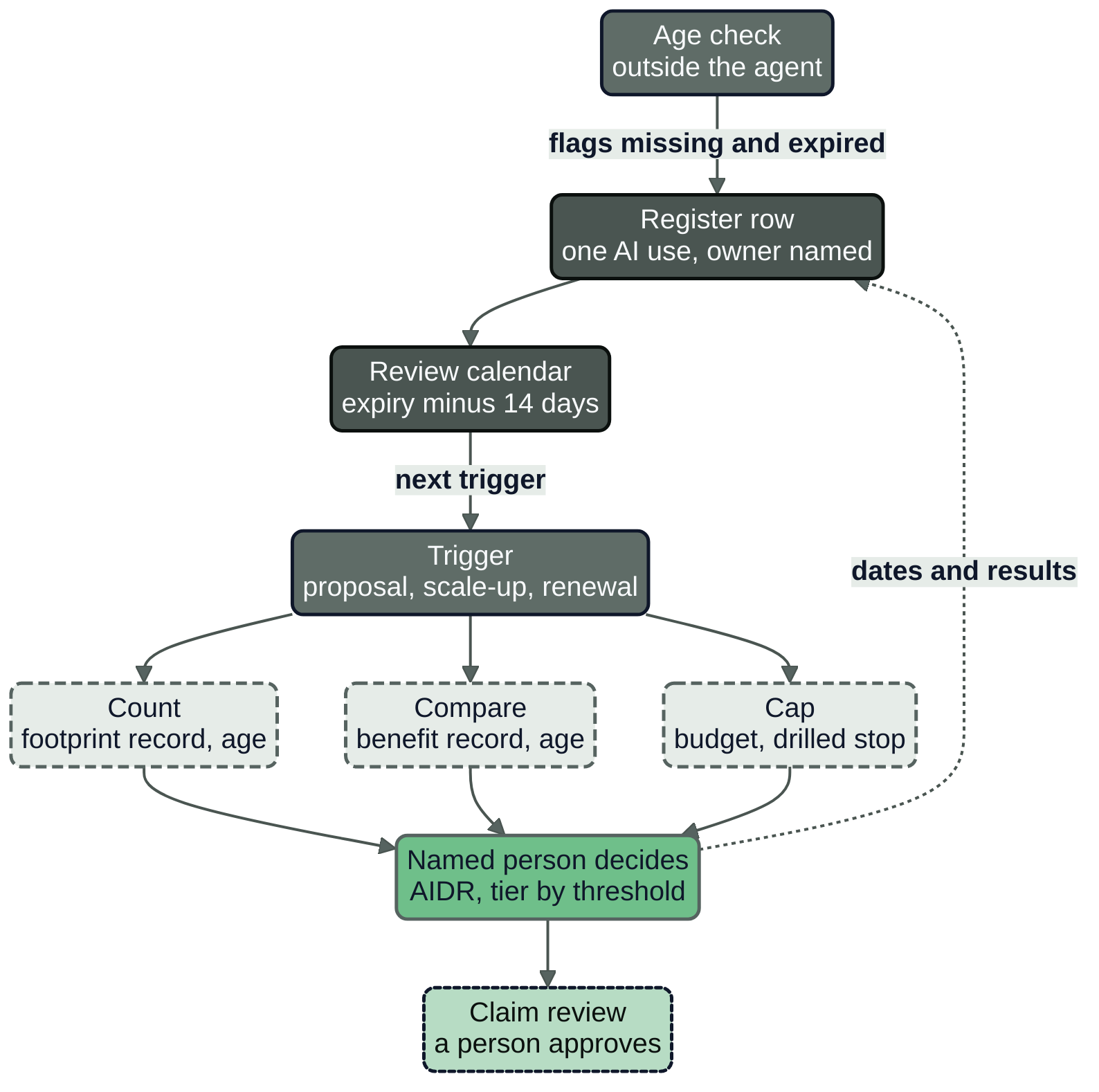
Figure 24.1: The environmental register and the gate. The row holds the owner and the dated evidence; the trigger opens the three tests; a named person decides and a decision record is written; an age check that sits outside any agent flags what is missing or expired; the calendar sets the next review at the earliest expiry minus 14 days.
A register with no owner
The scene is constructed from the profile of Nordvik Region, not reported from practice. In September 2032, before the decision that created the register, the sustainability lead, Astrid Nyberg, asks IT for the list of AI uses for the energy section of the annual report. A workbook arrives with nine rows and four columns: name, supplier, status and energy. The owner of every row reads "IT". The energy column has one entry, 1.90, with no unit, boundary or date, last edited in 2031 by an engineer who has since moved to another unit.
The list is not careless; it is what a list becomes when nobody owns it. It has no owner: "IT" is a department, and a department cannot be asked to explain a figure or stop a service. It has no date: the single number may be the 1.90 g CO2e per resolved enquiry of the October 2026 calculation (Chapter 8) or something else. It has no test and no consequence: a row can stay blank for years without anyone being asked a question.
The Region recorded the adoption of the environmental register on 20 September 2032 (AIDR-1300, Chapter 4). Adoption is a step; a register that works also needs named owners, tiers that route each decision to the lowest forum that can take it with evidence, a gate that applies the three tests, a rule for the age of evidence, a claim path and a calendar that makes the empty cells somebody's job.
What governance has to settle
Four questions need an answer for every use, and the answers must be names, not departments. Who answers for the footprint: that the use has been counted, at a stated boundary and year, and kept current. Who answers for the benefit: that it has been compared with the non-AI alternative and its rebound. Who answers for the budget: that a limit set by someone who is not the system exists, is measured outside it and can be enforced by a drilled stop. And who answers for the claim: that nothing is said in public that the evidence does not support. Table 24.1 gives the answers this book recommends.
Table 24.1: Who answers for what (the book's own design, illustrative).
| Record | Answers for it | Keeps it | Independent check |
|---|---|---|---|
Footprint FPR-* |
The environmental owner of the use | The platform team, with the facility meter owner | Sustainability lead |
Benefit BEN-* |
The owner of the outcome the benefit is stated in | That owner, with analysts | Someone outside the sponsor's line (finance, or the sustainability lead) |
Budget EBG-* |
The person who set it, who is not the service owner or the agent | The platform team (gateway and meters) | Sustainability lead; the drill is witnessed by a second person |
Claim CLM-* |
The named person who approves publication | The sustainability lead | Legal review; for statements in a reported statement, the auditor |
Five separations hold the table together, each carrying a principle of an earlier volume into the register. They are the book's own conclusion from those principles, and the part of governance easiest to drop under time pressure.
- The sponsor does not alone measure the benefit. Where the person who controls the budget also reports the benefits, the measurement is an advertisement (AI Leader, Chapter 15), so the baseline, method and evidence age move to the owner of the outcome, with a check from outside the sponsoring line (35, Nordqvist, 2026). Chapter 9 followed this rule.
- The person who sets a budget is not the system it limits and not the service owner of the use. Chapter 4 fixed this as the first property of a budget.
- What verifies is independent of what performed. This is the observer principle of AI Operations (34, Nordqvist, 2026): the age check and the arithmetic of a claim run in the pipeline, outside any agent that edits the register, and a meter is read by someone other than the use it meters.
- The drafter of a claim is not its approver. The claim record of Chapter 4 names claimant, reviewers and approver in separate fields, and the approver is a named person.
- A stop holder sits outside the system stopped and is reachable out of hours without approval. Any holder may stop without prior justification, and the holders include a role on a 24-hour rota (AI Operations, Chapter 22) (34, Nordqvist, 2026).
The stewardship principle of AI Developer, Chapter 4 adds a sixth point, for agents that help keep the records: AI may draft, generate and, within a mandate, execute, but it may not own (36, Nordqvist, 2026). An environmental agent may read meters, estimate a footprint, draft a record and propose a register change as a pull request, but never owns a record, because ownership is a relation between a person and a forum that a model cannot enter. Where an agent drafted the record, the owner passes a fourth test beyond Name, Explain and Reach: the count can be reconstructed with the agent switched off.
Roles
A role charter ROLE-* is the series' unit for writing down what a role holds and does not hold, so that a person can be named into it and a successor can be named out of it. The environmental roles are few, and most are existing roles with an environmental duty added. Table 24.2 lists them for the two organisations; the people are those of the profile in docs/EXAMPLE_ORGANISATIONS.md, and where a role has no named holder in the profile the table says so.
Table 24.2: Environmental roles at the two organisations (illustrative).
| Role | Nordvik Region | Hansa Mutual | Holds |
|---|---|---|---|
| Register owner | Henrik Dahl | Anja Weiß (platform rows) | The register, the age check, the calendar |
| Environmental owner of a use | Service owners, such as Sara Ekdahl | Business owners, such as Katrin Ohlsen | The use's row and its answers |
| Sustainability lead | Astrid Nyberg | Dr. Verena Lindner | Method, count review, claim review |
| Platform owner and meters | Maja Lindqvist, Joakim Wester | Anja Weiß, Katja Neumann (racks) | Gateway, telemetry, stop path |
| Procurement officer | Ida Pettersson | Stefan Wiedemann | Supplier disclosure records |
| Energy and facility manager | Mats Öberg | Katja Neumann | Facility meters and reporting |
| Benefit owner | Service desk manager (unnamed) | Head of claims operations, Polish service centre (unnamed) | Outcome measures outside the sponsor |
| Claim approver | Elisabet Holmgren | Group AI governance board, chaired by Dr. Annette Krämer | Publication of any claim |
| Legal reviewer | Maria Åkesson | Ulf Zimmermann | Review of every public statement |
The employee representatives' contact (Birgitta Almqvist at Nordvik Region, Thomas Brandt at Hansa Mutual) belongs on the list because telemetry that touches staff is monitoring of staff. The register never needs it: it holds uses, teams and budgets, not people. A per-person meter of AI use is negotiated before switch-on (Chapters 4 and 20), and no decision about a named person's access to work rests on environmental data.
The charter below shows two of the roles in the series' form: the environmental owner of a use at Nordvik Region and the register owner at Hansa Mutual. Each says what the holder answers for and does not hold, how the three tests of answerability are met, and the ceiling for AI.
# role/ROLE-NR-ENV-01.yaml and ROLE-HM-ENV-02.yaml (illustrative)
role: ROLE-NR-ENV-01
title: Environmental owner of an AI use
holders: {SVC-NR-005: Sara Ekdahl, SVC-NR-006: Gunilla Roos}
reports_to: Henrik Dahl            # register owner
answers_for: [row complete and dated, footprint kept current, budget respected, stop path known]
does_not_hold: [setting the use's own budget, measuring its benefit alone, approving a claim, the meter]
answerability:
  name: the row carries the owner's name; public under the access rules
  explain: reconstructs the count from meter data without the agent that drafted it
  reach: can change or stop the use through a path outside it; deputy named in the row
ceiling_for_ai: {measure: 3, recommend: 3, schedule: 3, provision: 2, scale: 2, stop: 3, publish: 1}
review: {every_months: 12, next: 2033-12-06, decision: AIDR-1324}
---
role: ROLE-HM-ENV-02
title: Register owner, group AI platform
holder: Anja Weiß
deputy: Jan Berger
reports_to: Dr. Annette Krämer     # chair of the group AI governance board
answers_for: [register file, age check in the pipeline, review calendar, quarterly board summary]
does_not_hold: [approval of claims, setting budgets above its tier, any agent's own limits]
answerability:
  name: holder and deputy named in the register header
  explain: re-performs one row a quarter from raw meter data
  reach: may stop any use on the platform through the gateway; restart after a recorded cause
ceiling_for_ai: {measure: 3, recommend: 3, schedule: 3, provision: 2, scale: 2, stop: 3, publish: 1}
review: {every_months: 12, next: 2033-12-07, decision: AIDR-1374}
Illustrative. The ceilings are the starting values of Chapter 4: Level 3 Bounded for measuring, recommending and scheduling inside a placement policy, Level 2 Supervised for provisioning and scaling up, Level 3 for scaling down, the stop at a budget being a gateway control and not a delegated act, and Level 1 Assisted (drafting only) for publishing.
Competence
Competence is what a person can show, with an expiry, and the series records it in a competence record CMP-* (AI Leader, Chapter 13) (35, Nordqvist, 2026). The environmental duties need four small competences: the keeper states a figure's boundary, year and exclusions; the benefit owner designs a baseline and a hold-out; the stop holder runs a drill; the claim approver reads a claim record and finds the missing field. Each is assessed by an exercise on a real row and expires after 12 months or on a change of role.
# competence/CMP-NR-ENV-02.yaml (illustrative)
id: CMP-NR-ENV-02
holder: Sara Ekdahl
role: ROLE-NR-ENV-01
competence: re-perform a footprint record from raw meter data and list what it does not count
assessed: 2032-12-09
assessor: Astrid Nyberg            # sustainability lead; not the holder's line manager
exercise: FPR-NR-0001, month 2032-09, gateway counts against provider metering
result: {reproduced_within_tolerance: true, exclusions_listed: 3, exclusions_missed: 0}
expires: 2033-12-09
Article 4 of the AI Act, in the consolidated text of 27 July 2026 after Regulation (EU) 2026/1744, requires providers and deployers to take measures to support the AI literacy of their staff, without obliging them to guarantee a level for an individual (1, European Union, 2024), (2, European Union, 2026). It does not mention the environment; the book's conclusion is that the training under Article 4 is the natural place to add the four competences, and the register can show who holds them and until when.
Forums and tiers
AI Governance, Chapter 13 gives the rule that the environmental decisions follow: decisions are tiered and routed to the lowest tier that can take them with evidence, the tier policy is data that changes by pull request, and forums decide what pipelines cannot, namely appetite, policy, exceptions and residual risk (26, Nordqvist, 2026). The same chapter fixes the stop in advance: the on-call incident commander and the owner of the use may each stop a system alone, and a restart needs the owner and, for a high-risk system, the risk function. The environmental tiers apply these rules.
Tier 1 is the pipeline and the platform on-call. It decides nothing: it enforces the gateway quota, runs the age check, raises the alerts of Chapter 20 and remembers every date. Tier 2 is the owner of the use with the register owner: counts, register entries, budgets inside the delegated limit, the gate when all three tests pass, and a restart after a stop. Tier 3 is the forum that already governs AI (at Nordvik Region a regional AI board convened by the AI governance lead of the earlier volumes, at Hansa Mutual the group AI governance board chaired by the chief risk officer): budgets above the delegated limit, any gate with an open or failed test, any exception to the age rule. Tier 4 is the management body, the regional director with the management group or the executive board in Hamburg: claims where the organisation's rules reserve them, and the statement of appetite, which this book does not make for anyone.
Table 24.3 sets out the thresholds the two organisations adopted. They are illustrative and agree with the approvals of earlier chapters.
Table 24.3: What is decided where, at the thresholds of AIDR-1324 and AIDR-1374 (illustrative; kWh are metered IT energy before facility overhead, 2032).
| Decision | Nordvik Region | Hansa Mutual |
|---|---|---|
| Budget, lowest band (metered IT kWh a month) | Up to 1,000: Henrik Dahl | Up to 2,500, not Mode 5: group CIO |
| Budget, middle band | Up to 4,000: regional AI board | Above 2,500: group AI governance board |
| Budget, top band | Above 4,000, or an agent that can start work: regional director | Any Mode 5 agent or facility budget: group AI governance board |
| Gate with three tests passed | Register owner | Register owner |
| Gate with a test open or failed | Regional AI board | Group AI governance board |
| Evidence kept past its expiry | Regional AI board, once, 30 days at most, with a date | Group AI governance board, once, 30 days at most, with a date |
| Restart after a stop | Register owner, cause recorded | Register owner, cause recorded; risk function for a high-risk system |
| Environmental claim | Regional director approves; Maria Åkesson reviews | Group AI governance board approves; Ulf Zimmermann reviews |
| Appetite | Regional director with the management group | Executive board |
Two details matter more than the thresholds. A failed or open test moves the decision up a tier, so that the forum with the widest view sees every use that cannot yet show its evidence. And the stop is not in the table because it is a right that the named holders keep outside the tiers (AI Operations, Chapter 22); the routed decision is the restart.
For Hansa Mutual the board's reporting line runs to the executive board, which Regulation (EU) 2022/2554 (DORA), Article 5(2), makes responsible for the ICT risk management framework (4, European Union, 2022). DORA creates no environmental duty; the register simply reuses a reporting line that exists.
The environmental register
The register is the one place where every AI use shows its owner, records, budget, the age of each and the result of the last review. Chapter 4 showed two baseline rows; this chapter fixes the columns, the validity values and how the register is kept. The book's own production, FPR-BK-0001 (Chapter 8), would be a row with an empty Cap cell and an unassigned owner.
One row per use, in a file in version control (register/environment-nr.yaml and register/environment-hm.yaml). A row is a use as Chapter 4 defined it, so two routes that differ in model or place are two rows. Uses the organisation cannot meter, such as ambient AI in licensed software (Mode 0), enter as supplier-reported rows, with the supplier's boundary beside the figure and the gap beside the row. A row names its owner, links the footprint record, the benefit record and the budget (and where they exist the supplier disclosure and the hardware record), holds their dates, records each of the three tests as pass, fail or open, and names the last decision. Every change is a pull request that a person merges.
Evidence has governance values. Table 24.4 states when each item expires by clock and by condition.
Table 24.4: Evidence validity in the register (the book's own values, illustrative).
| Evidence | Valid for | Expires at once on |
|---|---|---|
| Footprint of a running use | 90 days | Change of model, version, hardware, region, supplier or contract; volume above 1.5 times the measured month |
| Benefit record | 180 days | Change of the use, its baseline or its users |
| Stop drill | 90 days | Change of route, credential, holder or meter |
| Budget approval | Its period, at most 12 months | A footprint record that no longer supports its basis |
| Supplier disclosure | 12 months from receipt | The supplier's next reporting date |
| Hardware record | 90 days for utilisation; 12 months for the retirement plan | Change of the pool |
| Claim | The reporting year at most | Any change of boundary, method or underlying record |
The 90 and 180 days follow the series' convention for a usage claim and a value claim, and the stop drill is held to 90 days as the stop right is in AI Operations, Chapter 22 (34, Nordqvist, 2026). A benefit clock runs from its decision date (Chapter 9), a footprint or drill clock from the measurement or drill. A missing item and an expired one are alike not evidenced, as the coverage record of AI Purple counts "not tested" in the denominator (33, Nordqvist, 2026).
The register at the end of the first quarter
Tables 24.5 and 24.6 show the register of each organisation on 13 December 2032, the day on which both applied the gate for the first time. A cell shows the state and the age in days at that date. The owner column names the owner of the use, which is not always the person who produced its first record: Chapter 6 gave FPR-NR-0001 to Ida Pettersson for its supplier figures and FPR-HM-0002 to Anja Weiß as head of the platform, and the register now names the service or business owner of each row.
Table 24.5: Nordvik Region, environmental register, 13 December 2032 (illustrative).
| Use | Owner | Footprint | Benefit | Budget and stop drill |
|---|---|---|---|---|
FPR-NR-0001 Citizen assistant, open-weight route |
Sara Ekdahl | Valid, 70 days | Valid, 35 days | EBG-NR-0001, drilled 6 days ago |
FPR-NR-0002 Citizen assistant, hosted route |
Sara Ekdahl | Missing | Missing | None |
FPR-NR-0003 Staff assistant |
Gunilla Roos | Missing | Missing | None |
FPR-NR-0004 Benefits-triage ranking |
Head of the Benefits Unit | Missing | Missing | None |
FPR-NR-0005 Correspondence classifier |
Maja Lindqvist | Valid, 63 days | Missing | EBG-NR-0002, no drill |
FPR-NR-0006 Builder workspace |
Maja Lindqvist | Missing | Expired, 317 days | None |
Table 24.6: Hansa Mutual, environmental register, 13 December 2032 (illustrative).
| Use | Owner | Footprint | Benefit | Budget and stop drill |
|---|---|---|---|---|
FPR-HM-0001 Claims assistant |
Katrin Ohlsen | Valid, 56 days | Missing | EBG-HM-0002, drilled 47 days ago |
FPR-HM-0002 Claims-triage agent |
Katrin Ohlsen | Valid, 68 days | Valid, 28 days; Compare fails | EBG-HM-0001, drilled 14 days ago |
FPR-HM-0003 Correspondence assistant |
Katrin Ohlsen | Missing | Missing | None |
FPR-HM-0004 Underwriting support |
Head of underwriting | Missing | Missing | None |
FPR-HM-0005 IT-operations agent |
Tobias Richter | Missing | Missing | Cost cap only |
FPR-HM-0006 Agentic engineering tools |
Dr. Philipp Reinhardt | Missing | Missing | None |
The tables do not flatter either organisation, which is their use. Of Nordvik Region's six rows, one has complete evidence; of Hansa Mutual's six, none, because the one valid benefit record (BEN-HM-0002) belongs to the triage agent, whose Compare test fails. The staff assistant at Nordvik Region fails Compare by absence: its adoption claim of 61 per cent weekly active use has no recorded result (ADP-NR-2029-01), and a usage figure is not a benefit. The triage agent fails it by measurement: Chapter 9 compared it with the rule router on 6,000 claims over eight weeks to 31 October 2032 and found about 2,380 extra correct routes a month at a footprint of about 114 kg CO2e (operational, location-based, estimate), and the owner recorded a redesign (AIDR-1359). Only FPR-NR-0001 meets the evidence rules for a published figure about itself; Chapter 22 returns to what each may say.
A seventh row at Nordvik Region, FPR-NR-0008 (Chapter 15, the platform team's agentic work tools), is not shown because its footprint is not yet measured.
A record that parses, and a check that does not trust the agent
The extract below is the head of Nordvik Region's register with two rows: the citizen-service assistant, whose evidence is complete, and the staff assistant, whose is not. The header carries the register owner, the date of the evaluation and the validity values of Table 24.4.
# register/environment-nr.yaml (extract; illustrative)
register: environment-nr
organisation: Nordvik Region
register_owner: Henrik Dahl
as_of: 2032-12-13
limits_days: {footprint: 90, benefit: 180, stop_drill: 90, supplier: 365, hardware: 90}
uses:
  - use: FPR-NR-0001
    service: SVC-NR-005
    owner: Sara Ekdahl
    evidence:
      footprint: {record: FPR-NR-0001, measured: 2032-10-04}
      benefit: {record: BEN-NR-0001, measured: 2032-11-08}   # for a benefit record the clock starts at the decision date
      stop_drill: {record: EBG-NR-0001, measured: 2032-12-07}
      supplier: {record: SDR-NR-0001, measured: 2032-05-15}
      hardware: {record: HWL-NR-0001, measured: 2032-11-15}
    tests: {count: pass, compare: pass, cap: pass}
    decision: AIDR-1309
    claim: null
  - use: FPR-NR-0003
    service: SVC-NR-006
    owner: Gunilla Roos
    evidence:
      footprint: {record: null, measured: null}
      benefit: {record: null, measured: null}
      stop_drill: {record: null, measured: null}
    tests: {count: open, compare: open, cap: open}
    decision: AIDR-1326
    claim: null
The check below reads the file at its as_of date. It extends the check of Chapter 4 with the supplier and hardware records, the three tests and a review date, and reports a row as complete only when every item is valid and every test has passed. It runs in the pipeline as a required check on every pull request, outside any agent that proposes a change, which is the observer principle applied to the register.
"""Evaluate an environmental register at its as_of date (illustrative)."""
import sys
from datetime import timedelta

import yaml

LEAD_DAYS = 14  # a review falls this long before the earliest expiry
CORE_KINDS = ("footprint", "benefit", "stop_drill")  # a row without these is missing them, not exempt

def state(item, limit, today):
    if item["record"] is None or item["measured"] is None:
        return "missing", None
    expires = item["measured"] + timedelta(days=limit)
    return ("valid" if expires >= today else "expired"), expires

def evaluate(reg):
    today = reg["as_of"]
    for row in reg["uses"]:
        found = {kind: state(row["evidence"].get(kind) or {"record": None, "measured": None}, days, today)
                 for kind, days in reg["limits_days"].items()
                 if kind in row["evidence"] or kind in CORE_KINDS}
        ages = {kind: s for kind, (s, _) in found.items()}
        expiries = sorted((e, k) for k, (s, e) in found.items() if s == "valid")
        complete = all(s == "valid" for s in ages.values()) \
            and all(t == "pass" for t in row["tests"].values())
        yield row["use"], row["owner"], ages, complete, expiries

if __name__ == "__main__":
    reg = yaml.safe_load(open(sys.argv[1]))
    done = 0
    for use, owner, ages, complete, expiries in evaluate(reg):
        due = expiries[0][0] - timedelta(days=LEAD_DAYS) if expiries else None
        print(use, owner, ages, "complete" if complete else "incomplete",
              "review by", due or "now")
        done += complete
    print(f"{done} of {len(reg['uses'])} rows have complete, valid evidence")
Run on the full file, the check reports for FPR-NR-0001 all five items valid, the row complete and a review by 19 December 2032, 14 days before its footprint expires on 2 January 2033; for FPR-NR-0003 every item missing and a review "now". It gives no credit for partial evidence.
The review calendar
The calendar is derived, not kept by hand. For each valid item the earliest expiry minus 14 days is a review date, and a row with a missing item is reviewed now. Table 24.7 shows the main dates that follow from the two registers and the records they link, in order; the hardware records and the other footprints follow the same rule. Each row is a task for a named person, and the register owner publishes the calendar to the forums.
Table 24.7: The review calendar derived from the registers of 13 December 2032 (illustrative).
| Review by | Expiry | Row and item | Who reviews |
|---|---|---|---|
| 2032-12-19 | 2033-01-02 | FPR-NR-0001 footprint |
Sara Ekdahl with Astrid Nyberg |
| 2032-12-21 | 2033-01-04 | FPR-HM-0002 footprint |
Katrin Ohlsen with Dr. Verena Lindner |
| 2032-12-26 | 2033-01-09 | FPR-NR-0005 footprint |
Maja Lindqvist with Astrid Nyberg |
| 2033-01-11 | 2033-01-25 | FPR-HM-0001 stop drill |
Anja Weiß |
| 2033-02-13 | 2033-02-27 | FPR-HM-0002 stop drill |
Anja Weiß |
| 2033-02-21 | 2033-03-07 | FPR-NR-0001 stop drill |
Maja Lindqvist |
| 2033-04-23 | 2033-05-07 | FPR-NR-0001 benefit |
Service desk manager, with Pär Lindgren's unit |
| 2033-04-30 | 2033-05-14 | FPR-HM-0002 benefit (BEN-HM-0002) |
Head of claims operations, Polish service centre, with Dr. Verena Lindner |
| 2033-05-01 | 2033-05-15 | FPR-NR-0001 supplier disclosure |
Ida Pettersson |
The calendar sits inside a cadence: the platform on-call reads the ages weekly (Chapter 20), the register owner reviews all rows monthly, the sustainability lead and register owner review drills and conversion factors each quarter, the tier-3 forum receives the summary each quarter, and once a year an independent check re-performs a sample. The Region's first quarter is spent keeping one row alive while writing five.
The gate
The net-benefit principle applies wherever a use of AI is proposed, scaled or renewed (Chapters 4 and 9). At those three triggers the three tests are applied to a row and a decision record is written. The gate is not a new approval for each purchase: it is the same three tests run on the evidence the row already holds, with the age check first. Table 24.8 sets out what each test needs at each trigger.
Table 24.8: What each test needs at each trigger (the book's own design, illustrative).
| Trigger | Count | Compare | Cap |
|---|---|---|---|
| Proposal | An estimate with a range and a boundary; a measured record within 90 days of go-live | A benefit hypothesis, a named baseline and the non-AI alternative; a measured record within 180 days | Budget set, meter named, stop path drilled before production |
| Scale-up (volume above 1.5 times the measured month, or a new route or user group) | A record valid at the current volume; an estimate at the planned volume | A valid benefit record at the current scale, from a hold-out and not from usage; rebound reported | Budget re-derived for the new volume; drill valid |
| Renewal (period, contract, model or hardware) | A record no older than 90 days; supplier disclosure in date | A valid benefit record; the baseline still holds | Budget period ends or is renewed; drill valid; the non-AI path still staffed |
Three results are possible for each test: pass, fail or open. Four rules turn them into a decision, and the register owner or the forum applies them in this order.
- A failed test means redesign, defer or decline. The decision names which, as AIDR-1359 did for the triage agent.
- A use may scale only on a Compare that has passed. An open Compare allows continuing at the volume already evidenced, under the cap, with a date by which the benefit record is due. It does not allow growth, and a use whose growth is the proposal does not pass on a hypothesis.
- An open Cap is tolerated for a use already running for one period of 90 days, with the drill date in the decision, and never for a new production use. A budget with no drill is
proposedand not counted as a cap (Chapter 4). - No claim rests on an open test. A published statement needs all three tests passed and every item valid.
Practical guide: the gate in one page
Purpose. To apply the three tests to one row at one trigger, route the decision to the right tier and leave a record and a date.
Roles. The environmental owner of the use (opens the gate and answers), the register owner (runs the age check and routes), the sustainability lead (reviews Count and, with finance, Compare), the platform owner (Cap), the tier-3 forum when a test is open or has failed, and the employee representatives' contact where any measure touches staff.
Inputs. The register row, the age check output, the footprint record, the benefit record, the budget and its drill record, and the proposal or renewal papers.
Steps.
- Name the trigger and read the row. State whether this is a proposal, a scale-up or a renewal, and read the row's owner, ages and previous decision.
- Run the age check. Run it in the pipeline and attach the output. Any missing or expired item is a failed or open test, not a note.
- Fill each test. For Count, Compare and Cap enter pass, fail or open, with the record identifier and its date. A reviewer other than the owner signs each.
- Route. Use Table 24.3. Three passes stay at tier 2; any open or failed test goes to tier 3.
- Decide and record. A named person applies the four rules and writes the AI Decision Record with a date for every open item and the next review.
- Update the row and the calendar. Enter the result, the decision and the new dates in one pull request, and let the age check pass before the person merges it.
Artefact. The updated register row and an AI Decision Record, linked, with the review date at the shortest expiry.
Decision records
The register records the state of a use; a decision record records why the state changed. The AI Decision Record (AIDR) records a decision about an AI use or its governance; this book's records are AIDR-1300 to AIDR-1399 (Nordvik Region 1300 to 1349, Hansa Mutual 1350 to 1399). The Architecture Decision Record (ADR) records a design choice that outlives the decision. An AIDR links the ADR where there is one, and each links the register row.
An environmental AIDR carries the number, date and organisation, the subject and the use, the trigger, the three tests with dated records, the decision, the conditions with dates, the decider, approver and tier, the effect on any claim (normally none) and the next review. Two records follow, the first uses of the gate, both dated 13 December 2032 and illustrative.
# decision/AIDR-1326.yaml (illustrative, Nordvik Region)
id: AIDR-1326
date: 2032-12-13
organisation: Nordvik Region
subject: Proposal to extend the staff assistant from about 3,200 to about 4,400 users
use: FPR-NR-0003            # service SVC-NR-006, Mode 4
trigger: scale-up
tests:
  count:   {result: open, basis: no footprint record; share of the reserved pool unmetered}
  compare: {result: open, basis: adoption claim ADP-NR-2029-01 has no recorded result}
  cap:     {result: open, basis: no environmental budget; gateway cost counts only}
decision: do not extend; continue at about 3,200 users under an interim gateway quota of 110 per cent of the September 2032 requests
conditions:
  - {what: footprint record from a measurement plan like MPL-NR-0001, by: 2033-02-28}
  - {what: benefit record from a comparison on a sample of work, not usage, by: 2033-04-29}
  - {what: environmental budget with a drilled stop, by: 2033-03-14}
decided_by: regional AI board           # tier 3; recorded by Henrik Dahl
claim_effect: none
review: 2033-03-14
labels: [illustrative]
# decision/AIDR-1376.yaml (illustrative, Hansa Mutual)
id: AIDR-1376
date: 2032-12-13
organisation: Hansa Mutual
subject: Extension of the claims assistant to the UK and Swiss entities, about 140 further handlers
use: FPR-HM-0001            # service SVC-HM-007, Mode 4
trigger: scale-up
tests:
  count:   {result: pass, basis: FPR-HM-0001 measured 2032-10-18, node boundary}
  compare: {result: open, basis: no benefit record BEN-HM-0001}
  cap:     {result: pass, basis: EBG-HM-0002, drill 2032-10-27}
decision: approve inside the volume trigger of EBG-HM-0003 (1,210,000 queries a month); refuse any growth beyond it
conditions:
  - {what: benefit record BEN-HM-0001, owner: head of claims operations, by: 2033-03-31}
  - {what: footprint record re-measured and drill repeated, by: 2033-01-16}
decided_by: group AI governance board   # tier 3; chair Dr. Annette Krämer
claim_effect: none
review: 2033-01-16
labels: [illustrative]
The records show the rules at work. At Nordvik Region every test is open and growth is declined with three dated conditions; the running use is held by the quota. At Hansa Mutual two tests pass and Compare is open, so the extension is approved only inside the volume that EBG-HM-0003 already covers.
Two records of governance itself sit beside them. Nordvik Region's AIDR-1324 (6 December 2032, recorded by Henrik Dahl, approved by Elisabet Holmgren) adopts the roles, the thresholds of Table 24.3, the validity values of Table 24.4, the gate and the claim path, and asks that CLM-NR-0001 be reviewed under that path, the owner reporting by 31 January 2033 whether it stands, is restated or is withdrawn (Chapter 22). Hansa Mutual's AIDR-1374 (7 December 2032, owner Anja Weiß, approved by the group AI governance board) adopts the same set, keeps the board's statement that AI work "became more efficient" held, as AIDR-1361 requires, until CLM-HM-0001 is complete, and fixes the quarterly summary.
Claims: review before publication
A claim is the most exposed thing the register touches, because it is the only one the public reads. Chapter 22 treats what a claim may say; this chapter fixes who may let it out and in what order. Table 24.9 gives the order, which is the same for every claim, whoever drafts it.
Table 24.9: The claim path (the book's own design, illustrative).
| Step | Who | What must be true |
|---|---|---|
| 1 Draft | Anyone, including an agent at Level 1 Assisted | The statement, boundary, year, baseline and unit are written down |
| 2 Evidence check | The keeper, with the age check | Every record linked is valid; the arithmetic is re-performed outside the drafter |
| 3 Independent check | The sustainability lead; the auditor for a reported statement | A check by someone who gains nothing from the figure |
| 4 Legal review | Maria Åkesson; Ulf Zimmermann | The wording stays inside what the evidence supports |
| 5 Approval | The regional director; the group AI governance board | A named person, never an agent, answers for the statement |
| 6 Publication | The approver's office | The claim carries its record number and its expiry |
| 7 Expiry | The register | A claim lapses when any record behind it expires, and is withdrawn or renewed |
Level 4 Autonomous is never used for publishing an environmental claim. An agent may draft a claim, assemble its evidence and check its arithmetic; a named person with authority to speak for the organisation publishes it after review and answers for it. This is the third prohibition of Chapter 4 and an application of the answerability principle of AI Leader: AI may inform, draft, prepare and, within a mandate, execute, but it may not answer (35, Nordqvist, 2026).
A review that never finds anything proves little. The author recommends that the sustainability lead seed one deliberate fault into about one claim draft in 20 before step 3 and record whether the reviewer found it, following the seeded defects that AI Developer, Chapter 9 sets for code review (36, Nordqvist, 2026); the 1 in 20 is a starting value, not a finding.
Answerability
The answerability principle of AI Leader has three tests: Name, the person who answers is identifiable; Explain, the person can reconstruct the reasons without the system that took part; Reach, the person has the authority, time and information to change or stop the decision, outside the system that proposed it (35, Nordqvist, 2026).
The register applies them as follows. Name is the owner and approver field, in a file that at Nordvik Region is requestable under the public-access rules unless classified. Explain is the exercise of the competence record: the owner reconstructs the count from raw data. Reach is the stop path, held by named people outside the system and drilled within 90 days. An empty owner, a missing dated record or an undrilled stop fails the test of answerability as well as the net-benefit principle.
The board sits at the end of the chain, the position the series warns about: it keeps the decisions that law assigns to it, and every paper to it carries provenance, age and dissent (AI Leader, Chapter 13) (35, Nordqvist, 2026). Each quarter the environmental pack carries one page: rows by state as in Tables 24.5 and 24.6, evidence expiring within the quarter, decisions with their tiers, claims in preparation, the watch-list markers of Chapter 11 and any dissent, with source and date.
Assurance and the management system
Three lines hold the register to account, and the third is not the owner's. The first is the owners and the platform, who keep the rows and meters; the second is the sustainability lead and the register owner, who review and run the age check; the third is internal audit, which once a year draws three rows and one claim, re-performs each count from raw meter data, repeats one stop drill and compares each public statement with its record. At Hansa Mutual the group sustainability statement already receives limited assurance from the group auditor, and the register gives the auditor records, dates and owners to test the AI part. At Nordvik Region, which has no such duty, the audit committee receives the findings.
Many organisations already hold an environmental management system, and the register belongs inside it; the next section says how such a system changes for AI.
Adapting the environmental management system to AI
An environmental management system (EMS) is the policy, roles, procedures, records and reviews by which an organisation plans, controls and improves its environmental performance. This section sets out what the main standards ask, what changes in an EMS when AI is used broadly and how the book's records map onto ISO 14001. It concerns E5 Account, with controls from E3 Design and E4 Operate. The adaptation is the book's own design: no EMS guidance written for AI was found (sources retrieved November 2026), and the text of ISO 14001:2026 was not read.
What the standards and rules ask
ISO 14001 asks an organisation to determine the environmental aspects of its activities, products and services (the elements that interact with the environment), decide which are significant and control them. ISO 14001:2026 was published on 15 April 2026 and replaces the 2015 edition with its 2024 climate amendment (165, DNV, 2026); CEN-CENELEC made EN ISO 14001:2026 available the same day (166, CEN-CENELEC, 2026). UKAS, the accreditation body, gives the transition: certification bodies have until 30 April 2029 to transition their certified customers, and in the bulletin's table they stop all new certifications to the 2015 edition on 31 October 2027, a date that its prose gives as about 18 months from publication (167, UKAS, 2026). The standard is paywalled and was not read. Its 2015 wording is read in Annex II of the EMAS Regulation, which reproduces it (170, European Union, 2009); the 2026 changes are as reported by DNV, two consultancies and UKAS (168, DQS, 2026), (169, SLR Consulting, 2026), and any 2026 clause number below is theirs, to be checked against the standard. As reported, the revision is moderate: broader environmental conditions, a stronger life-cycle perspective, planning of changes in a clause of its own, "externally provided processes, products and services" for outsourced processes, stated audit objectives and separate management review inputs and outputs (Table 24.10). The last of these, the sub-clause numbering, the wording "available" against "maintained" and the numbering of clause 10 rest on one certification body or consultancy each and are not verified. The control of planned changes was already in clause 8.1 of 2015.
EMAS, the EU Eco-Management and Audit Scheme (Regulation (EC) No 1221/2009), requires the 2015 clauses and adds an environmental review, an audit, a public statement checked by an accredited verifier and core indicators for energy, material, water, waste, land use and emissions (170, European Union, 2009). Its inventory must cover indirect aspects, those arising from interaction with third parties that the organisation can reasonably influence, with suppliers and "choice and composition of services" as examples: "an inventory limited to the environmental aspects of an organisation's site and facilities is insufficient" (Annex I). Annex II is tied to the 2015 edition; an amendment for 2026 was not found. The Commission's EMAS reference document for ICT services pre-dates the generative-AI build-out and has no AI-specific practice (171, European Commission, 2021).
ISO 50001 and the Energy Efficiency Directive. ISO 50001 is the energy management standard; its current edition was not checked. Article 11 of Directive (EU) 2023/1791 exempts an enterprise with a certified environmental management system from the energy management and audit duties if the system includes an Annex VI energy audit; Chapter 21 gives the thresholds and the Swedish status.
ISO/IEC 42001, the standard for AI management systems, shares the harmonised structure of ISO 14001, so the two can run as one procedure set. In a vendor's secondary guide (172, Modulos (n.d.), 2023) its Annex A has no control named for environmental impact, Annex C lists "environmental impact" among possible AI objectives (C.2.4), and Annex D recommends treating it with safety and security for the whole system. On that reading it asks for no footprint, budget or benefit comparison; that is the book's inference.
What changes when AI is used broadly
- Significant aspects are found per use, not per site. An aspects register built for buildings sees an AI estate as one line of electricity. The environmental register is the aspects register for AI: one row per use, with documented criteria for significance and the supplier's share. For a user of hosted models the EMAS rule on indirect aspects is why the supplier's footprint belongs in it.
- Scope is control and influence. The 2015 text scopes the system by "authority and ability to exercise control and influence". For a hosted model the organisation controls the use (volume, model, routing, budget) and only influences the facility; each record's boundary field says so.
- Operational control is a budget and a stop path. The standard asks that outsourced processes be controlled or influenced, with the type and extent defined. The book's extent is an environmental budget with a stop path outside the system, a placement policy and the terms of a supplier disclosure record.
- A model swap, a new agent or a change of region is a planned change. The AI Decision Record shows it was planned and its consequences reviewed; Table 24.4 says which changes reopen a row.
- A life-cycle perspective is required; a life-cycle assessment is not. That is the book's reading of the 2015 wording; the hardware lifecycle record and the boundary of each footprint record supply the perspective.
- Monitoring carries an age, and audit and review work on the rows. For AI the counting method per use and the evidence age of every figure replace an annual number. The audit re-performs a count and a stop drill; the management review takes each use's renew, scale or retire decision; a failed drill, an exceeded budget or an expired figure is a nonconformity to be corrected, its cause found.
- Objectives are results. EMAS says the means to achieve an objective cannot be environmental objectives (170, European Union, 2009); "use a smaller model" is a means, and the objective is a budget with a benefit. People who choose models and agent permissions do work that affects environmental performance, so their competence records are in scope.
Table 24.10 maps the clauses to the artefacts of this book.
Table 24.10: ISO 14001 clauses and the book's artefacts (the book's own design; clause numbers of the 2015 edition as read in EMAS Annex II; the last column is as reported by certification bodies, not read in the standard).
| ISO 14001 clause | Book artefact or practice | 2026 as reported |
|---|---|---|
| 4.1 context, 4.3 scope | Register preface; boundary field of FPR-*; scope decisions in an AIDR-* |
Broader conditions |
| 5.1 to 5.3 leadership, roles | Budget and row owners; ROLE-*; MND-* |
Accountability kept when delegated |
| 6.1.2 aspects | FPR-* per use; HWL-*; SDR-*; the register row |
Life-cycle note |
| 6.1.3 compliance obligations | Regulatory register (Chapter 21); CLM-* |
Unchanged in substance |
| 6.2 objectives; risks and opportunities | EBG-* per use; BEN-* as the opportunity side |
New sub-clause 6.1.4; 6.1.5 as reported by one consultancy, not verified |
| Planned changes (in 8.1) | AIDR-* for a model, region or agent change |
New clause 6.3 |
| 7.2, 7.3, 7.5 competence, documented information | CMP-*; the register with its records and evidence age |
"Available" versus "maintained", as reported by one certification body, not verified |
| 8.1 operational control; 8.2 emergency | EBG-* with stop path; PLC-*; MND-*; RBK-*; stop drill |
"Externally provided" services |
| 9.1 monitoring, compliance evaluation | FPR-* method and meters; age check; CLM-* path |
|
| 9.2 internal audit | Annual sample: three rows, one claim, one stop drill | Audit objectives stated |
| 9.3 management review | Net-benefit review per use | Inputs and outputs as sub-clauses, as reported by one certification body, not verified |
| 10 nonconformity, improvement | Failed drill, exceeded EBG-*, expired FPR-*, withdrawn CLM-*; re-plan by the optimisation hierarchy |
Clause 10 numbering differs between reports; as reported by one certification body, not verified |
| EMAS Annex IV; ISO/IEC 42001 6.1.4 | Output of FPR-* and HWL-* as core indicators; BEN-* and FPR-* summary in an impact assessment |
Annex II still tied to 2015 |
The two organisations
Nordvik Region. The Swedish ordinance on environmental management in state authorities (Förordning (2009:907)) applies to the courts and the state authorities it lists (173, Sveriges riksdag, 2026). A region is not a state authority, and no equivalent ordinance for regions was found, so the Region may adopt an EMS voluntarily. Västra Götalandsregionen is an example: its environmental goals for 2030 reportedly require units with larger impact or complexity to be certified to ISO 14001, according to a regional news item (secondary) (175, Västra Götalandsregionen & Skaraborgs Sjukhus, 2026). Separately, Chapter 26, section 19 of the Environmental Code (egenkontroll) requires whoever conducts an activity that may harm health or the environment to plan and check it continuously and keep informed of its impact (174, Sveriges riksdag, 2026). It does not mention an EMS; the book's reading, architectural and not legal advice, is that the register's dated records show such checking for the AI part.
Hansa Mutual. An insurer has few direct aspects. Its significant ones are mostly indirect or shared: electricity in its Frankfurt halls and racks, and purchased cloud and model services. AI uses enter as rows of the same register, and the climate figures flow into the group sustainability statement that Chapters 21 and 22 place under ESRS E1, so the evidence the EMS keeps is the evidence the group auditor tests. Whether the group exceeds the Article 11 thresholds depends on all its energy, and the profile gives no total. Dr. Verena Lindner owns the counting method, Anja Weiß the register, and the group AI governance board decides the scope.
Across the modes and the organisations
Across the usage modes
The mode sets what the organisation can meter and so who owns the row. Table 24.11 gives the owner and the approval tier by mode.
Table 24.11: Row owner and budget approval by usage mode (the book's own design, illustrative).
| Mode | Who owns the row | What the row holds | Budget approval |
|---|---|---|---|
| Mode 0 Ambient AI | Procurement officer | Supplier-reported figure with its boundary; the gap | No budget; a clause at renewal |
| Mode 1 Conversational assistants | Owner of the enterprise tier | Seats; usage by team | Tier 2 |
| Mode 2 Embedded workplace assistants | Owner of the seat licence | Seats; supplier's disclosure | Tier 2 |
| Mode 3 Agentic work tools | Platform owner | Sessions, calls, tokens; footprint when metered | At least tier 3 |
| Mode 4 Assistants and services | Environmental owner of the use | Full row | By the thresholds of Table 24.3 |
| Mode 5 Autonomous production agents | Environmental owner of the use | Full row with per-run limits | Tier 3 at Hansa Mutual; none at Nordvik Region |
Across the degrees of delegation
The series grades delegation per class of action; the environmental classes are measure, recommend, schedule, provision, scale, stop and publish (Chapter 4). Table 24.11 sets the decision and ceiling for each. Lowering a level is immediate and any named holder may do it; raising one is a decision of the tier that approved the delegation. An unlisted action is undelegated.
Table 24.12: Who decides each class of action and the ceiling for AI (the book's own design, starting values).
| Class | Decides | Ceiling for AI | Never at Level 4 |
|---|---|---|---|
| Measure | Environmental owner; keeper | Level 3 Bounded | Disabling the meter |
| Recommend | Environmental owner, then the tier of Table 24.3 | Level 3 | Changing its own budget |
| Schedule | Platform owner, inside the placement policy | Level 3 | Moving work outside the floors |
| Provision | Owner, within the budget | Level 2 Supervised | Beyond the budget |
| Scale | Owner; up needs the gate | Down Level 3, up Level 2 | Beyond the budget |
| Stop | Named holders; the gateway enforces | Gateway control, not delegated; an agent may request a stop of its own run (Level 3) | Removing the stop path |
| Publish | The approver of Table 24.9 | Level 1 Assisted (drafting) | Always |
Two further actions are governance actions and not classes of work. Setting or changing a budget is never an agent's: it belongs to the setter of Table 24.1 and the tier of Table 24.3. Changing the register may be proposed by an agent as a pull request at Level 1 and merged only by a person after the age check has passed outside the agent. Where an environmental agent also does operations or development work, the ceilings of AI Operations, Chapter 4 and AI Developer, Chapter 4 apply to that work as well, and a decision about a named person's access to work is never Level 4 (34, Nordqvist, 2026), (36, Nordqvist, 2026).
Nordvik Region and Hansa Mutual
The Region's register is owned by Henrik Dahl, who answers to the regional director, Elisabet Holmgren, and is maintained with the platform team (Maja Lindqvist and Joakim Wester) and reviewed by Astrid Nyberg. The regional AI board decides; the regional director approves the large budgets and every claim after Maria Åkesson's review. The Region's task is small in volume and clear in kind: put the owner's name on every row, drill the stop of its one active budget again before 7 March 2033, write the footprint and benefit records of five more uses and carry the supplier's reporting date into the re-tender of the hosting contract. The platform team is seven engineers.
Hansa Mutual's register is owned by Anja Weiß for the platform rows, and Dr. Verena Lindner owns the method for counting AI inside Scope 2 and Scope 3 (AIDR-1350). The group AI governance board, chaired by Dr. Annette Krämer, approves budgets above 2,500 kWh a month, every Mode 5 budget and every claim, and receives the quarterly summary. The group meters its own racks, so its rows carry more footprint evidence than the Region's; its difficulty is the benefit side. The triage agent fails Compare at its current design, and the claims assistant's extension waits for a benefit record due on 31 March 2033.
Observable, expected, speculation
Observable. The series already keeps registers of the same kind for other subjects, the resilience register of AI Operations and the coverage record of AI Purple, each with its empty cells visible (34, Nordqvist, 2026), (33, Nordqvist, 2026). ISO 14001:2026 was published on 15 April 2026, with transition to 30 April 2029 (165, DNV, 2026), (167, UKAS, 2026). Article 4 of the AI Act requires measures to support AI literacy and states no level (2, European Union, 2026). The register in this chapter is the book's own; the sources read describe no environmental register of AI uses like it.
Expected. Organisations that report under the Corporate Sustainability Reporting Directive and have their statements assured are expected to be asked by their auditor for dated records behind any figure that concerns AI (Chapters 21 and 22). Suppliers that report annually under Article 12 of the Energy Efficiency Directive are expected to give disclosures that expire annually, which is why the supplier disclosure in Table 24.4 is valid for 12 months (5, European Union, 2023). Certified organisations are expected to be asked how they control externally provided AI services, since UKAS reports stronger control of external providers among the main changes of ISO 14001:2026 (167, UKAS, 2026).
Speculation. Whether a supervisor or auditor will ask to see an environmental register of AI uses as a matter of course is not evidenced, nor whether guidance specific to AI will be added to ISO 14001 or EMAS.
Summary
Governance of the environmental cost of AI is the work of making four answers into names. The owner of a use answers for its footprint; the owner of the outcome answers for its benefit; a person who is neither the service owner nor the agent sets the budget; and a named person, never an agent, approves any claim. Five separations hold them: the sponsor does not alone measure the benefit, the setter of a budget is not the system it limits, what verifies is independent of what performed, the drafter of a claim is not its approver, and a stop holder sits outside the system stopped.
The register is the instrument. One row per use holds the owner, the records, the dates and the results of the three tests, in a file checked in the pipeline outside any agent. Evidence expires (90 days for a running footprint and a stop drill, 180 for a benefit, 12 months for a supplier disclosure), and the review calendar falls out of the dates. The gate applies Count, Compare and Cap at proposal, scale-up and renewal, routes any open or failed test up a tier, lets a use grow only on a Compare that has passed and rests no claim on an open test. On 13 December 2032 Nordvik Region has one of six rows with complete evidence and Hansa Mutual none. The same register serves as the aspects register of an environmental management system adapted to AI (Table 24.10).
The chapter concerns E5 Account, with E2 Justify as its gate. Level 4 Autonomous is never used for an agent that provisions or scales its own compute, or starts work, beyond a budget set by someone else; for an action that disables the measurement, the budget or the stop path itself; for the publication of an environmental claim; or for a decision about a named person's access to work. Setting or changing a budget is never an agent's act. The reader can start on Monday by adding an owner's name and a date to every row of the list of AI uses the organisation already has, by running the age check on it, and by booking the first review at the earliest expiry minus 14 days. Chapter 25, the last of Part VI, turns from governing a use to the question of limits: whether efficiency is enough, or whether sufficiency has to be a decision of its own.
Sources
- European Parliament and Council of the European Union. Regulation (EU) 2024/1689 (Artificial Intelligence Act). (1, European Union, 2024)
- European Parliament and Council of the European Union. Regulation (EU) 2026/1744 (Digital Omnibus on AI). Article 4 of the AI Act read in the consolidated text of 27 July 2026. (2, European Union, 2026)
- European Parliament and Council of the European Union. Regulation (EU) 2022/2554 (DORA). Article 5(2) read in the Publications Office text, November 2026. (4, European Union, 2022)
- European Parliament and Council of the European Union. Directive (EU) 2023/1791 (Energy Efficiency Directive). (5, European Union, 2023)
- Nordqvist, G. (2026). AI Governance. The Transformed Architecture, Book 2. (26, Nordqvist, 2026)
- Nordqvist, G. (2026). AI Purple. The Transformed Architecture, Book 9. (33, Nordqvist, 2026)
- Nordqvist, G. (2026). AI Operations. The Transformed Architecture, Book 10. (34, Nordqvist, 2026)
- Nordqvist, G. (2026). AI Leader. The Transformed Architecture, Book 11. (35, Nordqvist, 2026)
- Nordqvist, G. (2026). AI Developer. The Transformed Architecture, Book 12. (36, Nordqvist, 2026)
- DNV (2026). New edition of ISO 14001 published. dnv.com, 15 April 2026 (a certification body's report; secondary; the standard was not read). (165, DNV, 2026)
- CEN-CENELEC (2026). New version of EN ISO 14001 now available. News item, 15 April 2026. (166, CEN-CENELEC, 2026)
- UKAS (2026). Technical Bulletin: Environmental Management Systems (EMS), ISO 14001:2026, revision 2, which replaces revision 1 of 22 May 2026. (167, UKAS, 2026)
- DQS (2026). ISO 14001:2026 transition guide. (A certification body's guide; secondary.) (168, DQS, 2026)
- SLR Consulting (2026). Changes to ISO 14001. (A consultancy's guide; secondary.) (169, SLR Consulting, 2026)
- European Parliament and Council of the European Union (2009). Regulation (EC) No 1221/2009 (EMAS), consolidated version of 12 July 2023, Annexes I, II and IV read. (170, European Union, 2009)
- European Commission (2021). Decision (EU) 2021/2054 on the EMAS sectoral reference document for telecommunications and ICT services. (171, European Commission, 2021)
- Modulos (n.d.). ISO/IEC 42001:2023 Annexes A to D. (A vendor's guide; secondary; the standard was not read.) (172, Modulos (n.d.), 2023)
- Sveriges riksdag (2026). Förordning (2009:907) om miljöledning i statliga myndigheter, in force as amended to SFS 2026:1410. (173, Sveriges riksdag, 2026)
- Sveriges riksdag (2026). Miljöbalk (1998:808), 26 kap. 19 §, as amended to SFS 2026:1442. (174, Sveriges riksdag, 2026)
- Västra Götalandsregionen (2026). SkaS miljöledningssystem certifierat enligt ISO 14001. Skaraborgs Sjukhus news item, 26 January 2026 (secondary). (175, Västra Götalandsregionen & Skaraborgs Sjukhus, 2026)