A Year of Measuring and Optimising: Nordvik Region and Hansa Mutual
Chapter 26 listed the ways in which the method is skipped. This chapter follows the two example organisations through the year of the book proper, September 2032 to August 2033, month by month, and shows the checks of Chapters 24 to 26 at work. It takes nothing new from the world: every record, decision and figure comes from the chapters that precede it, with the identifiers of the chapters that wrote each record. What it adds is the order in which things happened, what each organisation did when a record failed, and what the register showed at the end. The form follows the year chapters of AI Operations, Chapter 29 (34, Nordqvist, 2026), AI Leader, Chapter 31 (35, Nordqvist, 2026), and AI Developer, Chapter 31 (36, Nordqvist, 2026). It concerns all five environmental functions: E1 Measure (what was counted first and at what boundary), E2 Justify (what was compared and what was declined), E3 Design (budgets and levers), E4 Operate (drills, a breach, placement and hardware) and E5 Account (claims, disclosures, contracts and the review of evidence age).
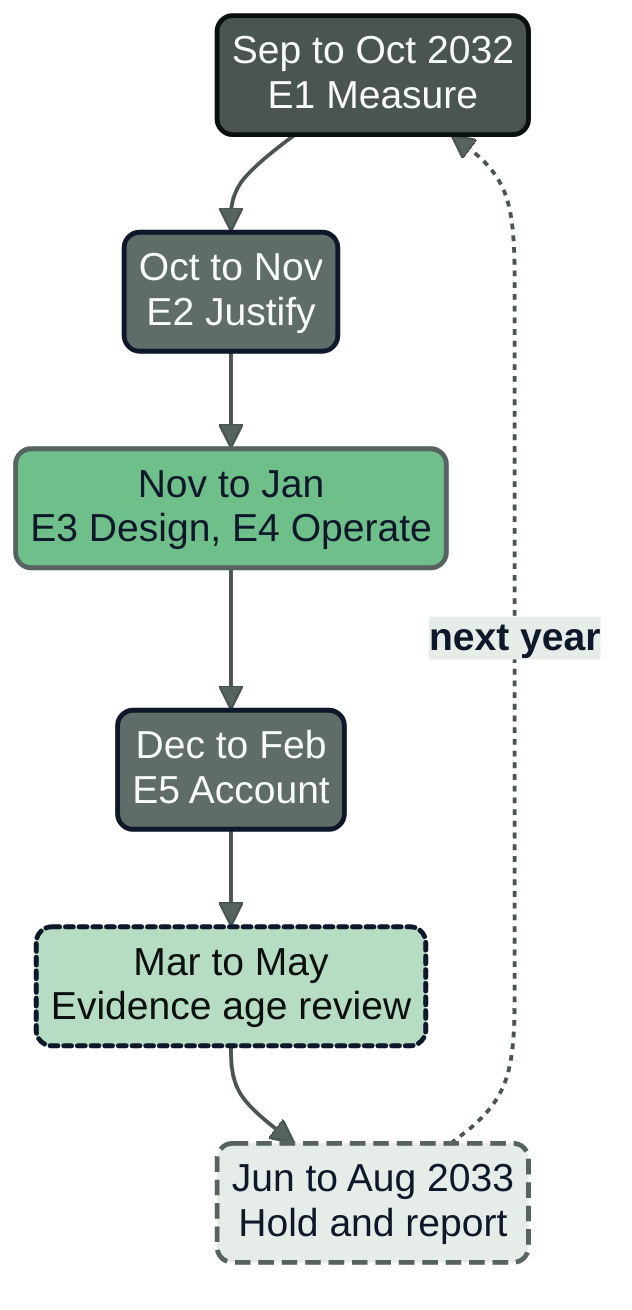
Figure 27.1: The year of the book proper, September 2032 to August 2033, in the order in which the five environmental functions were needed. The steps overlap in practice. Illustrative; no figure is shown.
Every statement about the future carries one of the three labels of AI Governance, Chapter 22 (26, Nordqvist, 2026). Everything about Nordvik Region and Hansa Mutual here is illustrative: the two organisations are fictional and their figures are not data. The account is the book's construction, written to show where a method that is sound on paper meets friction: a key held by a provider, a meter that cannot be read, a benefit record that is a month old when it is needed.
How to read the year
The year has the shape that Figure 27.1 shows. The first quarter is counting, and the counting is lopsided: each organisation measures what it can reach, and the gaps become the agenda. The second is deciding: records exist, so a proposal can meet the three tests of Chapter 4, Count, Compare and Cap, and some fail them. The third is operating, with budgets and stop paths that are drilled and that, in two cases, fail the drill. The fourth is accounting: claims withdrawn or held, contracts changed. Across all of it runs the age of the evidence: 90 days for the footprint of a running use, 180 for a benefit record, 90 for a stop drill, 12 months for a supplier disclosure and the reporting year at most for a claim (Chapter 24), with each review date derived as the earliest expiry minus 14 days. In a year every one of those clocks runs out at least once.
The question is not whether AI got greener; neither organisation can say that. It is whether, at the end, each can state what it counts, at what boundary, how old the count is, who can stop the work, and which statements it has declined to make (Chapter 4).
September 2032: two registers and an old number
Nordvik Region adopted its environmental register on 20 September 2032 (AIDR-1300), with Henrik Dahl as owner and a Count rule: no use is extended, renewed or described in public without a footprint record at a stated boundary. Hansa Mutual followed on 27 September (AIDR-1350), delegating the counting of AI inside Scope 2 and Scope 3 to Dr. Verena Lindner, head of group sustainability. Neither measured anything; each wrote down what it did not know.
The Region's last documented measurement was the Software Carbon Intensity figure of October 2026 for the citizen FAQ service, 1.90 g CO2e per resolved enquiry, calculated for 71,000 enquiries a month with the hosted route excluded. By September 2032 the service resolved about 168,000 a month. The figure would be 2,235 days old by 13 December and was still the basis of a public statement. Hansa Mutual had the opposite problem: plenty of numbers, including rack-level metering in Frankfurt, but AI not separable inside either scope, the energy of Cloud A burst capacity not metered by the group, and a draft board statement, traceable to no record, that AI work "became more efficient".
The two registers started with six rows each and almost nothing in the columns. E1 Measure had its agenda.
October 2032: counting what each could reach
The first measurements show how the two organisations differ. Nordvik Region buys most of what it runs, and measured first the use that it could meter at its own gateway and that carried the aged public figure: the open-weight route of the citizen-service assistant (FPR-NR-0001), on 4 October. Hansa Mutual measured first what it could count completely: the sensitivity classifier of the claims route (FPR-HM-0007), a model-scope record counted as of 30 September from the metered rack energy of 11 runs, with both electricity bases, an allocated embodied term and a stated cut-off for pre-training (Chapter 5). It then measured the claims-triage agent (FPR-HM-0002, Mode 5) on 6 October, the use whose nine model calls per claim made a per-claim figure hardest to state.
The triage agent returned the year's first uncomfortable finding. A bottom-up count of active accelerator-seconds gave about 114 kg CO2e a month, and a top-down attribution that included the idle capacity held for the agent about 1,443 kg, thirteen times more at one boundary, the facility's (about nine times as first quoted in Wh at two boundaries; Chapters 6, 8 and 20). The register carries both, each with its direction, and nobody resolved the gap during the year.
The same month set the shape of the other functions. On 6 October Ida Pettersson sent the model footprint sheet (FPR-NR-0007) for the hosted model of the eligibility-explanation route to the supplier, reply due 30 November; one field of eight was given. The classifier was measured on 11 October and a tuned small model chosen on 20 October (AIDR-1312). The platform team set an output-length limit and an exact-match cache on the open-weight route on 25 October (AIDR-1313) and booked no energy saving, because the reserved pool keeps drawing power until it is resized (Chapter 13). Hansa Mutual measured its claims assistant at the node on 18 October and the rack on 28 October, never added or compared, and approved its cascade (AIDR-1362) and serving budget EBG-HM-0003 (AIDR-1363).
Two decisions of E5 Account fell in October. The Region adopted a watch list of five markers (WCH-NR-0001, AIDR-1311, 18 October) with a default reading of calm with caps, and Hansa Mutual's board adopted its own (WCH-HM-0001, AIDR-1361, 25 October). On the same day the board held its draft statement that AI work had become more efficient, since CLM-HM-0001, revision 1, had no evidence behind it: the year's held claim.
November 2032: justifying, and two drills that failed
The month of decisions. The service desk manager, outside the sponsor's line, produced the first benefit record of the book (BEN-NR-0001, 8 November), built on a two-week hold-out in October: calls within 48 hours per 100 enquiries were 21 without the assistant and 14 with it, about 10,200 calls avoided a month. The Region proceeded and made no environmental claim for it (AIDR-1309), with a rebound recheck set for 31 March 2033. Hansa Mutual's board, hearing the triage agent on 15 November, found that its gain in correct routing, 93.5 per cent against 91.8 per cent for the rules, came almost wholly from claims with free text, and redesigned it: rules for structured claims, the agent for free text, a 90-day retest (AIDR-1359). BEN-HM-0002 records that Compare failed for the use as built: the year's first use reshaped, not stopped, by a comparison.
E3 Design ran alongside. The Region adopted a retraining policy for the classifier on 15 November (AIDR-1314). Hansa Mutual kept the claims assistant at the retrieval rung and put a fine-tune on seven markets' wordings aside for two months (AIDR-1364, 22 November). Both wrote agent mandates: the Region's for the platform team's Mode 3 tools on 2 November (MND-NR-ENV-0001, AIDR-1315) and the group's for the triage agent on 8 November (MND-HM-ENV-0001, EBG-HM-0001, AIDR-1365). On 22 November the group decided to consolidate its Frankfurt GPU pool from twelve servers to nine, benchmark before any purchase and test any payback at three times the embodied figure (AIDR-1366, HWL-HM-0001).
Then the stop paths. A budget is worth what its stop is worth, and a stop is worth what its last drill says. Hansa Mutual drilled the triage agent's stop on 15 November and the drill failed: 11 minutes against a target of 5, because the Cloud A burst route used a key held by the provider and outside the gateway. Frankfurt stopped in 40 seconds. The key moved into the gateway's identity service, egress was limited to the gateway, and the repeat on 29 November took 2 minutes 10 seconds. The Region drilled the citizen assistant's stop on 16 November against a target of 10 minutes and took 14, because the platform on-call could read the gateway's route table but not change it (EBG-NR-0001). The permission was given, and the drill of 7 December took 6 minutes 20 seconds. Both organisations failed first and passed second, which is what a drill is for; the register counts a stop only from the date of the pass.
One disclosure came back thin. Hansa Mutual's comparison sheet (HCS-HM-2032-11) put the same ten questions to its own Frankfurt facility, to Cloud A and to a regional provider with a Nordic site. Frankfurt answered eight (SDR-HM-0001) and the regional provider six. Cloud A, received on 8 November, answered three (SDR-HM-0002): an account-level, market-based, monthly carbon report, rung 3 of the disclosure ladder (Chapter 8), and nothing on the energy of burst accelerator-hours, the location-based factor or water. For a re-scoring batch of about 9,500 accelerator-hours the provider's tool gave 0.41 t market-based and the group's estimate 2.2 t location-based, which are not comparable. AIDR-1369 of 15 November keeps Frankfurt as baseline, allows Cloud A only as burst capacity under a cap in invoiced accelerator-hours (EBG-HM-0006) and starts a 90-day pilot with the regional provider. The Region made the same move in its own terms (AIDR-1319, 8 November): no hosting option chosen or excluded on environmental grounds until the tender answers are in.
On 29 and 30 November the two organisations adopted their regulatory registers (AIDR-1321, AIDR-1371), each row with an as-of date, a review every 180 days and a trigger.
December 2032: accounting
The governance decisions of Chapter 24 came in the first fortnight (AIDR-1324 for the Region on 6 December, AIDR-1374 for Hansa Mutual on 7 December). The register now recorded, for each row, whether the owner could answer the four questions of the gate. Tables 24.5 and 24.6 give the snapshot of 13 December. In brief, one of the Region's six rows was complete, FPR-NR-0001; the benefit record of the builder workspace assistant (BEN-NR-0006), measured on 31 January 2032, was 317 days old, long past its 180. At Hansa Mutual no row was complete: the claims assistant had a footprint record and a drilled stop but no benefit record, and the triage agent had both records, with a failed Compare.
The same day was the day of the claims. The regional director approved the withdrawal of the Region's public figure of 1.90 g (CLM-NR-0001, revision 2, AIDR-1322): it was 2,235 days old, the volume behind it had grown 2.4 times and the hosted route had never been in it. The Region published a correction, declined two further statements ("energy per enquiry fell since 2026" and "the assistant is low-carbon") and wrote down when it could publish again: when FPR-NR-0001 has an independent check and the statement says what the hosted route lacks. Hansa Mutual's board approved a narrow claim in place of the one it held (CLM-HM-0001, revision 2, AIDR-1372): in the test pool, at the IT energy of the accelerator racks, the claims assistant used 3.9 Wh per query before the levers of Chapter 13 and 2.4 Wh after, a fall of 38 per cent, valid for 90 days to 26 January 2033.
Two scale-up gates ran the same day, with the records of Chapter 24. The regional AI board declined to extend the staff assistant from about 3,200 to about 4,400 users until a footprint record, a budget with a drilled stop and a benefit record existed (AIDR-1326). Hansa Mutual's board approved the extension of the claims assistant to the UK and Swiss entities, about 140 further handlers, because the volume sat inside the volume trigger of the serving budget EBG-HM-0003, and asked for BEN-HM-0001 by 31 March (AIDR-1376).
Joakim Wester measured the conversion factor of the citizen route on 14 December and found 25.2 Wh per resolved enquiry at the boundary of the GPU servers and the host. Revision 2 of FPR-NR-0001 differs from revision 1 in three inputs, the power draw, the facility overhead and the pool share, and took its place at the calendar review of 19 December. The facility figure rose from 16.3 to 30.5 Wh per resolved enquiry.
On 14 December each organisation took the first decision with which Chapter 29 closes. The regional director joined the footprint of the citizen assistant and the recheck of its benefit record into one reading due on 31 March and withheld any statement about the assistant until then (AIDR-1329). Hansa Mutual's board asked for a metered fortnight on the Frankfurt rack to reconcile the two footprints of the triage agent before any statement about it (AIDR-1379); it waited behind the tagged rack meters that the May work required and had not reported when the year ended, so the register kept both figures.
January 2033: a notice, a breach and a lapse
On 9 January the classifier's footprint record reached its 90 days; the re-measurement fell inside the tolerance of 0.05 and the record was renewed. On 13 January Hansa Mutual re-measured the claims assistant, the condition of AIDR-1376, after repeating its stop drill the day before; the sentinel-pool reading agreed with the October reading within the 2 per cent of the claim's independent check, and MCR-HM-0001 was renewed. These dull renewals are the year's most common event, and a register's value is that they happen on schedule.
The breach was not dull. Chapter 20 tells it in full. In mid-January the region's municipalities sent a notice on changed benefit levels to about 38,000 households, with a link to the assistant. By 17 January the gateway had counted 129,400 resolved enquiries, 80.5 per cent of the monthly quota of 160,650. On 22 January the gateway began routing requests answerable from the published FAQ page to that page. On 24 January, at 177,800, the count passed 110 per cent and the gateway switched the route to the FAQ page and the phone service within a minute. The rebound alert, 20 per cent over the September baseline of 146,000, that is 175,200, was also crossed. The cause was a notice, not a habit, and the incident record INC-NR-2033-0007 classed it as volume growth with energy per unit steady within its drift.
The review on 27 January found three things. A single monthly quota had let one notice use most of the month's allowance in three weeks. Nobody could say how much calls to the service desk rose in the last week, because the benefit record rested on an October hold-out and none had run in a month with a notice. And the quota had been derived once, in September, from a factor that had drifted by minus 9.0 per cent, outside the 0.05 tolerance. Elisabet Holmgren approved no change to the January budget and a temporary allowance of 10 per cent for February, to 4,895 kWh, conditional on a refreshed benefit record by 31 March and a re-derived quota, with weekly sub-quotas from February (AIDR-1320). An allowance without a refreshed benefit record would have set an unproven benefit against a measured cost, which the net-benefit principle forbids.
The claim lapsed in January too. CLM-HM-0001, revision 2, reached the end of its 90 days on 26 January, and its own withdraw_if condition withdrew it from the group intranet note, automatically at Level 3 with a person informed (Chapter 22). The sentence had never been about the group, so the sustainability statement did not change, which is how a narrow claim should behave.
February 2033: declining
Both organisations used the month to say no, on the same ground: the evidence for the extension did not exist on the day the proposal arrived (Chapter 25). On 8 February the Region declined to extend the eligibility-explanation route (FPR-NR-0002) from about 22,000 to about 60,000 explanations a month and capped it at 25,000 (AIDR-1325). On 15 February the group board declined to double the licences of the agentic work tools for engineering (FPR-HM-0006) from about 700 to about 1,400 and held them at 700 (AIDR-1375). Chapter 25 gives both records and the conditions for reopening.
The staff assistant (FPR-NR-0003) delivered the first of its three conditions on 25 February, its first footprint record, owned by Gunilla Roos. HWL-HM-0001 was renewed on 6 February after the consolidation to nine servers, with measured utilisation close to the modelled one, so nobody reopened the order for new servers; HWL-NR-0001 was renewed on 13 February with its finding unchanged, four of the 24 reserved accelerators idle by plan at about EUR 65,000 a year, a cost that only the contract can remove. On 14 February the Region issued the tender annex TA-NR-ENV-01 for the re-tender of NR-2026-031, with environmental disclosure carrying 12 of 100 quality points. The retest of the triage agent's redesign fell due about the same time: the volume split matched the prediction, the two footprints still disagreed, and the decision of AIDR-1359 held on either.
March 2033: rebound and the first rechecks
March held the dates that the earlier chapters had fixed. On 2 March the Region drilled EBG-NR-0001, five days before the December drill expired, and the stop path passed; the same session drilled the cap on the eligibility route, which Chapter 25 had said would not count as a cap until someone had tried it. On 10 March it re-measured the citizen route and the conversion factor held inside tolerance. The staff assistant's second condition, a budget with a drilled stop (EBG-NR-0004), arrived on 11 March. On 25 March the Region refreshed the benefit record of the citizen assistant (BEN-NR-0001, revision 2) with a hold-out in a normal week and re-derived the quota at 25.2 Wh: with the energy budget unchanged at 4,450 kWh the quota became about 176,600 resolved enquiries a month, derived arithmetic and not a measurement.
At Hansa Mutual BEN-HM-0001, the condition of AIDR-1376, arrived on 30 March, a day early. It compared handlers with and without the assistant on a sample of claims handled and was graded as measured. The claims assistant now had a footprint record, a benefit record and a drilled budget, all inside their ages. The rebound recheck of the triage agent was due the same day; volume had stayed close to the September level of 140,000 claims, and the redesign held.
On 31 March the Region read its watch list. M1, the share of register uses with a footprint record inside its evidence age, stood at 3 of 6, which is 0.50: not below the 0.50 that would have moved the Region toward the concerned reading and a rule that no new use starts without a record. The marker was on the line, and the minutes say so. M4, uses with a measured benefit record under 180 days old, stood at 1 of 6, up from 0.
April 2033: replay and benefit
The Region's placement policy (PLC-NR-0001) had space closed and time shift off, pending a replay of a month of nightly indexing jobs against hourly grid data. The replay ran in April; the saving from shifting the indexing window stayed below the policy's threshold of 10 per cent and 1 kg, and time shift stayed off. It became active when its stop path, queue suspension and credential revocation at the identity provider, was drilled. Hansa Mutual's basin look-up for the cloud regions (PLC-HM-0001) was completed for Cloud A and not for Cloud B, so moves into Cloud B stayed blocked.
The staff assistant's third condition arrived on 28 April: a benefit record from a comparison on a sample of work, not on usage counts (BEN-NR-0003). It showed a time saving for drafting and none that could be separated for guidance search, which is why the decision of May was a conditional yes.
May 2033: the evidence age review
The review calendar had its busiest fortnight in the first half of May: SDR-NR-0001 expired on 15 May, BEN-HM-0002 on 14 May, and the eligibility cap's review was due on 31 May. Nordvik Region held its second-quarter evidence age review on 3 May and Hansa Mutual on 10 May. The age check ran outside any agent, and its output was a list of rows with an item missing or about to expire, sorted by date. The review changed four things.
First, the quota rule at the Region. The regional director approved a revision of EBG-NR-0001 on 10 May (AIDR-1328): the quota is re-derived at every re-measurement of the conversion factor, and a drift beyond the 0.05 tolerance makes the quota stale at once, as a change of model makes a footprint stale.
Second, the benefit rule at Hansa Mutual. The triage agent's benefit record expired on 14 May and the Polish service centre needed a new paired sample. The board used the exception that Chapter 24 allows, once and for 30 days at most, to keep the record in force to 13 June while the sample ran, and recorded that it had done so.
Third, the claim at Hansa Mutual. The re-measured claims assistant could not support a renewed revision 2, because the sentinel pool of 400 queries on the Frankfurt test racks no longer resembled production after the extension to the UK and Swiss entities. The board decided (AIDR-1377) that a renewed claim needs a reading at the production boundary, from tagged rack meters, and that the sentence on all AI work stays held until one exists.
Fourth, the staff assistant. With the three conditions of December met, the regional AI board approved the extension from about 3,200 to about 4,400 users (AIDR-1327), with the benefit claim limited to drafting, a rebound check after 90 days and the interim quota lifted. The gate said no for lack of records and yes when they existed.
SDR-NR-0001 expired on 15 May, a day after the request for the Annex VII figures of reporting year 2032 had gone to the hosting provider; until they arrived the Region published no facility indicator from the provider, and none was due.
June 2033: a clause
The hosting provider's figures reached the Region on 2 June, and SDR-NR-0001 was renewed for 12 months from that date, with the same gaps: energy per customer, grid mix and water by customer were not given. The hosted model's record, SDR-NR-0002, stayed at rung 5. The questions that the supplier would not answer for an existing contract had become scored items in a new one.
Hansa Mutual's clause family HM-PROC-ENV (ENV-01 to ENV-10, Chapter 23) went into its first contract on the renewal of the Cloud A commitment. Cloud A agreed to the disclosure schedule (ENV-01) and to region and grid (ENV-04), and deferred the energy of capacity (ENV-02) to the next renewal, so the group's record for Cloud A stays at rung 3 for energy until 2034, with its instance-hours estimate and the cap in invoiced accelerator-hours (EBG-HM-0006). A clause is not a disclosure, and the register distinguishes a promised figure from a received one.
The supplier's benchmark for the Frankfurt refresh also arrived. On Hansa Mutual's triage workload the gain of the candidate servers was smaller than the 2.5-fold assumed in the worked example of Chapter 16, so option C was not shown to beat the consolidation already carried out, and no order was placed.
On 30 June the Region read the watch list again. M1 still stood at 3 of 6, 0.50, below the 0.83 that would have moved it toward calm and not below the 0.50 that would have moved it toward concern. M4 stood at 2 of 6, above the zero that would have meant refusing to renew any use without a benefit record. The stance remained calm with caps, by decision and not by drift.
July 2033: placement and hardware
July was the quietest month and the most useful for the register's discipline. The weekly cycle kept running: platform on-call read the ages every week, the register owners reviewed all rows every month, and the sustainability leads went through drills, conversion factors and rows inside their look-ahead window each quarter.
Hansa Mutual produced the estimate that the board had asked for in February: energy per session of the agentic work tools from gateway tags, at rung 4 of the ladder, labelled an estimate. A benefit record from a controlled trial was not in hand, so the doubling stayed declined. The board noted that an estimate allows a decision on the Count test and does nothing for Compare.
The heat studies, at nordvik-dc (AIDR-1318) and at Frankfurt (AIDR-1368), were still open at the end of the month, carried in the register as open, with an owner and a date.
August 2033: the register at year end
The year closed on 31 August, the sunset date of the two builds of Vibe to Dev. The builder workspace assistant (FPR-NR-0006), whose benefit record had never been renewed and which had never had a footprint record, was retired from the register on that date with a note of what had been measured and when; a row that ends is recorded as ended, with its evidence, and not deleted.
The Region's re-tender of NR-2026-031 was still open at the end of August, which public procurement lead times of 9 to 14 months make the expected state. CLM-NR-0001 remained withdrawn: its condition for republication, an independent check of FPR-NR-0001 and a stated gap for the hosted route, needed metering that the provider did not give. Hansa Mutual's CLM-HM-0001 stood where it had since October, revision 1 held and revision 2 lapsed. The group's sustainability statement carried AI inside Scope 2 and Scope 3 at the rung the group could support, both electricity bases side by side, and no efficiency claim.
What the register shows
Table 27.1 sets the registers at the start of the year beside the registers at its end. The counts are of uses, six for each organisation at the start, and they are illustrative.
Table 27.1: The two registers at the start of September 2032 and at the end of August 2033. Counts of uses and rows; illustrative; the end figures follow the identifiers of Table 27.2. "Live rows" excludes FPR-NR-0006, retired on 31 August 2033. A stop counts from the date of a passed drill and only inside 90 days. The end counts assume that the quarterly re-measurements and re-drills of running uses were made on schedule; the chapter does not narrate each of them.
| Measure | Nordvik, start | Nordvik, end | Hansa, start | Hansa, end |
|---|---|---|---|---|
| Footprint record inside its age | 0 of 6 | 3 of 5 live rows | 0 of 6 | 3 of 6 |
| Benefit record inside its age | 0 of 6 | 2 of 5 | 0 of 6 | 2 of 6 |
| Budget with a stop that passed a drill | 0 | 3 | 0 | 3 |
| Rows complete (all three of the above) | 0 | 2 | 0 | 2 |
| Public claim in force | 1, aged | 0 | 0 | 0 |
The number of public claims in force fell from one to zero at the Region and stayed at zero at the group. After a year of measuring, neither organisation said more in public than before, and both said it with more evidence behind what they held back. In the book's method a claim is the last thing that evidence permits, and the register's purpose in the first year is to make the next claim possible.
Table 27.2 lists what changed, by record.
Table 27.2: What changed, by record, September 2032 to August 2033. Illustrative. Dates are those of the decision or the record; the identifiers are those of the chapters that wrote each record.
| Record | Change in the year | When | Decision |
|---|---|---|---|
FPR-NR-0001 |
Revision 2 replaces revision 1; facility figure 16.3 to 30.5 Wh per resolved enquiry | 2032-12-19 | register |
FPR-NR-0003 |
First footprint record for the staff assistant | 2033-02-25 | AIDR-1326 |
FPR-NR-0006 |
Retired with the build's sunset; benefit record never renewed | 2033-08-31 | register |
BEN-NR-0001 |
First record (hold-out in October); revision 2 after the breach, effect smaller | 2032-11-08; 2033-03-25 | AIDR-1309, 1320, 1329 |
EBG-NR-0001 |
Drill failed (14 min), then passed (6 min 20 s); quota re-derived; rule revised | 2032-11-16; 2032-12-07; 2033-05-10 | AIDR-1320, 1328 |
EBG-NR-0004 |
New budget with drilled stop for the staff assistant | 2033-03-11 | AIDR-1326, 1327 |
INC-NR-2033-0007 |
Stop at 24 January; weekly sub-quotas from February | 2033-01-27 | AIDR-1320 |
CLM-NR-0001 |
Revision 2: 1.90 g withdrawn, correction published; still withdrawn at year end | 2032-12-13 | AIDR-1322 |
SDR-NR-0001, -0002 |
Renewed 2 June with the same gaps; hosted model stays at rung 5 | 2033-06-02 | none |
PLC-NR-0001 |
Replay record entered; time shift stays off; policy active after drill | April 2033 | none |
FPR-HM-0001 |
Re-measured, agrees within 2 per cent; MCR-HM-0001 renewed |
2033-01-13 | AIDR-1376 |
FPR-HM-0002 |
Redesigned: rules for structured claims, agent for free text; both footprints carried | 2032-11-15; 2033-02 | AIDR-1359, 1379 |
BEN-HM-0001, -0002 |
First record 30 March; second kept 30 days past expiry once, then refreshed | 2033-03-30; 2033-05-14 | AIDR-1376 |
EBG-HM-0001 |
Drill failed (11 min), then passed (2 min 10 s) after the key moved | 2032-11-15; 2032-11-29 | AIDR-1365 |
CLM-HM-0001 |
Revision 1 held; revision 2 lapsed and withdrawn automatically; revision 3 needs a production reading | 2032-10-25; 2032-12-13; 2033-01-26; 2033-05-10 | AIDR-1361, 1372, 1377 |
SDR-HM-0002 |
Cloud A answered 3 of 10; clauses ENV-01 and ENV-04 agreed, ENV-02 deferred | 2032-11-08; June 2033 | AIDR-1369 |
HWL-HM-0001 |
Consolidated to nine servers; refresh not ordered after benchmark | 2032-11-22; June 2033 | AIDR-1366 |
FPR-HM-0006 |
Declined doubling; energy per session estimated from gateway tags | 2033-02-15; July 2033 | AIDR-1375 |
The worked example of the year, a register row at the end of August for the Region's citizen-service assistant, shows the record that the age check reads.
# register/environment-nr.yaml, excerpt (illustrative; Nordvik Region, 2033-08-31)
row: FPR-NR-0001
use: citizen-service assistant, open-weight route (SVC-NR-005)
owner: sara-ekdahl            # service owner; register owner henrik-dahl
footprint: {record: FPR-NR-0001, revision: 2, measured: 2033-08-22, valid_days: 90, expires: 2033-11-20}
benefit: {record: BEN-NR-0001, revision: 2, measured: 2033-03-25, valid_days: 180, expires: 2033-09-21}   # clock from the decision date, here the same day
budget: {record: EBG-NR-0001, revision: 2, kwh_per_month: 4450, quota_rederived: 2033-08-22}
stop: {path: STOP-NR-ENV-01, last_drill: {date: 2033-08-29, result: pass}, valid_days: 90, held_by: [henrik-dahl, platform-on-call]}
claim: {record: CLM-NR-0001, revision: 2, status: withdrawn, republish_when: [independent check, hosted route gap stated]}
next_review: 2033-09-07       # earliest expiry minus 14 days
labels: [illustrative]
What went wrong
Two errors repeated across the year, and the method found them.
The first is that a number outlived the thing it described. The Region's public figure, its quota and the first footprint record of the citizen assistant each rested on a measurement or derivation at one moment and were used after the conditions had changed. None was dishonest. The cost came in January, when a quota derived once and a benefit measured once could not say what a notice to 38,000 households had done. The corrections are in the register as rules: re-derive on drift, refresh the benefit in a normal week, put a date on everything.
The second is that a control existed on paper before it worked in practice. Both stop paths failed their first drills for reasons that no reading of the budget could show: a key held by a provider outside the gateway, and a permission that allowed reading a route table and not changing it. A stop path that has not been drilled inside its evidence age is a hope.
What they would do differently
The following is the book's construction of the two organisations' own conclusions, not a quotation. Nordvik Region would drill the stop before approving the budget, write the permission to change the route table into the on-call role, and schedule the benefit hold-out so that a refreshed record exists before a month that tests it. It would ask the supplier of the hosted route the ten questions at the start of a contract. Hansa Mutual would move the provider-held key into the gateway before the first drill, require a production-boundary reading for any claim from the start, and put its clause family into the first Cloud A contract and not a renewal.
Practical guide: a year plan for the first year of a register
Purpose. To plan a first year so that each environmental function has a gate and a dated artefact, and the evidence clocks are scheduled and not discovered.
Roles. The register owner, the sustainability lead, the use owners, a procurement officer, the data-centre or energy manager and the person who signs claims.
Inputs. The uses of the estate with their owners, the evidence ages of Chapter 24, the contract calendar and the dates of any public statement already made.
Steps.
- Quarter one, count. Adopt the register and the Count rule. Measure the largest use and the least visible use first, each at a stated boundary, and send the supplier sheets.
- Quarter two, justify and design. Write a benefit record for each use that a proposal touches and decide one proposal on it. Set a budget and drill its stop; expect the first drill to fail.
- Quarter three, operate and account. Run the claim path on every public statement, withdraw what lacks evidence and write down when it may be made again. Put the disclosure questions into the next contract.
- Quarter four, review. Read the age check, renew what is due, retire what is finished and record each change of rule as a decision.
- Put every expiry on the calendar on day one, at expiry minus 14 days, and let the age check run outside any agent.
Artefact. A year plan, kept beside the register.
year_plan: first-year
owner: register-owner
quarters:
  - {q: 1, function: E1 Measure, gate: "footprint records for two uses, with date and boundary"}
  - {q: 2, function: "E2 Justify, E3 Design", gate: "one benefit record, one budget, one passed drill"}
  - {q: 3, function: "E4 Operate, E5 Account", gate: "claim path run; disclosure questions in a contract"}
  - {q: 4, function: "all, by age", gate: "age review held; rules changed by decision"}
clocks_days: {footprint_running: 90, benefit: 180, stop_drill: 90, supplier: 365, claim: reporting_year}
review_calendar: "earliest expiry minus 14 days"
exit_rule: "a row that ends is retired with its evidence, not deleted"
Across the modes and the organisations
Across the degrees of delegation
The year used the ladder of Chapter 4 without a Level 4 action. Table 27.3 shows the classes of action as used and what the year changed.
Table 27.3: The classes of action, the ceilings of Chapters 20 and 22 and what the year changed. Illustrative.
| Class of action | Ceiling | Used in the year | What changed |
|---|---|---|---|
| Measure and read ages | Level 3 | Gateway counts, rack meters, weekly age check | Age check ran outside any agent |
| Alert and defer | Level 3 | Alert 17 Jan, defer 22 Jan | Weekly sub-quotas added |
| Stop | Gateway control, not a delegated act | Automatic stop 24 Jan at 110 per cent | Drills failed, then passed |
| Restart | Level 1 Assisted | A person confirmed the restart | No change |
| Withdraw an expired claim | Level 3 Bounded | CLM-HM-0001 revision 2, 26 Jan |
A person informed |
| Publish a claim | Never Level 4 | Approval by a named person only | No change |
No agent set or changed a budget, disabled a meter or a stop path, started work beyond its budget or published a claim. That is the book's ceiling, and a year of use did not call for lifting it.
Across the usage modes
Table 27.4 shows what the register could hold at year end for each mode.
Table 27.4: What the register could hold by usage mode at year end. Illustrative.
| Mode | Example in the year | What the register could hold |
|---|---|---|
| Modes 0 to 2 | Ambient AI, embedded assistants, SVC-NR-008 |
Supplier-reported rows only |
| Mode 3 | Agentic work tools: MND-NR-ENV-0001, FPR-HM-0006 |
Estimate from gateway tags; benefit unproven |
| Mode 4 | Citizen assistant, claims assistant, staff assistant | Footprint, benefit and budget records |
| Mode 5 | Claims-triage agent | A budget per run and per day; two footprints, direction stated |
Nordvik Region and Hansa Mutual
The year shows two different organisations arriving at the same kind of discipline. Nordvik Region is small, supplier-reliant and subject to public-access rules; its levers are the contract, one question at a time to the supplier and a gateway it controls, and everything it writes can be read by a resident. It finished with fewer public statements than it started with, a working stop path, a quota that is recomputed and a tender that carries the questions. Hansa Mutual owns capacity, buys burst capacity and reports to a board and an auditor; its levers are metering, routing and clause families. It finished with a model-scope record, two footprints of the triage agent with their direction, a consolidated Frankfurt pool and a board that has learned to hold a sentence until a record exists. No per-person meter was switched on at either: the negotiation under MBL-NR-IT-2027-01 and the co-determination of Hansa Mutual apply before one is.
Observable, expected, speculation
Observable. Every dated event of the year belongs to the illustrative record and carries its identifier. That stop paths fail their first drills for reasons outside the budget is the book's experience of the method in these two cases, not an observation about real organisations.
Expected. The Region's re-tender is expected to remain open beyond August 2033, because public procurement lead times of 9 to 14 months are normal for hosting contracts of this kind. The claim rows are expected to stay mostly empty in a second year unless the Region obtains metering by customer or the group a production-boundary reading.
Speculation. Whether a second year shows lower footprints or higher ones is not established by anything in this chapter: volumes may grow and levers may be spent as rebound (Chapter 10). The author's own projections are kept to Chapters 25 and 29.
Summary
A year at the two organisations is a year of records and decisions, and the records came first. Nordvik Region counted the use it could meter and Hansa Mutual the one it could count completely; both found that their largest figures rested on a count that was old or on a boundary that was partial. The decisions followed the records: a benefit measured before a use proceeded, a triage agent redesigned because Compare failed, two uses declined for lack of evidence and one approved when the evidence arrived.
The budgets and stop paths were drilled, and both first drills failed, once for a provider-held key and once for a permission. A breach at the Region showed what a quota derived once and a benefit measured once could not say. The claims were the most conservative part of the year: a 2026 figure withdrawn, a board's sentence held, a narrow claim that lapsed on schedule. A cloud supplier's thin disclosure was met with a cap in invoiced accelerator-hours and a clause that the supplier accepted in part. The evidence age review of May changed four rules or decisions.
The chapter concerned all five functions: E1 Measure in the first quarter, E2 Justify in the decisions of November and February, E3 Design in the budgets and mandates, E4 Operate in the drills, the breach, placement and hardware, and E5 Account in the claims, disclosures, contracts and the review. Level 4 Autonomous was used for no action. The reader can start on Monday by writing down, for one use, the date of its last measurement, the name of the person who can stop it and the date of its last drill. Chapter 28 turns to the conclusions for each organisation.
Sources
- Nordqvist, G. (2026). AI Governance. The Transformed Architecture, Book 2. (26, Nordqvist, 2026)
- Nordqvist, G. (2026). AI Operations. The Transformed Architecture, Book 10. (34, Nordqvist, 2026)
- Nordqvist, G. (2026). AI Leader. The Transformed Architecture, Book 11. (35, Nordqvist, 2026)
- Nordqvist, G. (2026). AI Developer. The Transformed Architecture, Book 12. (36, Nordqvist, 2026)