Procurement and Public Authorities: Clauses, Disclosures and Evidence from Suppliers
Chapter 22 ended with a claim that is only as good as the evidence under it. For most AI that evidence comes from a supplier, because most of the AI that an enterprise or a public authority uses is bought: the model sits in a supplier's data centre, the accelerators are reserved from a hosting provider, the assistant is a feature of a licensed product. What the buyer can later say about the footprint therefore depends on what it asked for before it signed. Chapter 8 showed the consequence from the measuring side: a supplier that does not disclose is the normal case, and the buyer works on a lower rung of the evidence ladder. This chapter turns the same fact, seen from the buying side, into clauses, award criteria and records. It concerns E5 Account, the function of the book's method that covers complying, reporting, claiming, procuring, governing and holding to account, with evidence that has a boundary and a date (Chapter 4). It serves the Count test: a figure per use cannot be counted if the supplier was never asked for the inputs.
Nordvik Region is a public authority and buys under public procurement law, with frameworks, published criteria and lead times of 9 to 14 months. Hansa Mutual is a private group with a larger share of its own capacity, two hyperscaler tenancies and more room to negotiate. Both need the same thing from a supplier: a figure with a boundary and a year, a way to check it, and a date by which it is asked for again. The law decides how a public buyer may ask; a private buyer is free of those rules but not of the logic behind them.
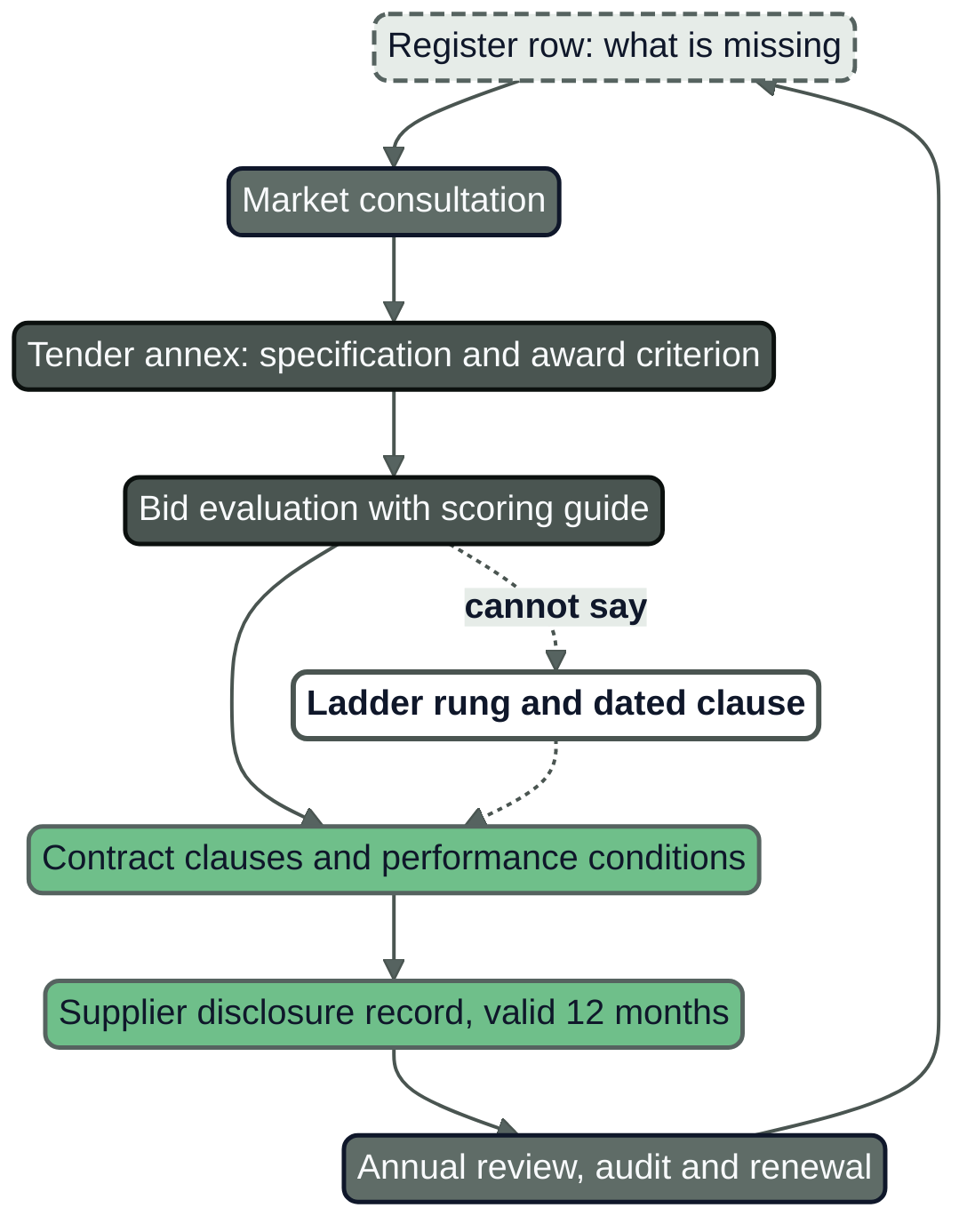
Figure 23.1: From tender to contract. The disclosure items travel from the register row through the tender annex and the contract into the supplier disclosure record; a supplier that cannot say stands on a named rung of the ladder and is bound to a dated clause. Roles are shown, not figures.
A framework with no figures
In 2026 Nordvik Region signed contract NR-2026-031 for reserved accelerators in a Nordic data centre. The contract fixed price, capacity, region, customer-held keys and the exit terms. It fixed nothing about environmental disclosure (illustrative).
Six years later the platform lead wanted energy for the reserved pool, and the sustainability lead wanted a figure she could sign. The Region had one thing from the provider: the annual report of a data-centre operator under Article 12 of the Energy Efficiency Directive, which gave installed IT power, a power usage effectiveness (PUE, the ratio of a facility's total energy to the energy of its IT equipment) and total water input for the site (5, European Union, 2023). The report was a legal duty of the provider, not a right of the customer. When the procurement manager, Ida Pettersson, asked for energy per reserved accelerator, the provider answered as a favour, in its own format, on its own boundary and without a date. Chapter 8 recorded the result as SDR-NR-0001 and the fallback rungs it left the Region on. The contract was not wrong; it was silent, and silence turns every later question into a request.
A supplier's willingness to disclose is worth little until it is written into something the buyer can enforce. The rest of the chapter is about writing the clause and keeping the evidence it produces.
What to ask for
The supplier disclosure items follow from what the earlier chapters needed and could not get, grouped by what they serve and not by what a supplier finds convenient to publish. Each needs a boundary, a year and a statement of whether it is metered, calculated or estimated. An answer that cannot say what it covers is recorded as such (Chapter 8, rung 3) and is not scored as if it could.
Table 23.1: The supplier disclosure items, with the boundary each needs and the chapter it serves.
| Item | What to ask for | Boundary the supplier must state | Serves |
|---|---|---|---|
| Energy of the buyer's capacity | kWh per month for the reserved pool; per call or token for a hosted service | IT only or whole facility; metered or modelled | The footprint record (Chapter 6) |
| Facility indicators | PUE, water usage effectiveness (WUE, litres per kWh of IT energy), renewable energy factor, as in Delegated Regulation (EU) 2024/1364 | Site, calendar year, measurement point | The register, the rating of Chapter 18 |
| Region, site and grid | Country and site of each hall; location-based emission factor and electricity sourcing | Location-based and market-based kept apart | Placement (Chapter 17) |
| Water | Water withdrawn and consumed at the site; per customer where it can be allocated | On-site or total; allocation rule | Chapter 7 |
| Hardware | Accelerator generation, service life, reuse and end-of-life route, embodied emissions with method | Per device; source of the factor | Chapter 16 |
| Model figures | Training energy (MWh) and method; energy or emissions per inference, with the task | Operational or life cycle; hardware | Chapters 5 and 6 |
| Cadence and restatement | Annual or quarterly report; restatement when the method changes | Reporting year | Evidence age |
| Change notice | Notice before a change of model, region, hardware pool or method | Notice period in days | The footprint record's event triggers |
Table 23.1 is the schedule that the annex and the clause set below carry. Four points deserve comment, because suppliers' own disclosures usually answer a different question than the buyer's.
First, facility figures are not use figures. A PUE of 1.21 says how much overhead a hall adds to IT energy, not how much energy a buyer's tokens consumed. The suppliers that publish most publish at the facility or company level. OVHcloud's fiscal-year 2025 sheet lists PUE, WUE and a renewable energy factor for each of nine sites, with a group PUE of 1.24 and a group WUE of 0.34 litres per kWh (vendor-reported, fiscal year 2025, retrieved November 2026) (49, OVHcloud, 2025). Scaleway's impact report gives, for calendar year 2024, an average PUE of 1.375 and an average WUE of 0.22 across its sites, with electricity of 132,881 MWh and a location-based footprint of 118,284 tonnes CO2e across scopes 1 to 3 (vendor-reported, retrieved November 2026) (50, Scaleway, 2025). Both suit a facility criterion; neither contains a figure for a customer's workload.
Second, model figures are published on different boundaries. Mistral AI published in July 2025 a life-cycle study of Mistral Large 2 carried out with Carbone 4 and the French environment agency ADEME and peer-reviewed by Resilio and Hubblo: after 18 months of use, 20.4 kt CO2e and 281,000 m3 of water for training and usage, and 1.14 g CO2e and 45 mL of water for a marginal 400-token response, with users' terminals excluded and GPU embodied impacts approximated, which the company calls a first approximation (vendor-reported, life cycle, to January 2025, retrieved November 2026) (45, Mistral AI, 2025). Google's authors reported a median Gemini Apps text prompt of 0.24 Wh as of May 2025, on a boundary that includes the whole serving system and its overhead, in a paper authored by the vendor (51, Elsworth et al., 2025). The two figures are per response and per prompt, for a vendor's own product, at different boundaries, and neither is a figure for a buyer's tenancy. The book does not compare them; it records that two providers published a method and a number, and that a buyer who wants the same for its own use must ask.
Third, the customer-level tools of the large cloud providers answer at account level and on their own method. The AWS customer carbon footprint tool, in its model version 3.0 of October 2025, and the Google Cloud carbon footprint methodology each describe what their report covers (83, AWS, 2025) (84, Google Cloud, n.d.). In Hansa Mutual's illustrative re-scoring test (Chapter 8) a market-based monthly account report and a location-based estimate built from accelerator-hours differed by about a factor of five for the same batch. A clause that asks for "the carbon report" is satisfied by such a tool; a clause that asks for energy of the reserved capacity, on a stated boundary, is not.
The EU's own disclosure route does not close the gap. The AI Act requires providers of general-purpose AI models to keep technical documentation that includes, for the AI Office and the national authorities, the known or estimated energy consumption of the model (Article 53(1)(a) with Annex XI, Section 1, point 2(e)) (1, European Union, 2024). The Model Documentation Form of the General-Purpose AI Code of Practice asks for training energy in megawatt-hours and for inference computation in floating-point operations. Its energy rows are marked for the AI Office and the national competent authorities, not for downstream providers, and it asks for no inference energy (74, European Commission, 2025) (9, European Commission, 2025). A deployer has no direct energy duty under the Act, so a buyer who wants model energy must write it into the contract (an architectural implication, not legal advice).
The legal frame
A public authority, unlike a private buyer, is bound by principles that decide how it may ask. This section reads the consolidated text of Directive 2014/24/EU (January 2026) and Sweden's Lag (2016:1145) om offentlig upphandling, as amended to SFS 2026:880 and read in the Riksdag's database in November 2026 (7, European Union, 2014) (107, Sveriges riksdag, 2026). Counsel (Maria Åkesson) owns the legal reading; what follows is the architecture it implies, not legal advice.
The principles. Article 18(1) requires contracting authorities to treat economic operators equally and without discrimination and to act in a transparent and proportionate manner; the Swedish Act says the same in 4 kap. 1 §. Article 18(2) obliges Member States to ensure that operators comply, in performing public contracts, with applicable environmental, social and labour obligations. The Swedish Act adds in 4 kap. 3 § that an authority "bör", should, take environmental, social and labour considerations into account where the nature of the procurement justifies it. The Region may weigh the environment and is expected to where the purchase warrants it, but the Act prescribes no environmental criterion in every contract. France differs: the DINUM sheet discussed below states that under the Climate and Resilience Act of 22 August 2021 every public contract must include an environmental clause, condition or specification and an environmental award criterion (128, MiNumEco, 2025), a duty a Swedish authority cannot borrow.
Three places for a requirement. They differ in effect on the bidder.
- The technical specification (Article 42, 9 kap. 1 to 3 §§) lays down required characteristics. They may refer to the process or method of providing the service, even where it is not part of its substance, if linked to the subject-matter and proportionate (Article 42(1)), and may be set as performance or functional requirements that include environmental characteristics (Article 42(3)(a)). A bid that fails a specification is non-compliant. This is the place for a minimum: that a disclosure schedule is delivered, that figures follow a stated method.
- The award criterion (Article 67, 16 kap.) decides which compliant bid is best. The most economically advantageous tender may be assessed on cost-effectiveness, such as life-cycle costing, or on a price-quality ratio that includes environmental aspects linked to the subject-matter (Article 67(2)); a criterion is linked where it relates to the service in any respect and at any stage of its life cycle (67(3)). Criteria may not confer unrestricted freedom of choice and must come with specifications that allow the tenderers' information to be effectively verified (67(4)), and the weighting is stated in the procurement documents (67(5)).
- The contract performance condition (Article 70, 17 kap. 1 §) sets environmental conditions for how the contract is carried out, if linked to the subject-matter and stated in the documents. This is the place for clauses that run for years: cadence, audit, change notice, improvement.
Life-cycle costing. Article 68(1) lets the authority include the consumption of energy and other resources over the life cycle, and costs imputed to environmental externalities such as greenhouse-gas emissions where their value can be determined and verified. Under Article 68(2) it must say in the documents which data tenderers give and which method it will use, and the method must be objectively verifiable, non-discriminatory, accessible and workable with reasonable effort (16 kap. 4 and 5 §§). For AI this is practical: no bidder can supply a figure for a boundary the documents do not define.
Labels and proof. Article 43 allows a required label only where its criteria are linked to the subject-matter, objectively verifiable and set by a third party in an open procedure, and equivalent labels must be accepted; Article 44 allows a test report or certificate from a conformity assessment body. For AI there are few such labels. The AI Energy Score of Hugging Face and partners scores GPU energy for inference only, on one accelerator type, and for proprietary models relies largely on the uploader's attestation (133, Hugging Face, 2026). AFNOR Spec 2314 is a methodology, not a label (79, AFNOR, 2024). A label requirement would exclude most bidders or admit anything; the safer route is to specify the data and method and ask for evidence of compliance.
In practice. The scoring guide and weights are in the documents before bids arrive (Article 67(5)), and every bidder gets the same schedule. A requirement that only one provider can meet risks being read as artificially narrowing competition, which Article 18(1) forbids. The requirement is proportionate: a small call-off for a hosted model does not carry the burden of a multi-year hosting tender, and a small supplier may have no life-cycle assessment. The Region records its proportionality reasoning in the tender file.
Frameworks. Many public AI purchases are call-offs. Under Article 33(2) contracts based on a framework may under no circumstances entail substantial modifications of its terms, and with a single supplier they are awarded within its limits (33(3)). A disclosure duty missing from the framework cannot be added in the call-off, which is why the environmental annex belongs in the framework and why a framework without one produces the scene at the start of this chapter.
Energy efficiency law. Article 7(1) of the Energy Efficiency Directive requires Member States to ensure that authorities, above the procurement thresholds, purchase only products, services, buildings and works with high energy-efficiency performance in accordance with Annex IV, unless not technically feasible, and apply the energy efficiency first principle; Article 7(5) lets Member States require account of wider sustainability aspects (5, European Union, 2023). Whether Annex IV reaches a hosted AI service is a question for counsel. What is clear is that an authority cannot look at energy efficiency in what it buys without figures.
Public access. Under 31 kap. 16 § of the Offentlighets- och sekretesslag, secrecy applies to a private party's business or operating conditions where harm can be assumed if disclosed, and under 19 kap. 3 § bid information is protected until the award decision (108, Sveriges riksdag, 2026). The Region decides on secrecy case by case; a supplier's label on a page does not settle it. The contract can say in advance which disclosed figures the Region may publish, because an authority that cannot publish a figure cannot make a public claim resting on it (Chapter 22).
What the public guidance asks today
Four bodies of public material exist. None was written for a use of AI at the level this book needs.
Upphandlingsmyndigheten, data-centre services. The Swedish National Agency for Public Procurement issued a consultation draft of criteria for data-centre services on 29 September 2025: a PUE not above 1.4 at the basic level and 1.3 at the advanced level, electricity covered by cancelled guarantees of origin, reporting of the indicators of Delegated Regulation (EU) 2024/1364, and a failure to reach agreed improvements as a possible breach of contract (89, Upphandlingsmyndigheten, 2025) (6, European Commission, 2024). The criteria pages on the agency's site in November 2026 are undated and say that their values are proposals for the buyer to adapt. A basic level has environmental management, energy-efficiency work, 100 per cent fossil-free electricity during the contract period as a special contract condition, PUE as a technical specification, and resource efficiency; a higher level adds renewable electricity as an award criterion, annual reporting of PUE, WUE, the energy reuse factor and the renewable energy factor, climate disclosure and improvement of the indicators (106, Upphandlingsmyndigheten, n.d.). When the pages were published, and whether the agency treats them as final, could not be established; they differ from the draft on the electricity wording. Neither contains a criterion specific to AI, no accelerator, per-use or model disclosure.
The EU criteria for data centres. The Commission's voluntary green public procurement criteria for data centres, server rooms and cloud services (SWD(2020) 55 of 11 March 2020) come in core and comprehensive versions. They include server efficiency thresholds, points for the utilisation of IT equipment, a renewable energy factor of one, a limit on refrigerant warming potential and a designed PUE (152, European Commission, 2020). Utilisation carries furthest into AI: a buyer of reserved accelerators pays for idle hours, and a criterion that rewards utilisation ties the supplier's interest to the buyer's. No revision after 2020 was found.
The French purchasing sheet for AI. In November 2025 (version of that month) the French digital directorate DINUM, the Ecolab of the Ministry for Ecological Transition and the State's purchasing directorate issued a practical sheet for the responsible purchase of AI solutions under an open licence (128, MiNumEco, 2025). It is the closest guidance to this chapter. It offers sourcing questions and example clauses: transparency on the environmental footprint (what the supplier measured, the methods, the limits and the planned improvements); declaration of impact for training and use, including PUE, WUE and CUE and use-phase indicators such as the impact of one inference, an hour of use or a standard user journey; the frequency of retraining; and the location of data centres, updated annually and on any change. It says plainly that standards are still being developed and asks suppliers to be transparent about what they cannot yet measure. It is guidance, drafted against French procurement documents.
The Cloud and AI Development Act proposal. The Commission's proposal of 3 June 2026 (COM(2026) 502) is only a proposal. Article 32 would put non-price criteria on a tenderer's contribution to a European cloud and AI ecosystem into the quality evaluation of covered tenders, capped in the recital at 15 of 120 points. They concern the European supply chain, not environmental performance (10, European Commission, 2026).
A fifth instrument is relevant to what a buyer can ask for. The Commission adopted on 21 September 2026 a delegated regulation establishing a rating scheme for data centres (C(2026) 3472 final), not yet published in the Official Journal or in force, with first labels due on 15 August 2027 and grades A to G on PUE and WUE (15, European Commission, 2026). Expected: once labels exist, an authority may ask for the site's rating as one item of the schedule, accepting equivalent evidence as Article 43 requires. Observable: in November 2026 there is nothing to ask for yet. Region Stockholm's undated guidance asks suppliers to report scope 1 and 2 emissions under the Greenhouse Gas Protocol and to say where and when computation runs (90, Region Stockholm, n.d.); it is a proportionate minimum for a small call, again at company level.
The pattern is the same throughout: the public criteria that exist are for facilities, the AI-specific clauses are guidance from one state, and nothing yet asks for a figure per use, which the Count test needs (Chapter 4). The buyer's clause set has to close that gap itself.
Award and specification
A call needs three decisions: what is a minimum, what is scored, and what runs after award. A bidder who misses a minimum is out, one who scores low is behind, and one bound by a condition is held to it for the contract's life. A workable allocation for an AI hosting or model-service call keeps the minimum small and checkable:
- Specification (minimum). The bidder delivers the disclosure schedule with its bid, states the boundary of every figure in it, and names for each item whether it is metered, calculated or estimated. The bidder commits to the reporting cadence. The facility indicators are calculated as in Delegated Regulation (EU) 2024/1364. Every bidder can meet these by saying what it has and what it lacks; none requires a particular figure.
- Award criterion. The environmental disclosure is one criterion within the quality part, scored from the schedule. What is scored is the depth and verifiability of the disclosure, not the marketing. A bid that gives metered energy for the buyer's capacity with an assurance statement scores above a bid that gives a modelled figure, which scores above one that gives a company-level figure. This follows the ladder of Chapter 8 and satisfies Article 67(4), because the guide that allows verification is in the documents. Facility indicators can be scored on thresholds, as the Swedish criteria and the EU criteria do. Life-cycle costing may be added for energy cost where the method is stated (Article 68).
- Performance conditions. The clauses of the clause set below: cadence, restatement, audit, change notice, improvement plan and exit.
The weight is a policy decision. A weight so small that no bidder changes behaviour for it is a gesture; one so large that it decides the contract on a figure nobody can verify is a risk. The Region sets its weight in the open and scores an unverifiable figure as the rung it stands on.
Practical guide: a tender annex for environmental disclosure with a scoring guide
Purpose. Put the items of the table above into a tender in a form that every bidder can answer, an evaluator can score and a reviewer can reproduce.
Roles. The procurement manager (Ida Pettersson) owns the annex. The sustainability lead (Astrid Nyberg) writes the technical content and reviews the scoring. The platform lead (Maja Lindqvist) checks that the items answer the footprint record's gaps. The regional legal counsel (Maria Åkesson) checks linkage, proportionality and equal treatment. The property and energy manager (Mats Öberg) checks the facility items against what the Region itself reports.
Inputs. The register row of the use, the footprint record with its gaps, the last supplier disclosure record, the model clause set of this chapter and the Region's procurement policy.
Steps.
- Read the register row and list the items that are missing or expired. Those are the items the annex must ask for.
- Hold a market consultation (Directive Article 40) and ask what the market can document, not only what it can demonstrate. Record what bidders said they cannot give.
- Write each item as a specification (what must be delivered), a criterion (how it is scored) or a condition (what runs after award), and check that each is linked to the subject-matter and proportionate (Articles 42, 67, 70).
- Write the scoring guide with levels tied to the ladder of Chapter 8, publish the weight and state what evidence of compliance counts.
- Test the annex on a past supplier answer, such as
SDR-NR-0001, to see that it can be scored and that the scores differ in the right places. - Have counsel review for equal treatment, then issue the annex with the procurement documents.
- After the bids, score, record the reasons per item and keep the scored schedules as the first disclosure records of the contract.
Result. The annex TA-NR-ENV-01, in the form below. The figures and dates are illustrative.
# tender/TA-NR-ENV-01.yaml (illustrative; issued 2033-02-14 with the re-tender of NR-2026-031)
annex: TA-NR-ENV-01
owner: ida-pettersson
reviewed_by: [astrid-nyberg, maria-akesson]
subject_matter: reserved accelerators and hosting for the Region's AI platform
specification:            # minimum: a bid without these is non-compliant
  - {id: S1, text: disclosure schedule delivered with the bid, covering items D1 to D8}
  - {id: S2, text: every figure states boundary, year and kind (metered, calculated, estimated)}
  - {id: S3, text: PUE, WUE and renewable energy factor calculated as in Delegated Regulation (EU) 2024/1364}
  - {id: S4, text: reporting cadence and restatement duty accepted}
award:                    # part of the quality criterion
  criterion: environmental disclosure
  weight_of_quality_points: 12      # of 100; stated in the procurement documents
  items:
    D1_energy_of_capacity:   {max: 4, levels: {4: metered with assurance, 3: metered, 2: modelled with method, 1: company level only, 0: none}}
    D2_site_indicators:      {max: 2, levels: {2: all three, year and site, 1: some, 0: none}}
    D3_region_and_grid:      {max: 2, levels: {2: site and location-based factor, 1: country only, 0: none}}
    D4_water_and_hardware:   {max: 2, levels: {2: site water and hardware route, 1: one of them, 0: none}}
    D5_change_notice:        {max: 2, levels: {2: 60 days or more, 1: 30 to 59 days, 0: less}}
  rule: an unverifiable figure scores as the rung it stands on; the reason is recorded
conditions:               # run after award; see the clause set
  clause_family: ENV
  first_report_due_days_after_start: 90
evidence_of_compliance: bidder statement plus, for D1, the supplier's method note and assurance where it exists
equivalence: labels and standards accepted as equivalent if they cover the same data (Directive Art. 43)
The item points sum to 12, matching the stated weight, and the scoring is reproducible: another evaluator given the same schedule reaches the same levels or records why not. The guide gives no points for a number as such, only for how it is known.
The supplier disclosure record
The supplier disclosure record (SDR) is the artefact of the chapter. It states what a supplier gave, on which boundary, in which year, of what kind and with what check, what it did not give, and the clause or request through which the missing items are asked for. Chapter 8 introduced a short form; the form below is the full record, with an age for each item and the rung on which the figure stands. The worked example is the Region's record for the hosting provider of NR-2026-031, with the facts of Chapter 8 and the fields a tender makes possible added. It is also the evidence that an environmental management system holds for purchased services (Chapter 24), and Chapter 5 lists what a supplier's LCA must state to be more than a label.
# supplier/SDR-NR-0001.yaml (illustrative; form version 2, 2033-02-14)
id: SDR-NR-0001
supplier: European hosting provider, contract NR-2026-031
holder: ida-pettersson
received_on: 2032-05-15
source_document: provider report under Energy Efficiency Directive Art. 12, reporting year 2031
items:
  - {item: installed IT power, boundary: site, year: 2031, kind: vendor-reported, check: none, rung: 2, valid_until: 2033-05-15}
  - {item: PUE, boundary: site, year: 2031, kind: vendor-reported, check: none, rung: 2, valid_until: 2033-05-15}
  - {item: total water input, boundary: site, year: 2031, kind: vendor-reported, check: none, rung: 3, valid_until: 2033-05-15,
     note: site figure; allocation to customers not stated}
not_given:
  - {item: energy per reserved accelerator or per customer, rung: 4, asked_via: TA-NR-ENV-01 D1}
  - {item: grid mix and location-based factor of the hall, rung: 4, asked_via: TA-NR-ENV-01 D3}
  - {item: embodied footprint of the accelerators, rung: 5, asked_via: TA-NR-ENV-01 D4}
  - {item: water by customer, rung: 5, asked_via: TA-NR-ENV-01 D4}
independent_check: {status: none, next: assurance statement requested for D1 in the re-tender}
evidence_age: {limit_days: 365, event_triggers: [region change, hardware pool change, method change]}
published_by_region: {allowed: facility indicators only, basis: publication condition of the contract}
review: {due: 2033-05-01, by: astrid-nyberg}
Three items stand on rung 2 or 3, none has an independent check, and four were not given, each with the way it will be asked for next. The evidence age is 12 months, as in Chapter 8, and the record is reviewed before it lapses on 15 May 2033, not after. A register figure that cites this record inherits its age.
A second record covers the hosted large-provider model behind the eligibility-explanation route (SDR-NR-0002), whose provider publishes no site, grid or per-request energy: all items are not given, the route stands on rung 5 until a labelled estimate is made, and the call-off terms are where the Region asks.
When suppliers cannot say
Some suppliers will not disclose, and some cannot; the response should differ. A supplier may lack the meter, hold the data but not share it for competitive reasons, share only at a different boundary, or have no method. The fallback ladder of Chapter 8 orders the evidence; the procurement question is what the buyer does about each.
Before award. A bid that discloses less scores less, and the evaluator records which rung each item stands on. A bid that fails the specification, because it will not state the boundaries or accept the cadence, is non-compliant. It is not excluded for lacking a figure the specification did not require, because the authority cannot add a requirement after the bids are in without breaching transparency (Article 18(1)). This is the reason the specification asks for a schedule and the boundaries, not for a particular number.
At award. Where the supplier stands on rung 3 to 5 for an item, the contract carries a dated clause that moves it up. The Upphandlingsmyndigheten draft shows the pattern: agreed indicators with baselines and targets, annual reporting, and a failure to improve that may constitute a breach of contract (89, Upphandlingsmyndigheten, 2025). A clause with a date survives staff changes; a clause with a remedy can be enforced, and the remedy should be graduated: a remediation plan first, a price adjustment next, termination only for persistent failure.
During the contract. The buyer estimates what it cannot get. A figure at rung 4 is built from the buyer's own parameters, with a range and a method, and labelled as an estimate in the footprint record; Chapter 8 shows the Region's estimate for the citizen-service route at 0.98 g CO2e per resolved enquiry, range 0.85 to 1.17, operational, location-based, September 2032 (illustrative). Billing data can be used on that rung as a proxy for volume and trend, if labelled.
At renewal. If a supplier that has been asked, with clauses, over a contract period still cannot say, that is evidence for the exit decision. The exit plan of AI Governance, Chapter 7 and the hosting trade-offs of Chapter 19 then include an environmental line next to price, risk and sovereignty (26, Nordqvist, 2026). Exit is a weighing, not a penalty: a provider with a poor disclosure record and the only qualified sovereign capacity may still be the right supplier, and the record shows the reasons.
Never. The buyer does not fill a gap with a marketing claim, total figures from different rungs without showing them, or offset an undisclosed footprint with an unmeasured benefit (Chapter 4).
Contract performance
A disclosure obtained once at award is the first data point of a series, and the performance clauses decide whether it continues. Five are essential.
Reporting and restatement. The supplier reports on the agreed cadence, with the boundary, the year and the method. When it changes its method, it restates earlier figures or states that it cannot, so that a trend is not an artefact of a changed method.
Audit and verification. The buyer has the right to verify, directly or through a third party, the figures it relies on, and to receive the assurance statement where one exists. For a public authority the practical route is often a statement from an independent assurance provider, accepted as equivalent. This follows the observer principle of the series: the check is not made by the party that produced the figure (AI Operations, Chapters 4 and 17) (34, Nordqvist, 2026).
Change notice and change control. A change of model, hardware pool, region or method changes the footprint and ends the validity of the earlier record. The clause requires notice of a fixed period, and a change under the clause is a managed event with an evaluation window and a right to roll back or terminate. AI Governance, Chapter 7 sets out the same logic for model updates and the modification of contracts under Article 72 of the Directive; the environmental line is added to it, not parallel to it (26, Nordqvist, 2026).
Improvement. For items that began on a low rung, the improvement plan states what moves up and by when, and the review checks it.
Remedies. Graduated, as above, and proportionate to the contract's value.
The record that keeps the loop honest is the SDR's evidence age. When an item is within 60 days of its limit, the procurement manager asks for it; when it lapses, the register row shows it expired and the figures that rest on it stop carrying claims.
A model clause set
The clauses below are examples of a pattern, not a recommendation of any supplier and not legal advice: an authority adapts them to its documents and national law, and the French sheet and the Swedish criteria show other drafting. The set is Hansa Mutual's family HM-PROC-ENV-*; the Region's TA-NR-ENV-01 uses the same items, reworded as specification, criterion and condition.
# clauses/HM-PROC-ENV.yaml (illustrative model clause set; parameters in square brackets are set per contract)
family: HM-PROC-ENV
version: 1
owner: stefan-wiedemann
clauses:
  - {id: ENV-01, title: Disclosure schedule, kind: duty, text: "The supplier delivers the schedule in Annex E, with boundary, year and kind (metered, calculated, estimated) for each item."}
  - {id: ENV-02, title: Energy of contracted capacity, kind: duty, text: "The supplier reports kWh [monthly] for the contracted capacity, stating whether IT only or whole facility."}
  - {id: ENV-03, title: Site indicators, kind: duty, text: "PUE, WUE and renewable energy factor per site, calculated as in Delegated Regulation (EU) 2024/1364, annually."}
  - {id: ENV-04, title: Region and grid, kind: notice, text: "The supplier states country and site of each hall and the location-based factor used, and gives [60] days notice of a change of site."}
  - {id: ENV-05, title: Model and hardware change, kind: notice, text: "Notice of [60] days before a change of model version, accelerator generation or reporting method; an evaluation window of [30] days; a right to roll back."}
  - {id: ENV-06, title: Cadence and restatement, kind: duty, text: "Reports every [quarter]; earlier figures are restated or the supplier states that it cannot."}
  - {id: ENV-07, title: Verification, kind: right, text: "The customer may verify the figures itself or through an independent third party; the supplier supplies any assurance statement it holds."}
  - {id: ENV-08, title: Improvement plan, kind: duty, text: "Items not given at signature are given by the dates in Annex E; failure leads first to a remediation plan, then to a price adjustment of [x] per cent."}
  - {id: ENV-09, title: Publication, kind: right, text: "The customer may publish facility indicators and the aggregate figures it derives from the report, with the supplier named."}
  - {id: ENV-10, title: Hardware end of life, kind: duty, text: "The supplier states its reuse and end-of-life route for contracted hardware and reports on it annually."}
evidence_age: {supplier_disclosure_valid_days: 365}
legal_review: required   # a clause set is reviewed by counsel before use
The set separates duties, notices and rights because a reviewer reads them differently, and leaves parameters open because the value depends on the contract. For a hosted model whose supplier will not give per-inference energy, ENV-02 and ENV-08 stage the improvement; for ambient AI in licensed software, where the buyer can meter nothing, ENV-01 is the only route.
Hansa Mutual's bargaining position
A private buyer of Hansa Mutual's size has more options. It holds its own capacity in Frankfurt, which is a credible alternative for part of its AI workload, and it buys cloud consumption of about EUR 48 million a year, of which Cloud A and Cloud B carry the claims core and the analytics (profile of 2028, illustrative). That gives it a position at renewal, not a right: a hyperscaler's standard terms are rarely renegotiated clause by clause, and the group's leverage is the choice between providers and between cloud and Frankfurt. It attaches the ENV family to each renewal, accepts partial answers on a labelled rung, and uses the record to decide at the next renewal where an item has not moved. Its record for the main provider, SDR-HM-0002, shows a supplier that gives something, but not what the group needs.
# supplier/SDR-HM-0002.yaml (illustrative)
id: SDR-HM-0002
supplier: "Cloud A, EU region (placeholder, Ireland)"
holder: stefan-wiedemann
received_on: 2032-11-08          # the Cloud A answers of the comparison sheet HCS-HM-2032-11, Chapter 19
items:
  - {item: account-level carbon report, boundary: account, basis: market-based, cadence: monthly with lag, kind: vendor-reported, rung: 3, note: boundary only partly documented}
not_given:
  - {item: energy for accelerator-hours of the burst capacity, rung: 4}
  - {item: location-based factor and hourly data for the region, rung: 4}
  - {item: water by region and customer, rung: 5}
  - {item: notice of hardware or method change, rung: 5}
group_estimate: {item: re-scoring batch, accelerator_hours: 9500, tool_report_t_co2e: 0.41, own_estimate_t_co2e: 2.2, bases: [market-based, location-based], year: 2032}
asked_via: HM-PROC-ENV-02, HM-PROC-ENV-05
valid_until: 2033-11-08
Across the modes and the organisations
Nordvik Region and Hansa Mutual
Nordvik Region is the central case. The Region buys through public procurement law, with frameworks and a regional cloud, and must be able to defend every step in public: the annex, the scoring and the record are written so that a citizen or a journalist can read them. The re-tender of NR-2026-031 carries TA-NR-ENV-01, issued on 14 February 2033 in this chapter's illustrative timeline, with a stated weight of 12 of 100 quality points. Call-offs from the SamDrift framework (NR-2026-088) can only use the terms it fixed; the next framework is where the annex belongs, and the procurement plan says so. The environmental annex follows the form of TA-NR-S4, the annex section on boundaries and identity that earlier tenders already carry. SDR-NR-0001 and SDR-NR-0002 are the records. Ida Pettersson holds them, Astrid Nyberg reviews them and Maria Åkesson reviews the legal reading; the award is decided by the people the Region's rules name, and no AI system decides it.
Hansa Mutual is the private buyer. Stefan Wiedemann, head of group procurement, holds the records and the clause family. The group attaches HM-PROC-ENV-* to each renewal, as Chapter 20 said it would, starting with the renewal of the Cloud A commitment, and keeps SDR-HM-0002 for Cloud A (SDR-HM-0001 of Chapter 19 is the group's own Frankfurt facility, and SDR-HM-0003 the regional provider) and further records for the hosted model providers. Dr. Verena Lindner, head of group sustainability, owns the method that uses the records inside the group's Scope 3 estimates. The group's general counsel, Ulf Zimmermann, reviews any use of a supplier's figure in a public statement. Table 23.2 sets the two buyers side by side.
Table 23.2: The two buyers compared (illustrative).
| Aspect | Nordvik Region | Hansa Mutual |
|---|---|---|
| Legal frame | Directive 2014/24/EU as transposed; frameworks; public access | Contract law; group procurement policy |
| Vehicle | Tender annex TA-NR-ENV-01, in specification, criterion and condition |
Clause family HM-PROC-ENV-* attached at renewal |
| Leverage | The weight in the award; the next framework | The choice of provider and of Frankfurt; renewal |
| Records | SDR-NR-0001, SDR-NR-0002 |
SDR-HM-0002 and one per hosted provider |
| Weak point | Lead times of 9 to 14 months; call-offs bound by the framework | Standard terms rarely reopened; market-based reports only |
Across the degrees of delegation
An AI system may help with procurement and may not decide it. The degrees of delegation are the series' autonomy levels per class of action (Table 23.3). The award of a contract, the decision to exclude or to accept a bid, the decision to terminate and the publication of an environmental claim based on a supplier's figure belong to named officials. Level 4 is never used for any of them, and never for a decision about a named person's access to work.
Table 23.3: Procurement actions, the highest level of delegation and who decides.
| Action | Highest level | Who decides |
|---|---|---|
| Draft a tender annex or a clause set from the register row | Level 1 Assisted to Level 2 Supervised | Procurement manager and counsel approve every clause |
| Read a bidder's schedule and propose item scores | Level 1 Assisted | The evaluators score and record the reasons; the proposal is one input |
| Draft an SDR from the supplier's documents | Level 2 Supervised | Sustainability lead reviews against the source |
| Watch SDR evidence age and remind the holder | Level 3 Bounded | A reminder only; no clause, request or score changes without the holder |
| Award, exclude, terminate or publish a claim | Level 0 Advisory at most | The named official or body |
Across the usage modes
The route to a figure depends on the mode, and so does the clause (Table 23.4).
Table 23.4: What a clause can reach in each usage mode, and the typical gap.
| Mode | What the clause can reach | Typical gap |
|---|---|---|
| Mode 0 Ambient AI | ENV-01 as a duty to say whether and where AI features run; usually only a statement | No figure exists |
| Mode 1 Conversational assistants | Per-seat or per-token energy with boundary; region | Provider publishes company level |
| Mode 2 Embedded workplace assistants | The footprint of the embedded feature, separate from the host product | Host product's report does not separate it |
| Mode 3 Agentic work tools | Hosted inference per task, with region and change notice | Per-task figure is not published |
| Mode 4 Built AI applications | Energy of capacity, site indicators, region, change notice | Metering at rack level; grid and water by customer |
| Mode 5 Autonomous production agents | As Mode 4, with the calls and retries the supplier sees | Same; the stop path is the buyer's, outside the supplier |
Observable, expected, speculation
Observable. In November 2026 the public criteria for data-centre services concern the facility and none is specific to AI. The French sheet of November 2025 contains per-use clauses. The Model Documentation Form gives a deployer no inference energy. The procurement criteria of the Cloud and AI Development Act proposal concern the European supply chain.
Expected. Disclosure clauses of the kind in this chapter will appear in AI frameworks and contract templates, because guidance already exists in one Member State and the data-centre rating scheme, once in force, will give buyers a facility grade to ask for (the adopted but unpublished C(2026) 3472 final and the French sheet).
Speculation. That a model clause set for AI will be adopted across the public sector of the Union, or that suppliers will publish per-use figures in a common method, is plausible and has no decided instrument behind it.
Summary
This chapter concerned E5 Account and served the Count test. Procurement is where the evidence of the earlier chapters is either contracted for or not. A disclosure that is not written into a specification, a criterion or a performance condition is a favour with no boundary, no age limit and no duty to repeat. The items a buyer needs follow from the footprint record: energy of the buyer's capacity, site indicators, region and grid, water, hardware, model figures, cadence and notice of change, each with a boundary and a year and each marked metered, calculated or estimated.
A public authority asks within procurement law: equal treatment, transparency and proportionality (Article 18), three places for a requirement (Articles 42, 67 and 70), a stated weighting and verifiable scoring (Article 67), and life-cycle costing with a method set out beforehand (Article 68). Sweden says an authority should consider the environment where the purchase warrants it. The public criteria that exist are for facilities, one Member State has AI-specific clauses as guidance, and none asks for a figure per use. A framework without the annex binds its call-offs to silence.
The supplier disclosure record (SDR) holds what was given, what was not, the rung on which it stands and the clause through which the gap is asked for next, valid for 12 months. When a supplier cannot say, the buyer scores the rung, writes a dated clause, estimates with a range and weighs exit at renewal. AI may help draft the annex and read schedules at Level 1 to 2; award, exclusion, termination and the publication of a claim stay with named officials, and Level 4 is never used for them.
Nordvik Region gets TA-NR-ENV-01 and SDR-NR-0001; Hansa Mutual gets the clause family HM-PROC-ENV-* and SDR-HM-0002. Chapter 24 carries these records into the governance of the environmental register: who owns each row, what budget and review attach to it, and how a decision is recorded.
Sources
- European Union. (2024). Regulation (EU) 2024/1689 laying down harmonised rules on artificial intelligence (Artificial Intelligence Act), Article 53(1)(a) and Annex XI. Official Journal of the European Union. (1, European Union, 2024)
- European Commission. (2025). The General-Purpose AI Code of Practice. European AI Office, 10 July 2025. (9, European Commission, 2025)
- European Commission. (2024). Commission Delegated Regulation (EU) 2024/1364 on the first phase of the establishment of a common Union rating scheme for data centres. (6, European Commission, 2024)
- European Union. (2023). Directive (EU) 2023/1791 on energy efficiency (recast), Articles 7 and 12. (5, European Union, 2023)
- European Union. (2014). Directive 2014/24/EU on public procurement, Articles 18, 33, 40, 42 to 44, 67, 68, 70 and 72, consolidated text of 1 January 2026. (7, European Union, 2014)
- European Commission. (2026). Proposal for a Cloud and AI Development Act (CADA), COM(2026) 502, 3 June 2026, Article 32. (10, European Commission, 2026)
- European Commission. (2026). Commission Delegated Regulation establishing a common Union rating scheme for data centres, C(2026) 3472 final, 21 September 2026. (15, European Commission, 2026)
- Nordqvist, G. (2026). AI Governance, Chapter 7. (26, Nordqvist, 2026)
- Nordqvist, G. (2026). AI Operations, Chapters 4 and 17. (34, Nordqvist, 2026)
- European Commission. (n.d.). Model Documentation Form, Transparency chapter of the General-Purpose AI Code of Practice. Accessed November 2026. (74, European Commission, 2025)
- Upphandlingsmyndigheten. (2025). Förslag till hållbarhetskriterier för datacentertjänster. Consultation draft of 29 September 2025. Accessed November 2026. (89, Upphandlingsmyndigheten, 2025)
- Amazon Web Services. (2025). AWS Customer Carbon Footprint Tool methodology, Model Version 3.0, October 2025. Vendor-reported. (83, AWS, 2025)
- Google Cloud. (n.d.). Carbon Footprint reporting methodology. Vendor-reported. (84, Google Cloud, n.d.)
- Elsworth, C. et al. (2025). Measuring the environmental impact of delivering AI at Google Scale. arXiv:2508.15734, authored by the vendor. (51, Elsworth et al., 2025)
- AFNOR. (2024). AFNOR Spec 2314: General framework for frugal AI. (79, AFNOR, 2024)
- Region Stockholm. (n.d.). AI och hållbarhet: Vägledning för Region Stockholms verksamheter för hållbar användning av AI. (90, Region Stockholm, n.d.)
- MiNumEco (DINUM and the Ministry for Ecological Transition), Ecolab (CGDD) and Direction des achats de l'État. (2025). Fiche pratique pour l'Achat Responsable de solutions d'Intelligence Artificielle (IA). version of November 2025; open licence Etalab 2.1. Available at: https://ecoresponsable.numerique.gouv.fr/docs/2025/MINUMECO_fiche_IA_frugale_VF.pdf (accessed November 2026). (128, MiNumEco, 2025)
- European Commission. (2020). EU green public procurement criteria for data centres, server rooms and cloud services. SWD(2020) 55 final, 11 March 2020. Voluntary criteria. Available at: https://data.consilium.europa.eu/doc/document/ST-6775-2020-INIT/en/pdf (accessed November 2026). (152, European Commission, 2020)
- Upphandlingsmyndigheten. (n.d.). Hållbarhetskriterier för datacentertjänster, basnivå and högre ambitionsnivå. Criteria service, undated pages. Available at: https://www.upphandlingsmyndigheten.se/kriterier/it-och-telekom/datacentertjanster/ (accessed November 2026). (106, Upphandlingsmyndigheten, n.d.)
- Sveriges riksdag. (2026). Lag (2016:1145) om offentlig upphandling, as amended to SFS 2026:880. Available at: https://data.riksdagen.se/dokument/sfs-2016-1145.text (accessed November 2026). (107, Sveriges riksdag, 2026)
- Mistral AI. (2025). Our contribution to a global environmental standard for AI. 22 July 2025. Vendor-reported, third-party-reviewed. Available at: https://mistral.ai/news/our-contribution-to-a-global-environmental-standard-for-ai (accessed November 2026). (45, Mistral AI, 2025)
- Scaleway. (2025). Impact Report 2025 (data year 2024). Vendor-reported. Available at: https://www-uploads.scaleway.com/Impact_Report2025_22ee3a8232.pdf (accessed November 2026). (50, Scaleway, 2025)
- OVHcloud. (2025). PUE, WUE, REF values, Fiscal Year 2025. Vendor-reported. Available at: https://www.ovhcloud.com/sites/default/files/external_files/kpis_fy25.pdf (accessed November 2026). (49, OVHcloud, 2025)
- Hugging Face and partners. (2026). AI Energy Score documentation. Undated page. Vendor and community scoring. (133, Hugging Face, 2026)
- Sveriges riksdag. (2026). Offentlighets- och sekretesslag (2009:400), 19 kap. 3 § and 31 kap. 16 §. Available at: https://data.riksdagen.se/dokument/sfs-2009-400.text (accessed November 2026). (108, Sveriges riksdag, 2026)