Efficiency or Sufficiency? A Debate on Limits
Chapter 24 built the register and the gate that decide, use by use, whether a use is proposed, scaled or renewed. Chapter 10 showed how a gain in efficiency can be spent on volume, and Chapter 11 staged the debate on whether the environmental cost of AI is a crisis or a manageable cost. This chapter takes the question that the second debate leaves standing at the level of an organisation. If the energy, carbon and water per unit of AI work keep falling, is that enough to keep the total within a limit, or must some uses also be declined, capped or rationed? The first answer is called efficiency and the second sufficiency; the argument is a real one, held by people who read the same sources. The chapter concerns E5 Account, because an organisation that governs its AI has to say what it will not do as well as what it has made cheaper. It also concerns E2 Justify, because declining a use is the outcome of the Compare test of Chapter 9 when the benefit is not shown, and the Cap test, because a cap is the instrument on which both positions agree. For E3 Design and E4 Operate it adds one point: the budget that limits a use is set by someone other than the use, and a named holder can stop it outside the system stopped (Chapters 4 and 15).
The chapter stages the debate in four steps, the case for concern, the case for calm, where the positions meet and what can be done, and ends with a verdict. It is one of two places where the author's own projections appear, the other being Chapter 29; each is labelled observable, expected or speculation and marked as the author's judgement.
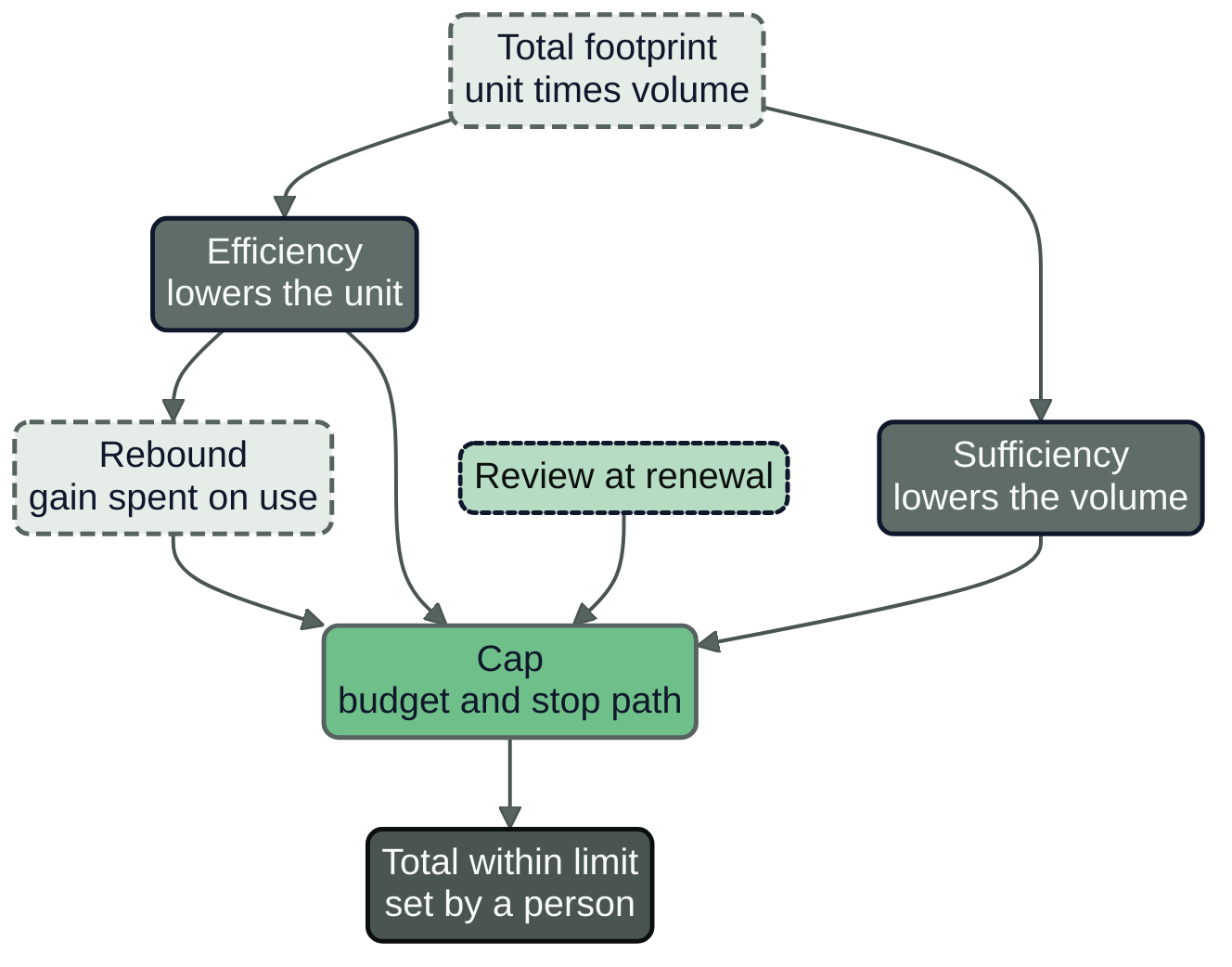
Figure 25.1: Two ways of keeping a total footprint within a limit. Efficiency acts on the unit, sufficiency on the volume, rebound turns some of the gain into more use, and the Cap joins them. No figure is shown; the boundary of any number is stated where it appears.
Real figures are as of November 2026, each with its boundary and year. The figures of Nordvik Region and Hansa Mutual are illustrative, set in the winter of 2032 to 2033, and labelled so.
Two ways of staying within a limit
The footprint of a use is the product of two quantities, the footprint of one unit of its work and the number of units (Chapter 4). A unit is a resolved enquiry, a claim triaged, a request answered or an agent run, whichever the register has chosen. A total can be held down by lowering the first factor, the second, or both.
Efficiency means lowering the footprint of a unit while delivering the same unit: a smaller model that passes the same evaluation, a cache, a quantised model, a cleaner hour, a longer-lived accelerator. Sufficiency means lowering the absolute level of use. The sustainability literature on digital technology defines it as any strategy aimed directly or indirectly at decreasing the absolute level of resource and energy demand, and it contrasts it with efficiency strategies, which it says may not lead to significant savings because any relative reduction of inputs can be outplayed by an absolute increase of output (60, Santarius et al., 2023). This book uses the word in three forms, and the chapter keeps them apart.
- Decline. The use is not started, not extended or not renewed, because its benefit is not shown or is smaller than the alternative.
- Cap. The use continues under a ceiling on volume or on a resource, enforced by someone other than the use and with a stop path outside it (the Cap test of Chapter 4).
- Ration or defer. A shared limit is divided among uses, or work is held until a condition is met (evidence arrives, a grid constraint eases, a budget period begins).
The optimisation hierarchy of Chapter 4 maps onto the distinction, with one wrinkle. Level 1, Necessity, is sufficiency in its plainest form: do not run what is not needed. Levels 3, 4 and 5 (efficient serving, place and time, hardware and lifecycle) are efficiency measures. Level 2, Sufficiency of model, lowers the unit and so is an efficiency measure in effect; it is called sufficiency because it asks what is enough and not what is best. Table 25.1 sets out the measures against the factor they act on.
Table 25.1: Efficiency and sufficiency measures, by the factor of the total that each acts on. The levels are those of Chapter 4.
| Measure | Acts on | Kind | Level of the hierarchy | Chapters |
|---|---|---|---|---|
| Retire or decline a use | Volume | Sufficiency | 1 Necessity | 9, 25 |
| Cap volume or energy of a use | Volume | Sufficiency | Cap test | 4, 15 |
| Defer work until a condition holds | Timing | Sufficiency or efficiency | 4 Place and time | 17 |
| Smallest adequate model | Unit | Efficiency in effect | 2 Sufficiency of model | 12 |
| Cache, batch, quantise, route | Unit | Efficiency | 3 Efficient serving | 13, 14 |
| Cleaner hour or site, longer hardware life | Unit | Efficiency | 4 and 5 | 16, 17 |
A cap joins the two columns. It does not say whether the unit or the volume should move; it fixes the total, so that efficiency gains buy more use up to the cap and no further, and volume cannot raise the total beyond it.
What the evidence can and cannot settle
The debate is not about whether efficiency matters; both sides accept that it does, and that the per-unit gains reported since 2024 are large. It is about whether efficiency is enough, a question about totals, which the evidence measures worst. Chapter 10 recorded that no source read for this book gives, for one provider and one boundary, the volume of AI work and the energy used over several periods. Any answer at the level of the world is therefore, in the labels of AI Governance, Chapter 22, speculation (26, Nordqvist, 2026).
What the evidence can settle is narrower, and Table 25.2 shows the most direct quantified frame available. The International Energy Agency (IEA), an independent intergovernmental body, models four cases for the electricity use of all data centres in the world in 2030, as Chapter 2 set out. Its High Efficiency Case is lower than the Base Case, and still higher than the 2025 figure.
Table 25.2: The IEA's four cases for 2030, electricity use of all data centres worldwide, total facility electricity, modelled and projected (independent). The last two columns are the book's own arithmetic from the IEA's figures.
| Case | TWh in 2030 | Against 2025 (485 TWh) | Against the Base Case |
|---|---|---|---|
| Headwinds | 833 | 1.72 times | 12 per cent lower |
| High Efficiency | 868 | 1.79 times | 8 per cent lower |
| Base | 945 | 1.95 times | not applicable |
| Lift-Off | 1,008 | 2.08 times | 7 per cent higher |
Source for Table 25.2: (38, IEA, 2026), figures as read in Chapter 2; the ratios are the book's arithmetic.
The table can be read in two ways. It can show that faster efficiency lowers the total by only about 8 per cent in the IEA's model, so that efficiency is a minor determinant next to adoption. It can also show that the efficiency case leaves the sector at nearly 1.8 times its 2025 level, so that something other than per-unit efficiency decides the total. Neither reading is a measurement.
The wording of the IEA statements quoted here was taken from the report as read by the author of the chapter; the independent check could not reach the report text (HTTP 403) and could confirm only the 17 per cent growth and the statement on efficiency and an AI-driven boost to output in the IEA analyst's presentation of June 2026, so the other quotations are marked as not independently verified.
How the debate is staged
The rules of Chapter 11 apply. Each position is stated at its strongest, and within each, what a source reports is separated from interpretation: what was measured or modelled, at which boundary, in which year and by whom, before what it is taken to mean. Neither position is a villain. The case for concern is held by energy economists, grid operators, a European agency and researchers who have measured something; the case for calm by engineers who have cut energy per task by large factors, by the same agency the concerned reading quotes, and by people who have measured a benefit and do not want it rationed on a hunch.
The debate
The case for concern
What the sources report. The case for concern starts from the shape of the evidence in Table 25.2 and from the history of efficiency in other sectors. The IEA states both halves of the present position: that "the energy efficiency of AI is improving at a rate unprecedented in energy history", and that "total electricity consumption from AI is set to increase in the near term" (38, IEA, 2026). Data-centre electricity grew by 17 per cent in 2025, to 485 TWh, in the IEA's estimate for the world, in the same period in which per-task energy fell sharply at the providers that report it. The two statements concern different quantities, and the concerned reading holds that the second is the one that reaches a grid.
The general literature gives the mechanism, with a limit that the concerned reader should state. A review of empirical estimates of the direct rebound effect found that, for household energy services in the OECD, it should generally be under 30 per cent (57, Sorrell et al., 2009), and a later review found little support for the hypothesis that efficiency gains raise total energy use outright, while noting that understanding of the macroeconomic rebound is limited (58, Gillingham et al., 2016). Chapter 10 explains why neither finding transfers to AI without a test: they concern household services with a natural ceiling on demand, and the demand for AI work has none. Two sources point the other way. Duranton and Turner (2011) found for the interstate highways of United States cities that vehicle kilometres travelled rose in proportion to the highways provided (59, Duranton & Turner, 2011). Luccioni, Strubell and Crawford (2025) argue that the debate on AI has concentrated on direct impacts without addressing the indirect effects of Jevons' paradox, in a conceptual paper that does not measure a rebound (56, Luccioni et al., 2025). The European Environment Agency (EEA) draws the institutional conclusion: "Efficiency gains alone are therefore unlikely to reduce overall environmental pressures" (42, European Environment Agency, 2026).
The unit is not a fixed thing. The IEA reports that video generation, reasoning and agentic tasks "can consume hundreds or thousands of times more energy per query than simple text generation" (38, IEA, 2026). Google reported that the tokens it processes across its surfaces rose sevenfold in a year to over 3.2 quadrillion a month in May 2026 (47, Pichai, 2026), and it published no total energy for that work. In the organisations of this book, Nordvik Region's citizen-service assistant grew 2.4 times in volume between October 2026 and September 2032 (Chapter 4), and Hansa Mutual's triage agent makes nine model calls per claim (Chapter 15).
Local limits bind whatever the per-unit figure. In Ireland, data centres used 23 per cent of metered national electricity in 2025 (40, Central Statistics Office (Ireland), 2026). In Sweden, the transmission system operator listed 8,200 MW of applied-for data-centre consumption in its connection queue on 1 November 2026 (39, Svenska kraftnät, 2026). Neither is a forecast (Chapter 2 explains why the queue cannot be turned into TWh), but a grid connection is allocated, and the allocation is already a form of rationing operated by the grid and not by the user. Efficiency per unit does not create a connection.
The benefit side is thinner than the claims made for it. Joshi's report for a network of environmental organisations coded 154 claims in eight prominent sources that AI would reduce emissions; 150 concerned traditional AI, four consumer generative AI, and 36 per cent cited no evidence (63, Joshi, 2026). Stern and colleagues estimate avoided emissions of 3.2 to 5.4 Gt a year by 2035 in three sectors and state that they do not consider rebound (61, Stern et al., 2025); Alpine and colleagues model productivity gains in fossil-fuel supply and find net emissions rising by 0.47 to 1.8 Gt a year (62, Alpine et al., 2026). A use scaled on an asserted benefit, the concerned reading says, is paid for by a footprint that has been counted.
The concerned reading also has an institutional vocabulary in France. The agency for ecological transition, ADEME, published a position paper in January 2025, Digital technology and the environment: opportunities and the need for sobriety, whose catalogue entry says that the impact of the sector "is already significant and growing fast" (158, ADEME, 2025). The AFNOR Spec 2314 framework for frugal AI makes necessity its first condition, that it has been demonstrated that an AI system is necessary (79, AFNOR, 2024).
The strongest form of the argument. The case for concern does not say that AI should be stopped or that efficiency is worthless. It says that an efficiency claim without a total and a limit cannot be falsified, that every efficiency programme should be paired with a ceiling that someone other than its owner has set, and that a use whose benefit cannot be shown should not be given room to grow. A cap is the one instrument that does not depend on a forecast of demand.
Interpretation, and where the sources stop. The sources report rising totals, falling unit figures, local queues, thin benefit evidence and institutional frameworks in France. They do not show a measured rebound for AI inference; the mechanism rests on a prior drawn from roads and household energy. They do not show that any sufficiency measure has reduced an organisation's footprint: AFNOR Spec 2314, the French purchasing sheet and the digital design reference are frameworks, and none of the sources read reports an outcome.
The case for calm
What the sources report. The case for calm reads the same agency and finds a different emphasis. The IEA reports that energy use per AI task has dropped "by at least an order of magnitude annually in recent years", and that software improvements have delivered some of the largest reductions, often without new capital investment (38, IEA, 2026). At one provider, the median Gemini Apps text prompt used 0.24 Wh on a whole-stack boundary in May 2025, and energy per prompt had fallen 33-fold over the preceding year, as reported by the vendor (51, Elsworth et al., 2025). An IEA analyst's presentation of June 2026 states that the efficiency of models and hardware is improving faster than any energy technology in history, and that new IEA modelling finds that an AI-driven boost to economic output would not lead to a proportional rise in energy demand, in a chart without tabulated values (38, IEA, 2026).
The totals are bounded. The IEA reports bottlenecks in grid connection, planning and memory supply that reduce the likelihood of its more aggressive near-term cases, and ties the pace of growth to market sentiment and financing (38, IEA, 2026). Data centres reach about 3 per cent of global electricity demand in 2030 in the Base Case and account for slightly under 10 per cent of the growth of demand to 2030, with emissions of about 350 Mt CO2 in 2035, about 2 per cent of electricity-sector emissions, on the IEA's figures (Chapter 11). Table 25.2 supports the calm reading in its own way: the Headwinds Case is 12 per cent below the Base Case, so the spread of outcomes the IEA models is tens of per cent and not multiples.
The calm reading adds an argument about incentives, which is its own interpretation and not a finding. The operators who pay for the electricity have the strongest reason to cut energy per unit, and they have done so; Google's report for 2025 says its electricity growth of 37 per cent was tempered by efficiencies in its AI stack (43, Google, 2026), a vendor statement whose endnotes say that the data were not independently verified. The public policy decided is of the same kind: the Commission has adopted, and not yet published in the Official Journal, a delegated act for a rating scheme that grades data centres A to G on power and water efficiency, with first labels due by 15 August 2027 (15, European Commission, 2026). It is a disclosure and efficiency instrument, and it does not limit use.
Rationing has costs of its own. The benefits shown are real: the European Centre for Medium-Range Weather Forecasts reports that its AI ensemble forecast uses about 1,000 times less energy than the physics-based system, an operator's estimate whose method the release does not give (64, European Centre for Medium-Range Weather Forecasts, 2025), and Joshi's report itself states that its results do not suggest AI will have no climate benefits. Sharing a limit among uses also needs a common unit of benefit, and there is none: an explained benefits decision in a region and a correctly routed claim in an insurer cannot be exchanged (Chapter 9). A volume cap that binds in the month of greatest need takes service from the residents who need it most.
The strongest form of the argument. The case for calm does not say that nothing needs doing. It says that the decision-relevant unit is the use, that a cost that has been counted can be managed with a budget, that the instruments already decided push towards disclosure and efficiency, and that sufficiency imposed without a measured benefit or footprint is as unfounded as growth imposed without them. Its practical conclusion is to measure first and cap where the measurement says it matters.
Interpretation, and where the sources stop. The sources report large past gains in energy per task, bounded near-term totals and efficiency-and-disclosure instruments. They do not show that the past rate of improvement will continue, or that totals will fall; the High Efficiency Case in Table 25.2 rises. The incentive argument is plausible and untested for AI inference, because no total series exists against which to test it.
Where the positions meet
The positions are closer than the argument suggests. Table 25.3 lists six points on which each side, by its own sources, accepts the other's premise, with the evidence and what remains open.
Table 25.3: Common ground, with its evidence and what remains open.
| Point of agreement | Evidence and boundary | Open question |
|---|---|---|
| Per-unit efficiency is real and large | IEA: order of magnitude a year per task; vendor 33-fold per median prompt, whole stack, 2025 (38, IEA, 2026) | Whether the rate holds for agents and reasoning |
| Efficiency does not set the total | IEA High Efficiency Case still 1.79 times 2025 (Table 25.2); EEA statement (42, European Environment Agency, 2026) | What volume and mix will be |
| Totals are unmeasured | No series of total inference energy against volume (Chapter 10) | Who will publish one, at which boundary |
| A benefit must be shown | Joshi finds the claims thinly evidenced; Stern omits rebound; Alpine models a sign reversal (63, Joshi, 2026) | The net sign at the world level |
| Local limits bind | Irish share 23 per cent, 2025; Swedish queue 8,200 MW, 2026 | Which sites, and what the grid allows |
| Necessity comes first | Hierarchy level 1; AFNOR first condition; French purchasing sheet (128, MiNumEco, 2025) | How a buyer tests necessity in a tender |
The last row deserves a paragraph, since the public sources of the sufficiency side are French. The practical sheet for responsible purchasing of AI, co-written in November 2025 by the state's interministerial unit for digital sustainability, the Ecolab of the ecological transition ministry and the state purchasing directorate, asks a buyer whether the use of AI is justified, tells the buyer to question its interest against non-AI solutions, and offers a contract clause under which a supplier does not add complexity to its models without informing users and lets them stay on an earlier version that still meets their needs (128, MiNumEco, 2025).
The French digital eco-design reference, whose second version of 2024 the same unit publishes, opens with a criterion that asks whether the digital service has been assessed favourably for usefulness with its environmental impacts taken into account (159, MiNumEco, 2024); the purchasing sheet counts 79 criteria in that reference, 7 of them for AI.
These are frameworks and guidance; the sheet carries an open licence and says that the AI Act is limited on the environmental impact of AI. None binds a Swedish region or a German insurer, and none has an outcome study behind it.
A commentary on a United States procurement handbook summarises the wider frugal AI movement as "as much as necessary, but as little as possible" (127, Lipstein, 2026), which shows that the idea travels, not that it works.
In a search made for this chapter in November 2026 the author found no Swedish, Danish, Norwegian or Finnish national guidance that sets a necessity or sufficiency criterion for AI on environmental grounds. That is not proof of absence; it says only that a Nordic buyer who wants such a criterion will have to write it.
The second piece of common ground is arithmetic, and it is the book's own. Take the citizen-service assistant of Chapter 10 at its baseline: 146,000 resolved enquiries in September 2032 at 16.34 Wh each, which is 2,385 kWh a month at an operational, facility boundary (illustrative). Suppose the Region sets a cap of 2,385 kWh a month and swaps the model so that the unit halves, and then halves again. Table 25.4 shows the result.
Table 25.4: What a fixed cap does with efficiency gains. Illustrative; operational, facility boundary, as Chapter 10; the grid factor is held constant.
| Energy per enquiry | Volume the cap permits | Total under the cap | Who receives the gain |
|---|---|---|---|
| 16.34 Wh | 146,000 | 2,385 kWh | Nobody yet |
| 8.17 Wh | 292,000 | 2,385 kWh | Residents, as more use |
| 4.09 Wh | 584,000 | 2,385 kWh | Residents, as more use |
| 8.17 Wh, no cap, volume 2.5 times | 365,000 | 2,982 kWh | Residents; the total rises 25 per cent |
In the first three rows, efficiency does not lower the total, and it does not need to: it raises the use that the limit allows. In the last row, no limit stands in its way, and the volume decides. The two positions agree on this table, and they differ on which row is likely. The concerned reading expects the last, and the calm reading expects that a budget set by a person will stop it. A cap is the instrument that turns that disagreement into a choice that someone makes and records.
What can be done
An enterprise or public authority cannot decide the grid or the pace of the build-out. It can decide which uses it starts, extends, caps and renews, and put its reasons on record. The actions below hold under either reading, which makes them safe to take before the argument is settled.
Practitioners (the sustainability lead, the platform engineer, the AI product owner) put a volume limit and an energy or cost budget on every use with a register row, and a stop path outside the use (Chapters 4 and 15). They state in each row what happens if the use stops, shrinks or waits, and use the smallest model that meets the requirement (Chapter 12). A use with no footprint record or benefit record is held at its present volume until it has them.
Procurement officers write the necessity question into the tender and the contract, as the French sheet does: whether AI is justified against non-AI solutions, a duty to inform users before complexity is added to a model, and a right to stay on an earlier version. Chapter 23 reads what Swedish and EU procurement law allows a buyer to ask. In a framework agreement, a term with an option to shrink keeps the sufficiency decision open.
Leaders and boards decide what growth in AI use the organisation will not fund on environmental grounds, state the criterion, and review it at renewal (Chapter 10). They keep the author of a proposal and the reviewer of the decision apart, and publish the decision where public-access rules or a sustainability statement make that the right place.
Everyone who takes part in a consultation can ask for the data that the argument lacks: energy per request by workload at a stated boundary, from providers, and total volume beside it. Both readings need it.
Share the results. A decline record that states the benefit forgone, the signal that would show the decision was wrong and the evidence that would reopen it is useful to other organisations, and it is the only way that evidence for or against sufficiency measures will accumulate.
The author's projections
This section and Chapter 29 are the only places where the author goes beyond the evidence. Each statement below carries one of the three labels of AI Governance, Chapter 22 (26, Nordqvist, 2026) and is the author's own judgement. The basis column says what it rests on, so that a reader who disagrees can see where.
Table 25.5: The author's projections, with labels and bases. All are the author's judgement.
| Projection | Label | Basis | What would change it |
|---|---|---|---|
| Energy per task for simple text uses keeps falling at reporting providers through 2028 | Expected | IEA and vendor trends above | A published series that flattens |
| An organisation that runs agents and reasoning sees its total AI energy rise through 2035 unless it caps it | Expected | New uses cost hundreds or thousands of times more per query (38, IEA, 2026); 2.4 times volume at Nordvik | Own series showing a fall |
| Efficiency alone keeps the world total of AI electricity inside a given limit | Speculation | No total series; Table 25.2 | A measured series of total inference energy |
| Sufficiency is needed at the world level to meet a given limit | Speculation | No total series; mechanism from other sectors | The same series, or a measured rebound |
| Sufficiency enters organisations first as procurement conditions and budgets, not bans | Expected | French frameworks; budgets and tender annexes in this book | A binding instrument by use class |
| By 2035 an EU or Nordic national instrument sets a binding limit on AI use by class of use | Speculation | None found; the rating act limits no use | A proposal in a Commission work programme |
Two further statements of judgement are not forecasts. First, for an organisation the choice is not between efficiency and sufficiency, because the hierarchy puts necessity first and the Cap test comes with every use; an organisation that has not asked whether a use is needed has no business telling its board that the use is efficient. Second, the cost of being wrong about sufficiency at the level of one organisation is small and reversible, since a declined extension can be reopened when evidence arrives, while the cost of being wrong about efficiency can be a total that nobody was watching. That asymmetry, and not a view of the crisis, is the reason the verdict recommends the default it does.
A sufficiency rule in practice
Practical guide: a sufficiency review and a declining rule
Purpose. Decide, for each use in the register, whether to extend, hold, cap, decline or stop it, by a rule written down before the proposal arrives and applied by someone other than the proposer.
Roles. The register owner (at Nordvik Region the CIO, Henrik Dahl) owns the rule. The sustainability lead (Astrid Nyberg) reviews decisions and is never the proposer. The platform lead enforces caps at the gateway.
Steps.
- Write the rule. State the evidence a use must hold before its volume, scope or autonomy level may grow, and the default when a line fails. The rule below is Nordvik Region's, adopted on 2033-02-08 (illustrative).
- Ask three questions of each use. What happens if it stops: who notices, and what is the fallback? If it shrinks: what is the smallest volume or model that meets the requirement? If it waits: how much of the work can be deferred? Write the answers in the register row.
- Apply the rule to a proposal. Each line is a date and a result. A failed line does not decline the use; it holds the use at its present volume until the evidence exists.
- Record the decision. A decline states the benefit forgone, how that loss would be seen, and the evidence that would reopen it. Someone other than the proposer reviews it, and it is published where the organisation's rules require.
- Review. Every 90 days, and on a change of model, supplier or contract.
# register/sufficiency-rule-nr.yaml  (illustrative; Nordvik Region, adopted 2033-02-08)
rule: sufficiency-rule
decision_record: AIDR-1325
owner: henrik.dahl
reviewer: astrid.nyberg              # not the proposer of any extension
applies_to: [volume, scope, autonomy_level, new_use]
extend_only_if:                      # every line must hold on the day of the decision
  footprint_record: {max_age_days: 90, boundary_stated: true}
  benefit_record:   {max_age_days: 180, grade: measured, compared_with_non_ai: true}
  budget:           {set_by_not_the_use: true, stop_drill_max_age_days: 90}
  rebound_series:   {reported_at_last_review: true}
if_a_line_fails: hold                # keep the present volume, cap it, ask for the evidence
decline_when:
  - the benefit record shows no benefit over the non-AI alternative
  - the footprint at the high end of its range exceeds the threshold for the benefit shown
every_decline_records:
  - benefit_forgone                  # what the organisation gives up, in the benefit unit
  - how_forgone_benefit_is_seen      # the signal that would say the decline was wrong
  - reopen_when                      # the evidence that would change the decision
  - published: true                  # Swedish public-access rules apply to the record
review: {every_days: 90, also_on: [model change, supplier change, contract renewal]}
The evidence ages in the rule are the starting values of Chapter 4 (90 days for the footprint of a running use and for a stop drill, 180 days for a benefit record); Chapter 24 sets the governance values. A short script can read the register row, so that the answer does not depend on who is in the room. The function below returns the outcome and the lines that failed; it is the book's sketch, run against the rule above, and it changes nothing by itself.
from datetime import date

def age(d, today):
    return None if d is None else (today - d).days

def evaluate(use, rule, today):
    """Return (outcome, failed_lines) for a proposed extension of a use."""
    ex = rule["extend_only_if"]
    failed = []
    fa = age(use.get("footprint_date"), today)
    if fa is None or fa > ex["footprint_record"]["max_age_days"]:
        failed.append("footprint_record")
    b = use.get("benefit")
    if not b or age(b["date"], today) > ex["benefit_record"]["max_age_days"] \
            or b["grade"] != ex["benefit_record"]["grade"]:
        failed.append("benefit_record")
    da = age(use.get("stop_drill_date"), today)
    if da is None or da > ex["budget"]["stop_drill_max_age_days"]:
        failed.append("stop_drill")
    if b and b.get("benefit_over_alternative") is False:
        return "decline", failed
    return ("extend" if not failed else rule["if_a_line_fails"]), failed
For the eligibility-explanation route of the citizen-service assistant (FPR-NR-0002), which has no footprint record, no benefit record and no stop drill, the function returns hold with all three lines failed. For a use with a footprint record of 20 January 2033, a measured benefit record of 1 December 2032 that beats the alternative and a drill of 10 January 2033, it returns extend. An agent may recommend an outcome (Level 3 Bounded, Chapter 4); the named owner decides.
Worked example (illustrative): a use declined, with the reasons recorded
The Region's regional director, Elisabet Holmgren, receives a proposal from the service desk to extend the eligibility-explanation route from about 22,000 explanations a month, 13 per cent of enquiries, to every benefits decision letter, about 60,000 a month. The route runs on a hosted large-provider model in the EU through the gateway, and the provider discloses neither its site nor its energy per request. The Region holds no footprint record and no benefit record for it. The CIO applies the rule on 2033-02-08. All three lines fail, so the rule returns hold, and the proposal to extend is declined. The decision record follows.
# register/decisions/AIDR-1325.yaml  (illustrative, Nordvik Region)
id: AIDR-1325
title: Decline to extend the eligibility-explanation route; cap it at its present volume
status: accepted
date: 2033-02-08
organisation: Nordvik Region
use: FPR-NR-0002
proposal: extend from about 22000 explanations a month to every benefits decision letter, about 60000 a month
decision: decline
cap: {unit: explanations_per_month, value: 25000, enforced_at: ai-gateway, set_by: henrik.dahl}
stop_path: {route: gateway route to the plain-language page and the phone service, holder: platform on-call, last_drill: null}
basis:
  footprint_record: {status: none, reason: hosted route; provider site and energy per request not disclosed}
  benefit_record: {status: none, intended: fewer follow-up calls per explanation}
  rule_lines_failed: [footprint_record, benefit_record, stop_drill]
benefit_forgone: not quantified; the intended effect (fewer follow-up calls) has never been measured
how_forgone_benefit_is_seen: follow-up calls per 100 benefit decisions, monthly, by the service desk manager
reopen_when: provider discloses energy per request at a stated boundary and a hold-out trial gives a benefit record
owner: henrik.dahl
reviewer: astrid.nyberg
published: true
review: {at: 2033-05-31, also_on: change of provider, model or volume above 25000}
Three features of the record are the point. The cap of 25,000 is in the unit that the gateway can count, because the energy of the route is not known, and it does not count as a cap until the stop path has been drilled, as Chapter 4 requires; last_drill: null says so. The record says that the benefit forgone is not quantified, which is the honest statement, and names the signal that would show the decision wrong. The decline is not a judgement that the explanations are bad: the extension is held until the Region can count what it would cost and compare it with what it would achieve.
Verdict
The verdict answers the question the organisation can answer. It is given by function, and each statement carries one of the three labels of AI Governance, Chapter 22. The author's projections are in Table 25.5.
E2 Justify. It is observable that per-task energy fell sharply at the providers that report it while data-centre electricity rose by 17 per cent in 2025 (38, IEA, 2026), that no source read for this book measures the total energy of AI inference against its volume, and that the benefit evidence for AI is mostly of traditional AI and mostly asserted or modelled (63, Joshi, 2026). It is expected, on the IEA's own statement, that total AI electricity use rises in the near term. Whether efficiency alone keeps any total inside a limit is speculation, and so is the claim that it cannot. For one use, E2 Justify answers by the Compare test: if the benefit is not shown against the alternative and the rebound, the use is not extended.
E5 Account. It is observable that frameworks for necessity exist in France (AFNOR Spec 2314, the purchasing sheet, the eco-design reference, ADEME's position paper) and that no Nordic equivalent was found. It is expected that sufficiency will enter organisations through procurement conditions and budgets. Whether a regulator will bind use by class is speculation.
E3 Design and E4 Operate. It is observable that the levers an organisation controls are its decisions to start, extend, cap and renew a use, the model it picks and the contract term it signs. A cap is a design choice that someone sets and a stop path someone can use outside the system (Chapters 4 and 15), and it is the single instrument both positions can accept.
On the question itself. Efficiency is necessary, and the evidence read here does not show it to be sufficient: in the IEA's own efficiency case the sector's electricity rises by about four fifths, and the totals that would settle the matter are not published. Sufficiency is not shown to be necessary at the level of the world either, because the same series is missing. At the level of one organisation the evidence supports a default: a use that has not passed Count and Compare is held at its present volume under a cap with a stop path, a use whose benefit is shown to be nil against the alternative is declined, and every decision is recorded with what is forgone and what would reopen it. That default costs little if the calm reading is right and prevents a total that nobody watched if the concerned reading is right.
What can be influenced. Almost everything in the default is within an organisation's reach: its rule, its register, its caps, its contracts and its record. The build-out, the grid and the standards that decide what providers disclose are not, and are influenced by what organisations ask for in tenders and say in consultations. What would change this verdict is the evidence of Chapter 11's watch list: marker M3, a rise of total energy by more than 30 per cent in 12 months without a benefit record, and M4, the share of uses with a measured benefit record, on the dates set there.
Across the modes and the organisations
Across the degrees of delegation
Table 25.6 sets the measures against the degree of delegation that the ceilings of Chapter 4 allow to an agent, and says who decides.
Table 25.6: Efficiency and sufficiency measures against the delegation of the agent concerned.
| Measure | Kind | Agent action class | Highest level for the agent | Who decides |
|---|---|---|---|---|
| Route to the smallest adequate model | Efficiency | Schedule | Level 3 Bounded, within the policy | Policy owner |
| Apply a serving change (cache, batch, quantise) | Efficiency | Recommend, then a change by a person | Level 3 to recommend | Platform lead |
| Defer work to a cleaner hour | Efficiency or sufficiency | Schedule | Level 3 Bounded, within the placement policy | Placement policy owner |
| Stop a use at its budget | Sufficiency | Stop | A gateway control, not a delegated act (request at Level 3) | Budget owner |
| Recommend a decline or a cap | Sufficiency | Recommend | Level 3 Bounded | Register owner |
| Raise a cap or extend a use | Sufficiency | None | Level 0 Advisory; never Level 4 | Register owner and reviewer |
| Publish a claim of an efficiency gain | Accounting | Publish | Level 1 Assisted, drafting only; never Level 4 | Named person, after review |
No agent raises its own cap, the Level 4 prohibition of Chapter 4 applied to volume. On Mode 5, the concerned reading says that an agent that can start work can spend resources and so needs a budget before a mandate; the calm reading says that a budget set by someone else and a stop path outside the agent make its cost as manageable as any other use. The two meet at Chapter 15, and the ceiling is the same under both.
Nordvik Region and Hansa Mutual
The two organisations decline different things for the same reason: the evidence for the extension did not exist on the day the proposal arrived. Both sets of figures are illustrative.
Nordvik Region. The Region is a public authority answering to residents and politicians, and its records are requestable under Swedish public-access rules. The decision of 2033-02-08 (AIDR-1325) declines the extension of the eligibility-explanation route and caps the route at 25,000 explanations a month. The regional director publishes the rule and the decision record, so that a resident who asks why the explanation does not appear on every decision letter can read the reason: the provider does not disclose the footprint of the hosted route and no benefit has been measured. It asks the provider for energy per request at a stated boundary and records the answer, or the refusal, in a supplier disclosure record (Chapter 23). The service desk manager reports follow-up calls per 100 benefit decisions each month, and a rise would say that the decision was wrong.
Hansa Mutual. On 2033-02-15 the group AI governance board, chaired by the chief risk officer, Dr. Annette Krämer, hears a proposal from the group CIO, Rainer Lehmann, to double the licences of the agentic work tools for engineering (FPR-HM-0006) from about 700 to about 1,400 engineers. The platform holds seats and tokens for the tools, about 38,000 sessions a month, and no energy per session and no benefit record; the profile of the group records no measured effect of such tools, and AI Developer, Chapter 20 shows why an activity count is not one (36, Nordqvist, 2026). The board declines the doubling (AIDR-1375), holds the licences at 700, and sets the conditions for reopening: energy per session estimated from gateway tags (Chapter 8) and a benefit record from a measured trial with a comparison group, each inside its evidence age. The board's statement that AI work became more efficient remains held, as revision 1 of CLM-HM-0001 has no evidence behind it (revision 2, the narrow test-pool claim of Chapter 22, lapsed on 26 January 2033), and Table 25.4 is the reason the board gives for pairing every efficiency claim with a ceiling.
Summary
Efficiency lowers the footprint of a unit and sufficiency lowers the amount of use, and the total is their product. The case for concern holds that efficiency alone has not kept totals down in other sectors, that the unit is not fixed because agents and reasoning raise it, that local limits bind and that benefits are thinly evidenced, with institutional support from the EEA and from French frameworks that ask for necessity to be demonstrated. The case for calm holds that per-task gains have been very large, that near-term totals are bounded, that the decided instruments push towards disclosure and efficiency, and that rationing without measurement forgoes benefits that have been shown. On the IEA's figures the High Efficiency Case is only about 8 per cent below the Base Case in 2030 and still 1.79 times the 2025 level, and no source read measures the total energy of AI inference against its volume.
The positions meet on six points, and on one instrument. A cap, with a budget and a stop path outside the use, lets efficiency gains buy use up to a limit and no further, and it turns the disagreement into a recorded choice. The author's projections are labelled in Table 25.5. The verdict is operational: efficiency is necessary and not shown to be sufficient, sufficiency is not shown to be necessary for the world, and for an organisation the evidence supports a default of holding a use that has not passed Count and Compare at its present volume under a cap, declining a use whose benefit is nil against the alternative, and recording each decision with what is forgone and what would reopen it.
The chapter concerns E5 Account and E2 Justify. The reader can act on it this week by adopting the rule of the practical guide, applying it to the largest proposed extension of a use, and writing the decision record. Chapter 26 turns to the ways in which organisations fail at the work of Chapters 4 to 25, and the anti-patterns they fall into.
Sources
- Santarius, T., Bieser, J. C. T., Frick, V., Höjer, M., Gossen, M., Hilty, L. M., Kern, E., Pohl, J., Rohde, F. and Lange, S. (2023). Digital sufficiency: conceptual considerations for ICTs on a finite planet. Annals of Telecommunications 78, 277-295 (online 2022), DOI 10.1007/s12243-022-00914-x. Available at: https://pmc.ncbi.nlm.nih.gov/articles/PMC10427517/ (accessed 2026-11-16). Abstract and definitions read; conceptual, not a measurement of AI. (60, Santarius et al., 2023)
- Nordqvist, G. (2026). AI Governance: Governing Artificial Intelligence in European Enterprises and Public Authorities. The Transformed Architecture, Book 2, published at aig.geon.se. Available at: https://aig.geon.se/ (accessed 2026-11-01). Conceived and directed by Nordqvist; text written by AI agents. (26, Nordqvist, 2026)
- International Energy Agency (2026). Key Questions on Energy and AI. World Energy Outlook Special Report, April 2026. Available at: https://www.iea.org/reports/key-questions-on-energy-and-ai (accessed 2026-11; PDF read from the IEA's publication server). Independent; modelled and projected figures. (38, IEA, 2026)
- Sorrell, S., Dimitropoulos, J. and Sommerville, M. (2009). Empirical estimates of the direct rebound effect: A review. Energy Policy 37(4), 1356-1371. Available at: https://doi.org/10.1016/j.enpol.2008.11.026 (accessed 2026-11). Abstract read via RePEc; full text not read. (57, Sorrell et al., 2009)
- Gillingham, K., Rapson, D. and Wagner, G. (2016). The Rebound Effect and Energy Efficiency Policy. Review of Environmental Economics and Policy 10(1), 68-88. Available at: https://doi.org/10.1093/reep/rev017 (accessed 2026-11). Abstract read; full text not read. (58, Gillingham et al., 2016)
- Duranton, G. and Turner, M. A. (2011). The Fundamental Law of Road Congestion: Evidence from US Cities. American Economic Review 101(6), 2616-2652; working paper NBER 15376 (2009). Available at: https://www.nber.org/papers/w15376 (accessed 2026-11). Working-paper abstract read. (59, Duranton & Turner, 2011)
- Luccioni, A. S., Strubell, E. and Crawford, K. (2025). From Efficiency Gains to Rebound Effects: The Problem of Jevons' Paradox in AI's Polarized Environmental Debate. ACM FAccT 2025; arXiv:2501.16548. Available at: https://arxiv.org/abs/2501.16548 (accessed 2026-11). Conceptual; abstract read. (56, Luccioni et al., 2025)
- European Environment Agency (2026). Europe must steer AI and digitalisation to support its green transition. News release, 5 May 2026. Available at: https://www.eea.europa.eu/en/newsroom/news/europe-must-steer-ai-and-digitalisation-to-support-its-green-transition (accessed 2026-11). Press release; the underlying briefings were not read. (42, European Environment Agency, 2026)
- Pichai, S. (2026). I/O 2026: Welcome to the agentic Gemini era. Google, 19 May 2026. Available at: https://blog.google/innovation-and-ai/sundar-pichai-io-2026/ (accessed 2026-11). Vendor statement; token volumes are unaudited. (47, Pichai, 2026)
- Central Statistics Office, Ireland (2026). Data Centres Metered Electricity Consumption 2025. Available at: https://www.cso.ie/en/releasesandpublications/ep/p-dcmec/datacentresmeteredelectricityconsumption2025/keyfindings/ (accessed 2026-11). The release header and the statistician's comment give inconsistent years for the release date (2025 and 2026). (40, Central Statistics Office (Ireland), 2026)
- Svenska kraftnät (2026). Information om pågående anslutningsärenden (statistics as at 1 November 2026, page reviewed 10 November 2026). Available at: https://www.svk.se/aktorsportalen/anslut-till-transmissionsnatet/information-om-pagaende-anslutningsarenden/ (accessed 2026-11). (39, Svenska kraftnät, 2026)
- Joshi, K. (2026). The AI Climate Hoax. Beyond Fossil Fuels with Friends of the Earth US, Stand.earth, Green Screen Coalition, Green Web Foundation and Climate Action Against Disinformation, February 2026. Available at: https://beyondfossilfuels.org/wp-content/uploads/2026/02/AI-for-climate-claims-Report_FEB-2026_FINAL-2-16.pdf (accessed 2026-11-16). Publication of advocacy organisations. (63, Joshi, 2026)
- Stern, N., Romani, M., Pierfederici, R., Braun, M., Barraclough, D., Lingeswaran, S., Weirich-Benet, E. and Niemann, N. (2025). Green and intelligent: the role of AI in the climate transition. npj Climate Action 4, 56, 23 June 2025. Available at: https://doi.org/10.1038/s44168-025-00252-3 (accessed 2026-11-16). (61, Stern et al., 2025)
- Alpine, W., Geldner, N., Alpine, H. and Chepeliev, M. G. (2026). AI-driven productivity gains enable more CO2 emissions than they avoid in a global energy-economy model. npj Climate Action 5, 71, 4 August 2026. Available at: https://doi.org/10.1038/s44168-026-00411-0 (accessed 2026-11-16). (62, Alpine et al., 2026)
- ADEME (2025). Digital technology and the environment: opportunities and the need for sobriety (Numérique et environnement : entre opportunités et nécessaire sobriété), ADEME position paper. Reference 012792 (English), 12 pp., edition of January 2025, authors E. Fangeat and M. Wellhoff. Available at: https://librairie.ademe.fr/consommer-autrement/8047-digital-technology-the-environment-opportunities-and-the-need-for-sobriety.html (accessed 2026-11-16). The catalogue entry and a summary page of Aix-Marseille University (anmt.univ-amu.fr) were read; the full text was not. (158, ADEME, 2025)
- AFNOR (2024). AFNOR Spec 2314: General framework for frugal AI. Available at: https://www.afnor.org/en/news/artificial-intelligence/reference-framework-reduce-environmental-impact-ai/ (accessed 2026-11-16). (79, AFNOR, 2024)
- Elsworth, C., Huang, K., Patterson, D., Schneider, I., Sedivy, R., Goodman, S., Townsend, B., Ranganathan, P., Dean, J., Vahdat, A., Gomes, B. and Manyika, J. (2025). Measuring the environmental impact of delivering AI at Google Scale. arXiv:2508.15734, 21 August 2025. Available at: https://arxiv.org/abs/2508.15734 (accessed 2026-11). Vendor-authored. (51, Elsworth et al., 2025)
- Google (2026). 2026 Environmental Report. Google LLC, 30 June 2026. Available at: https://sustainability.google/files/google-2026-environmental-report.pdf (accessed 2026-11). Vendor-reported; endnotes state that the data and claims have not been independently verified. (43, Google, 2026)
- European Commission (2026). Commission Delegated Regulation supplementing Directive (EU) 2023/1791 as regards the establishment of a common Union rating scheme for data centres. C(2026) 3472 final, 21 September 2026 (adopted by the Commission, not yet published in the Official Journal; the number in the act is a placeholder). Available at: https://eur-lex.europa.eu/legal-content/EN/TXT/?uri=PI_COM%3AC%282026%293472 (accessed 2026-11-16). (15, European Commission, 2026)
- European Centre for Medium-Range Weather Forecasts (2025). ECMWF's ensemble AI forecasts become operational. News release, 1 July 2025. Available at: https://www.ecmwf.int/en/about/media-centre/news/2025/ecmwfs-ensemble-ai-forecasts-become-operational (accessed 2026-11-16). (64, European Centre for Medium-Range Weather Forecasts, 2025)
- MiNumEco (DINUM et ministère de la transition écologique), Ecolab du Commissariat général au développement durable and Direction des Achats de l'État (2025). Fiche pratique pour l'Achat Responsable de solutions d'Intelligence Artificielle (IA). Version of November 2025, open licence Etalab 2.1. Available at: https://ecoresponsable.numerique.gouv.fr/docs/2025/MINUMECO_fiche_IA_frugale_VF.pdf (accessed 2026-11-16). (128, MiNumEco, 2025)
- MiNumEco, Mission interministérielle numérique écoresponsable (2024). Référentiel général d'écoconception de services numériques (RGESN), version 2. Last updated 28 May 2024. Available at: https://ecoresponsable.numerique.gouv.fr/publications/referentiel-general-ecoconception/ (accessed 2026-11-16). Criterion 1.1 read; the Algorithmie category was not read; the count of 79 criteria with 7 for AI is taken from the French purchasing sheet. (159, MiNumEco, 2024)
- Lipstein, H. (2026). Governments can advance greener AI through the power of procurement. Tech Policy Press, 7 July 2026. Available at: https://techpolicy.press/governments-can-advance-greener-ai-through-the-power-of-procurement (accessed 2026-11-16). Commentary on a handbook, "Greening AI in the public sector", by Data & Society and the GovAI Coalition; the handbook itself was not read. (127, Lipstein, 2026)
- Nordqvist, G. (2026). AI Developer: How the Developer Role Changes When AI Is Used Broadly in European Enterprises and Public Authorities. The Transformed Architecture, Book 12, published at developer.geon.se. Available at: https://developer.geon.se/ (accessed 2026-11-14). Conceived and directed by Nordqvist; text written by AI agents. (36, Nordqvist, 2026)