Operating Sustainably: GreenOps, Observability and Stop Paths
Chapter 19 asked where an AI use should run; this chapter asks how it is run once it is there. An environmental budget that nobody enforces is a wish, and a footprint dashboard that nobody owns is decoration. This chapter is about the work that turns the records of the earlier chapters into something that runs every week: counting what an AI use consumes, comparing the count with a budget set by someone other than the system, acting when the budget is reached, and reviewing the result when the contract, the model or the volume changes. Practitioners call the discipline GreenOps, the operating counterpart of FinOps, and the chapter concerns E4 Operate. It equips the Cap test of the net-benefit principle and keeps the Count test alive after approval, at every level of the optimisation hierarchy, because a saving lasts only while someone reads the meter. It does not repeat the cost and capacity practice of AI Operations, Chapters 11 and 15, or of AI Platform and Security, Chapter 22; it adds energy, carbon and water as a second budget beside money, and a stop path outside the thing it stops.
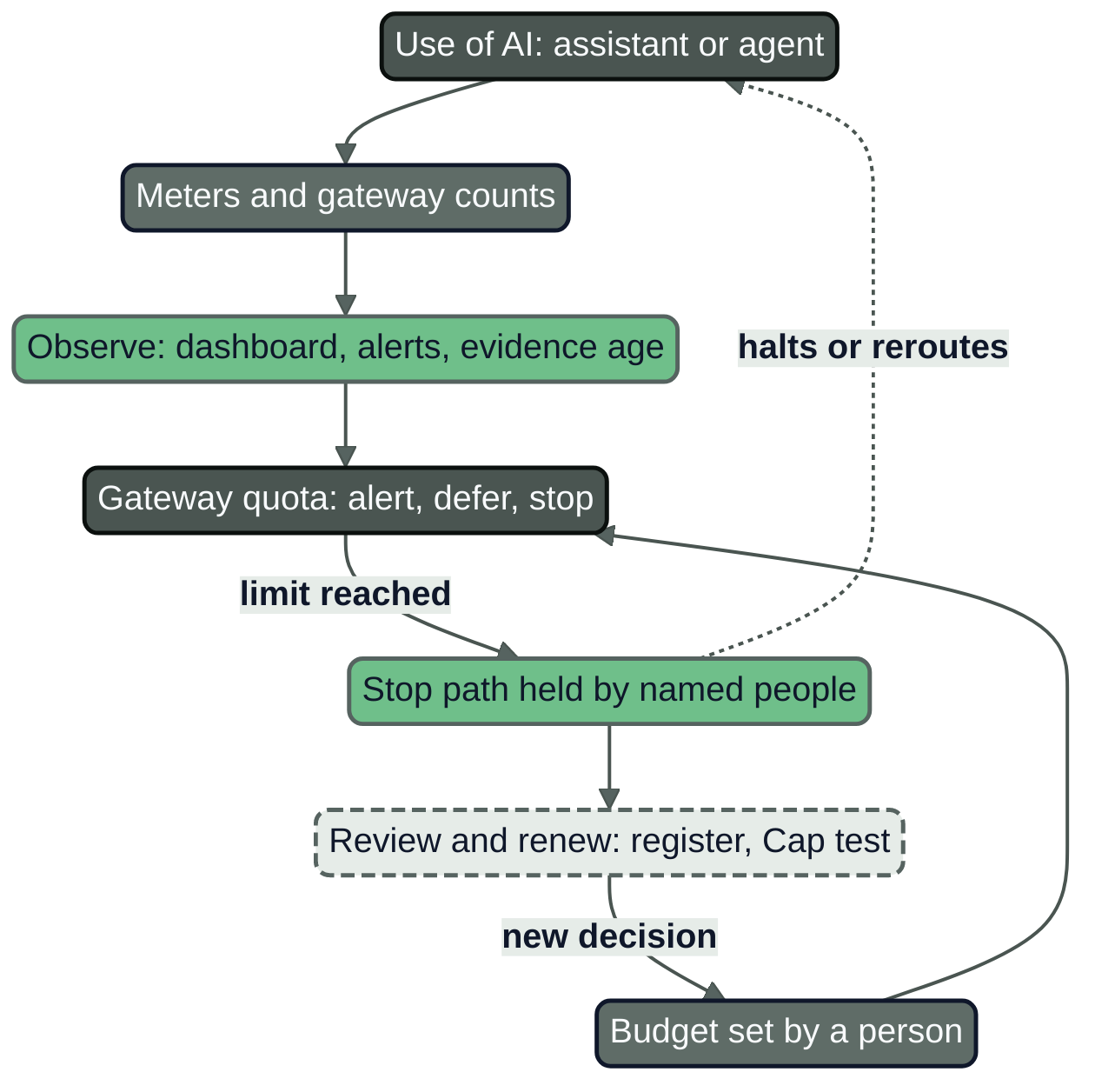
Figure 20.1: The environmental operating loop. The meter, the budget, the gateway quota and the stop path all sit outside the use they govern. The review closes the loop with a new decision, not with an automatic adjustment.
A dashboard nobody opened
The scene is constructed from the profile of Nordvik Region, not reported from practice, and its figures are illustrative. In autumn 2032 the platform team's weekly showback page for the citizen-service assistant has a new panel. It shows 1.90 g CO2e per resolved enquiry against the target of 2.0 that control FIN-COST-01 records, and it is green. The number is a constant: the result of the Software Carbon Intensity calculation of October 2026 for 71,000 resolved enquiries a month (27, Nordqvist, 2026). The service now handles about 168,000 a month, the page shows no date, the panel has no owner, and nobody is alerted when it changes, because it cannot change.
Nothing on the page is a lie; every number was right once, at a boundary and a year that the page does not show. What it lacks is a source that updates, an owner, a limit to compare with, and a person who can act when the limit is reached. Chapter 4 calls the missing pieces a budget and a stop path, and Chapter 8 showed that the 1.90 g was 2,161 days old at the end of the baseline month.
The operating loop
The loop has five verbs, each tied to a function of the book. The use is measured (E1 Measure): meters and gateway counts feed a footprint record at a stated boundary. A person sets a budget (E3 Design): a limit on energy, carbon, water, cost or compute for a period, with a stop path. The operating team observes the use against the budget, the first act of E4 Operate. The gateway enforces the budget, and a named holder can stop the use. The organisation reviews at a fixed cadence and at every renewal, feeding E5 Account, where claims and the register are kept.
Two properties make this a loop and not a report. First, every part that can end the use sits outside the use: an assistant or agent that can read its own meter, raise its own quota or remove its own stop route has turned a control into a suggestion, which is the observer principle of AI Operations, Chapter 17: what verifies an action must be independent of what performed it (34, Nordqvist, 2026). Second, every part has an age. A meter that has failed silently, a conversion factor that has expired and a stop path not drilled for a year are the three ways a loop stops looking at the world while staying green. The register of Chapter 4 records these ages; this chapter makes it the instrument the operating team reads.
Table 20.1 lists the roles of the loop with the two organisations' holders; in a small organisation one person holds several.
Table 20.1: Roles in the operating loop and their holders. Illustrative.
| Role in the loop | Does what | Nordvik Region | Hansa Mutual |
|---|---|---|---|
| Register owner | Reads the register monthly; owns the decision to change a budget | Henrik Dahl | Anja Weiß (platform rows) |
| Platform lead or on-call | Runs the gateway, the quota and the stop path | Maja Lindqvist and on-call | Platform on-call |
| Metering and scripts | Reads provider and rack meters; checks the count | Joakim Wester | Katja Neumann (Frankfurt racks) |
| FinOps or GreenOps practitioner | Showback, tags, cost beside carbon | Platform team (no separate role) | Jan Berger |
| Sustainability lead | Reviews the count and the claim | Astrid Nyberg | Dr. Verena Lindner |
The cadence keeps every age in the register inside its limit: a weekly reading of the showback page, a monthly register review, a quarterly drill and re-estimate, and an annual renewal review with the Cap test.
Observability
Observability means that the people who operate a use can tell, from signals the use does not control, what it is consuming and whether that is acceptable. Four classes of signal are needed.
Volume is the count of units of work (resolved enquiries, claims triaged, agent runs). It comes from the gateway, which sees every request, and is available whoever hosts the model. Consumption is energy and, where it can be had, water: best from a meter on hardware the organisation operates or a supplier who meters, weakest from a factor multiplied by volume. Outcome is the count of units that achieved their purpose, the denominator that stops a budget being met by doing less. Evidence age is the age of every figure above and of the stop drill, shown as a number.
Tags
Tags attach a call, a run, a node or an invoice line to a use. A footprint per use is impossible without them, and AI Platform and Security, Chapter 22 already requires them for cost (27, Nordqvist, 2026). They carry four fields: the use identifier (the footprint record, for example FPR-NR-0001); the route, since Chapter 4 treats an open-weight and a hosted route as two uses; the run identifier, issued by the gateway, which ties the many calls of an agent run to one unit of work; and the class, which marks a request as deferrable or not. The gateway and the deployment pipeline apply tags, not the assistant, and an untagged call is counted in a visible residual line, never discarded.
What the sources can and cannot say
Chapter 8 set out what an organisation can meter; the operating consequence is a ladder of sources, each with a limit. On hardware the organisation operates, the accelerator's own counters are the base. NVIDIA's management library documents a total-energy counter in millijoules since the driver was last loaded and a power reading in milliwatts that, on recent architectures, is averaged over one second (87, NVIDIA, 2026). The Kepler project of the Cloud Native Computing Foundation attributes active node power to workloads in proportion to CPU time, and labels its NVIDIA GPU monitoring experimental (86, Kepler maintainers, n.d.). An experimental attribution is an input to a dashboard and a cross-check against the rack meter, not an invoice and not a stop trigger.
On a public cloud, the customer carbon tools report by account, region and service, and Chapter 8 found that none of those read attributes energy to one AI use (83, AWS, 2025) (84, Google Cloud, n.d.). The monthly carbon report is a reconciliation item at account level, with a lag; the use-level signal comes from instance-hours and gateway counts.
On a hosted model the operator sees tokens, requests and cost, and nothing else. The General-Purpose AI Model Documentation Form asks providers for training energy and a benchmarked inference computation, not inference energy, and marks the energy rows for the AI Office and national authorities (74, European Commission, 2025). A hosted route is governed by what the gateway can count and what the contract obliges the supplier to report (Chapter 23).
Metered and modelled consumption
The budget is written in energy, but the gateway can enforce only what it counts. The bridge is a conversion factor from a countable unit to energy: watt-hours per resolved enquiry for a route, accelerator-seconds per claim for an agent. It comes from the footprint record and carries its boundary, method and age. Enforcement through a factor is enforcement on a proxy, which drifts when the model, context length, retry rate or hardware changes. The team therefore sets the quota in gateway units at approval, from the approved factor, and does not recompute it silently: a changed factor is a reason to review the budget, a decision for the person who set it. It also compares modelled consumption with the meter each month and records the gap.
For agents, whose runs make many calls, retry some and may fail, the unit matters more. The Software Carbon Intensity specification for AI suggests one workflow execution as an indicative consumer functional unit for agentic AI, whose work falls in its operation and monitoring stage (75, Green Software Foundation, 2026). A 2026 preprint proposes energy per successful goal, with the energy of failed attempts counted against the goals that succeeded; the account here rests on its abstract page (111, Panigrahy et al., 2026). Report energy per completed task, not per call.
Evidence age as a metric
The register check of Chapter 4 can be exported as metrics for each use: days since the footprint was measured, since the conversion factor was checked and since the last stop drill, and days to the next supplier disclosure and to the end of the contract. An expired footprint is shown as expired, not as the last value, and an alert fires when any age passes its limit (90 days for a running use and a stop drill, 12 months for a supplier disclosure).
Alerts
An alert is a message to a named person that asks for a decision, and the environmental alerts are few. The share of quota alerts at the first step of the ladder. The projected share, the share used divided by the share of the period elapsed, gives early warning: 40 per cent of the quota at 27 per cent of the month is on course to use all of it by about day 21. The rebound alert fires when volume exceeds the baseline by the share the budget names (20 per cent for EBG-NR-0001), the outcome alert when the resolution rate falls below a floor, and the age alerts when evidence expires.
A meter of how much AI an individual employee uses is monitoring of staff. The dashboards report by use and by team, and a per-person view needs the negotiation Chapter 4 names (MBL-NR-IT-2027-01 at Nordvik Region, section 87(1) no. 6 of the Works Constitution Act at Hansa Mutual). No decision about a named person's access to work rests on environmental telemetry.
FinOps and GreenOps
GreenOps reuses the allocation, tags, showback and review rhythm that FinOps built, and adds a second unit. The FinOps Foundation's framework carries a sustainability capability. Its page advises using whatever data is available even when incomplete, suggests treating AI as a distinct category within sustainability accounting, and describes three stages: at Crawl, impact is assessed after deployment through periodic reporting; at Walk, metrics begin to enter allocation and chargeback; at Run, sustainability is a standard consideration in migration, build and optimisation (88, FinOps Foundation, n.d.). The page is undated and is the framework's text, not a measurement of practice.
The two budgets share drivers and differ in what they respond to. AI Platform and Security, Chapter 22 found that cost and carbon per unit of work have common drivers, demand and supply (27, Nordqvist, 2026). The link holds for volume, context length, retries and utilisation. It breaks where price is set by something other than energy: a discount, a committed-spend agreement or a cheaper region on a more carbon-intensive grid changes the invoice without changing the watt-hours. The book's conclusion is that a saving is reported on both ledgers: a cost saving without an energy figure at a stated boundary is not an environmental saving, and the reverse holds. The guardrail of AI Operations, Chapter 11 carries over from cost to energy: floors, windows and a veto held outside the agent's platform, because an agent told to cut consumption will find the standby replica idle (34, Nordqvist, 2026).
Showback shows each unit what its uses consume, in money and energy, without moving money; chargeback moves money. For the environment showback is almost always the right start, because an internal carbon charge needs a price and boundary few organisations have. Hansa Mutual shows spend and energy by entity (illustrative); Nordvik Region shows cost and tokens per use case weekly and adds energy and age.
Budgets and quotas
Chapter 4 defined an environmental budget as a limit set by a person who is not the agent, measured outside the system, enforced and not requested, with a stop path. Chapter 15 designs it for agents; this section is about where it is enforced. AI Operations, Chapter 15 gave four layers for a spending limit on an agent (per call, per run, per agent per period, per service and organisation), enforced at the gateway on a credential the agent cannot widen (34, Nordqvist, 2026). The environmental budget uses the same layers with a second unit. Table 20.2 gives the enforcement points.
Table 20.2: Where an environmental budget can be enforced.
| Enforcement point | What it can limit | What it cannot see | Typical action |
|---|---|---|---|
| AI gateway | Requests, tokens, steps, run length, route | Energy of a hosted model | Alert, defer, switch route |
| Agent platform | Calls per run, runs per period, tools | Hardware power | Stop a run, revoke a credential |
| Cloud account or project | Instance-hours, accelerator counts, regions | Energy per use | Quota, scheduled shutdown |
| Own accelerator pool | Power cap, clock limits, job queue | Demand upstream | Cap power, queue work |
Limits are soft or hard. A soft limit alerts a person and changes nothing in the service; a hard limit defers, degrades or stops. The ladder of EBG-NR-0001 has both: the alert at 80 per cent is soft, the deferral at 100 and the stop at 110 are hard. A stop that harms the function it protects must have a rung to go to (34, Nordqvist, 2026). For a citizen-facing service that rung is the published FAQ page and the phone service, and the budget records that the path is staffed and for which hours. A limit with no staffed fallback is a decision to withdraw the service and should be made as one.
Every limit is paired with a measure of output: an energy limit that the assistant meets by answering fewer enquiries has reduced work, not footprint. The script below therefore reads the resolution rate beside the quota share, following the pairing of cost limits with cost per successful outcome in AI Operations, Chapter 15.
On hardware the organisation controls, a power cap on the accelerator trades speed for energy. The evidence is narrower than the idea. A 2024 preprint analysed GPU power capping on a shared research supercomputer and reported that an appropriate cap lowered temperature and power draw with little effect on job performance, while stating that the effect on overall energy was less clear, because slower jobs might be resubmitted (92, Zhao et al., 2024). The setting was a research supercomputing centre, not production inference. Test a cap on the organisation's own workload, with the service level objective measured outside the pool, and record energy per completed unit before and after, not power alone.
The budget in the gateway, and a script that evaluates it
The record below is the budget of the citizen-service assistant as the platform team's enforcement reads it. It completes the first version of EBG-NR-0001 printed in Chapter 4 (dated 20 September 2032, status proposed, ladder as text, no drill) as a second version, with the derived quota, the conversion factor and its age, and the stop drill. Every figure is illustrative.
# budget/EBG-NR-0001.yaml (illustrative; derived from the record of Chapter 4)
id: EBG-NR-0001
use: FPR-NR-0001
unit: resolved enquiry
budget: {energy_kwh_per_month: 4450}
quota:                           # derived once at approval, not recomputed silently
  units_per_month: 160650        # 4,450 kWh / 27.7 Wh per unit
  derived_with_wh_per_unit: 27.7
conversion:                      # latest estimate, re-checked each quarter
  wh_per_unit: 25.2
  measured: 2032-12-14
  valid_days: 90
baseline_units_per_month: 146000
on_breach: {alert: 0.80, defer: 1.00, stop: 1.10}
stop: {last_drill: 2032-12-07, drill_valid_days: 90}
rebound_alert_share: 0.20
resolution_floor: 0.80
The script reads that record and the gateway's counts and reports the state of the ladder with the flags that matter for operation.
# enforce_ebg.py: evaluate an environmental budget from gateway counts (illustrative)
import calendar
from datetime import date
import yaml

def evaluate(budget: dict, usage: dict, today: date) -> dict:
    quota, conv, stop = budget["quota"], budget["conversion"], budget["stop"]
    elapsed = today.day / calendar.monthrange(today.year, today.month)[1]
    share = usage["units"] / quota["units_per_month"]
    state = "ok"
    for name in ("alert", "defer", "stop"):                  # ascending thresholds
        if share >= budget["on_breach"][name]:
            state = name
    kwh_now = quota["units_per_month"] * conv["wh_per_unit"] / 1000
    return {
        "state": state,
        "share_of_quota": round(share, 3),
        "projected_share": round(share / elapsed, 3),
        "counts_as_cap": (today - stop["last_drill"]).days <= stop["drill_valid_days"],
        "conversion_expired": (today - conv["measured"]).days > conv["valid_days"],
        "quota_drift": round(kwh_now / budget["budget"]["energy_kwh_per_month"] - 1, 3),
        "rebound": usage["units"] / elapsed / budget["baseline_units_per_month"] - 1
                   > budget["rebound_alert_share"],
        "outcome_ok": usage["resolved"] / usage["sessions"] >= budget["resolution_floor"],
    }

if __name__ == "__main__":
    budget = yaml.safe_load(open("budget.yaml"))
    for day, units in ((17, 129400), (22, 167400), (24, 177800)):
        usage = {"units": units, "resolved": 0.86 * units, "sessions": units}
        print(day, evaluate(budget, usage, date(2033, 1, day)))
Run on the counts of the worked example below, it prints alert on 17 January 2033 with a projected share of 1.47, defer on 22 January and stop on 24 January, and reports a quota drift of minus 9.0 per cent each time. At the approved 27.7 Wh the quota matches the energy budget; at the latest estimate of 25.2 Wh the same quota is 4,048 kWh, 9 per cent below it, so the quota is stricter than the budget by a margin nobody decided. The script reports the gap and leaves the quota alone, because moving a stop point is the budget-setter's decision.
Stop paths
Chapter 4 set out the properties of a stop path, and AI Operations, Chapter 17 and AI Purple, Chapter 6 gave them their form: it runs outside the system it stops, is held by named people who need no approval, is timed and drilled, and restart is a separate decision at a lower level of delegation (34, Nordqvist, 2026) (33, Nordqvist, 2026). For an environmental budget the properties take concrete forms.
There are two stops. The automatic stop is the gateway's own ladder: at the hard limit the route is switched without a person. It is fast, but it is software and can fail or be bypassed. The manual stop is the path named people use when the automatic one has not acted, has acted wrongly or is unavailable; it switches the route at the gateway or revokes the credential at the identity service, by a mechanism that does not run on the assistant's platform. The drill exercises both.
Who may stop. The holders are named in the budget record and need no approval: at Nordvik Region Henrik Dahl and the platform on-call, at Hansa Mutual Anja Weiß and the platform on-call, with Jan Berger for the spend side. A stop in good faith is never a failure of the person.
What stops. The stop acts on a route, a credential or a quota, not on the whole service. A hosted route can be stopped while the open-weight route continues, and a deferral stops only the deferrable class.
Drilled and aged. A stop that has not been drilled is not counted, and a drill is valid for 90 days in this book's convention. A first drill usually finds something: AI Operations, Chapter 15 reports 17 minutes against a target of 5 for Hansa Mutual's operations agent (34, Nordqvist, 2026), and the drills of this chapter's example found a permission and a configuration in the wrong place. The register shows counts_as_cap as false until a valid drill is on file, and the budget is then an alert, not a cap, whatever the gateway does.
Restart. A person lifts a stop, after the cause is recorded, at the next period or on a new decision. The assistant, an optimiser or a scheduler never restarts a route that a budget stopped.
The prohibitions of Chapter 4 bear directly here. Level 4 is never used for an agent that provisions or scales its own compute or starts work beyond a budget set by someone else; for an action that disables the measurement, the budget or the stop path; for publishing an environmental claim; or for a decision about a named person's access to work. An agent that can raise its own quota has no budget, and one that can edit the gateway route table has no stop path.
Breach and incident
A budget breach is an incident, handled like one: it needs the on-call, record, communication path and review that the organisation already has. The first question is why. Table 20.3 lists the usual causes, how each shows in the signals above, and the first response.
Table 20.3: Causes of a budget breach and the first response.
| Cause | How it shows | First response |
|---|---|---|
| Volume growth | Units rise, energy per unit steady | Check the demand source; decide on allowance |
| Energy per unit rose | Meter and factor diverge; units steady | Check model, version, context, retries, hardware |
| Meter or factor fault | Modelled and metered values disagree | Fix the meter; do not move the quota |
| Loop or retry storm | Calls per run climb; outcome rate falls | Stop the run class; inspect the agent |
| Rebound or a new use | Volume above baseline after a change | Record; run the Compare test again |
Rebound is the cause the net-benefit principle of Chapter 4 anticipates, and Chapter 10 treats the evidence. The breach alert is where rebound becomes visible in the organisation's own data: volume 20 per cent above baseline prompts the question whether the use is being used for what justified it.
Practical guide: a budget breach runbook in one page
Purpose. To detect, stop, assess, restart and review a breach of an environmental budget without improvising, and to leave a record.
Roles. The platform on-call (detects and stops), the service owner, the register owner (decides on restart and on any change to the budget), the sustainability lead (reviews cause and count), the staff of the non-AI path, and the employee representatives' contact where staff are touched.
Inputs. The budget record, the gateway counts, the meter readings, the footprint record with its dates, the stop path and the date of its last drill, and the register row.
Steps.
- Detect. The gateway alert opens an incident record; the on-call notes the quota share, the projected share and the time.
- Stop or confirm. Confirm the automatic stop and that the fallback carries the load; otherwise use the manual stop path. Note the time taken: it is the next drill figure.
- Assess. Classify the cause with the table. Check the meter against the gateway count and whether the outcome rate held.
- Decide. The register owner holds the budget, grants a temporary allowance or changes the budget, and records the decision with boundary, period and evidence. The assistant never changes it.
- Restart. A person lifts the stop at the next period or on the new decision, and records the reason.
- Review. Hold a post-incident review within five working days; update the register row, the factor if it moved, the ladder if it was wrong, and the drill record.
Artefact. The runbook manifest below, an incident record, a decision record and the updated register row.
The manifest follows the runbook manifests of AI Operations, Chapter 10, and is illustrative.
# runbook/RBK-NR-ENV-001.yaml (illustrative)
runbook: RBK-NR-ENV-001
title: Environmental budget breach on the citizen-service assistant
version: 1
service: SVC-NR-005
budget: EBG-NR-0001
owner_unit: Platform team, Nordvik Region
accountable: Maja Lindqvist      # platform lead; register owner is Henrik Dahl
decision_record: AIDR-1320
trigger:
  - {signal: quota_share, at: 0.80, action: alert}
  - {signal: quota_share, at: 1.00, action: defer}
  - {signal: quota_share, at: 1.10, action: stop}
  - {signal: projected_share, at: 1.25, action: alert, note: early warning from day 7}
delegation:
  profile: DLG-NR-ENV-0001
  automatic_actions: [alert, defer, stop]     # enforced by the AI gateway, not by the assistant
  assistant_may: []                           # the assistant cannot change the quota, meter or route
steps:
  detect: "Gateway raises the alert; on-call opens an incident record INC-NR-*"
  stop: "Confirm the gateway has switched the route; if not, switch it by hand (stop path STOP-NR-ENV-01)"
  assess: "Cause: volume, energy per unit, meter fault, retry or loop, or rebound; check the non-AI path is staffed"
  restart: "Only by Henrik Dahl or the platform lead, after the cause is recorded; at the next period or on a new decision"
  review: "Post-incident review PIR-* within 5 working days; update register row and budget"
fallback: {path: published FAQ page and phone service, staffed: "07:00-17:00 working days"}
verification:
  meter: provider metering read by Joakim Wester's scripts   # outside the assistant
  volume: AI gateway counts
stop:
  held_by: [Henrik Dahl, platform on-call]
  path: STOP-NR-ENV-01
  independent_of_assistant: true
  drill: {last: 2032-12-07, result_minutes: 6.3, target_minutes: 10, valid_days: 90}
review: {due: 2033-03-07, approved_by: Henrik Dahl}
Worked example: a quota breach and the stop exercised (illustrative)
The example continues EBG-NR-0001 from Chapter 4, where the budget was proposed in September 2032 because no stop drill existed. All figures are illustrative.
On 16 November 2032 the platform team drilled the stop for the first time, with a target of 10 minutes from instruction to route switched. It took 14, because the on-call role could read the gateway route table but not change it. The permission was corrected, and on 7 December 2032 a second drill took 6 minutes 20 seconds; the result went into the register and EBG-NR-0001 became active, with the drill valid to 7 March 2033. In mid-December Joakim Wester re-estimated the conversion factor from provider metering and gateway counts at 25.2 Wh per resolved enquiry, at the budget's boundary (GPU servers and host before facility overhead); the quota was not changed. The figure is the IT-boundary energy of revision 2 of FPR-NR-0001 in Chapter 8 (8,986 kWh, 0.41 of it for the route, over 146,000 enquiries), higher than the 16.3 Wh of revision 1 in Chapter 6 at the facility boundary; the register keeps revision 1 until the check of revision 2 is closed.
In January 2033 the region's municipalities sent a notice about changed benefit levels to about 38,000 households, with a link to the assistant. By 17 January the gateway counted 129,400 resolved enquiries, 80.5 per cent of the quota of 160,650, with a projected share of 1.47, and the alert went to Henrik Dahl and Sara Ekdahl, service owner of SVC-NR-005. On 22 January the count reached 167,400 and the gateway began routing requests answerable from the published FAQ page to that page, which slowed the rate from about 7,600 to about 5,200 a day. On 24 January, at 177,800, the count passed 110 per cent and the gateway switched the route to the FAQ page and the phone service within a minute; the on-call confirmed it and recorded the time. Resolution stayed at 86 per cent throughout, so the limit had not been met by failing.
The incident record INC-NR-2033-0007 classed the cause as volume growth: energy per unit was steady within the 9 per cent drift and the meter and the count agreed. The review of 27 January found three things. A single monthly quota let one notice use most of the allowance in three weeks and left the last week unserved, and it proposed four weekly sub-quotas. The service desk reported more calls on 25 to 31 January, but nobody could say how many more than baseline, because the benefit record BEN-NR-0001 of 8 November 2032 (Chapter 9) rested on a two-week hold-out in October and no hold-out ran in January; a refreshed record is the missing evidence. And the decision for February could not rest on the aged figures alone.
The register owner recorded AIDR-1320 on 27 January 2033: no change to the January budget; a temporary allowance of 10 per cent for February, 4,895 kWh, conditional on a refreshed benefit record, with a hold-out in a normal week, by 31 March 2033 (the record of November expires on 7 May 2033 in any case) and on re-deriving the quota with the 25.2 Wh factor at the same time; weekly sub-quotas from February. Elisabet Holmgren approved. The cap forced the Compare question that nobody had asked, and an allowance without a refreshed benefit record would have set an unproven benefit against a measured cost, which Chapter 4 does not allow.
Reviews at renewal
The review at renewal is the second half of the Cap test: the budget is re-justified when the thing it governs changes. Four events trigger a review of a register row: the budget period ends; a contract, model or hardware pool is renewed or replaced; volume moves by more than the rebound alert's share; any age in the row passes its limit.
At each review the register owner asks four things and records the answers. Is the budget still the right size, and does it rest on a figure inside its validity? Is the stop drilled within 90 days, and does its fallback still work? Is there a benefit record inside 180 days that supports this scale, with a baseline? Does the supplier's disclosure cover what the contract promised, within its reporting year? A row that fails stays in the register with the failure shown; it is not renewed on last year's answers.
Nordvik Region's hosting contract NR-2026-031 is due for re-tender, and its review carries environmental disclosure into the tender annex TA-NR-ENV-01 (Chapter 23). Hansa Mutual's hosted-model contracts renew on their own cycles, and HM-PROC-ENV-* clauses attach to each. The register row is the procurement officer's brief: what was counted, what could not be, and what is needed from the supplier.
An organisation that already runs an environmental management system need not build a second loop. The routines of this chapter are what such a system calls operational control and monitoring: the gateway budget and the stop path are the control, the weekly age read and the monthly register review are the monitoring, and a breach, a failed drill or an expired figure is a nonconformity to be corrected and traced to its cause. Chapter 24 maps the clauses of ISO 14001 to the records used here (Table 24.10) and says what changes in such a system when AI is used broadly.
GreenOps for small teams
A small public authority has a platform team of a few people, a supplier-run service or hosted model, a gateway if it is lucky, and no environmental data scientist. The public sources are modest. Region Stockholm's guidance on AI and sustainability, undated in the text read, asks units to consider setting minimum energy use as the default for language models, asks suppliers to report emissions in scopes 1 and 2 under the Greenhouse Gas Protocol and to update the unit on where and when computation runs, and suggests setting aside one to two hours for its assessment (90, Region Stockholm, n.d.). The Danish Agency for Digital Government's model of April 2025 calculates the annual footprint of a user-facing IT solution from infrastructure energy, device and transmission energy, and development and operations, and notes that training may be relevant for AI solutions (91, Digitaliseringsstyrelsen, 2025). Neither measures an AI use; both show that a public body can start with an hour of structured judgement.
The author's recommendation for a loop that fits a small team follows the FinOps Foundation's stages (88, FinOps Foundation, n.d.).
Crawl. Tag every call with a use identifier at the gateway or, without one, at the supplier's project or key. Read volume and cost weekly. Write the register row for each use with the date of the last footprint and the owner. Write one budget, for the use that matters most, in gateway units, even if the energy conversion is an estimate with a wide range. Name who can stop it and write down how.
Walk. Drill the stop once and record the time and what it found. Put the quota in the gateway with an alert at 80 per cent and a hard limit at 110. Compare modelled consumption with any meter or supplier figure each quarter. Show evidence ages. Write the supplier request into the next contract or renewal.
Run. Add per-run limits for any agent, weekly sub-quotas for bursty services, and the renewal review with the Cap test for every use in the register.
Table 20.4 puts hours against the cadence for one use. They are the author's estimates for a small team that already runs a gateway and a showback page, and they scale less than linearly with the number of uses.
Table 20.4: Estimated hours for one use in a small team. Author's estimate, illustrative.
| Cadence | Task | Estimated time | Who |
|---|---|---|---|
| Weekly | Read showback: volume, quota share, alerts, ages | 30 minutes | Platform on-call |
| Monthly | Register review; compare modelled and metered values | 2 hours | Register owner, metering |
| Quarterly | Stop drill and re-estimate of the factor | 1 working day | Platform lead, metering |
| Annually | Renewal review, Cap test, supplier request | 2 working days | Register owner, procurement |
For one use this is about 98 hours a year (26 weekly, 24 monthly, 32 quarterly and 16 annual hours), roughly two and a half working weeks of one person's time (author's estimate). For the six uses in Nordvik Region's register the author would expect perhaps three times that, not six, with the saving coming from the shared parts.
A small authority cannot attribute the energy of a hosted model to its own requests, and the record for that route says so (FPR-NR-0002). It cannot run accelerator-level attribution on capacity it does not operate, and it cannot install a per-person meter without the negotiation Swedish rules require. Its records are requestable under Swedish public-access rules, so the dashboard and register are written to be read by a resident. The honest minimum is a count labelled for what it is, a limit that is enforced, a stop that has been tried and a review that happens.
Across the modes and the organisations
Across the usage modes
In Modes 0 to 2 the organisation seldom owns a gateway, and its control is the licence, the seats and the contract (Table 20.5). In Modes 3 and 4 the quotas, tags and stop paths of this chapter apply fully; in Mode 5 with per-run limits, because the run is the unit and the agent can start work.
Table 20.5: Operating by usage mode.
| Usage mode | What the operator can count | What the operator can enforce | Stop path |
|---|---|---|---|
| Modes 0 and 1 | Seats, licences | Contract terms, seat limits | Switch off the feature or the licence |
| Mode 2 | Sessions where logged | Seat limits, tool allow-lists | Revoke access to the tool |
| Mode 3 | Sessions, tokens per team | Per-team quotas | Gateway route or credential |
| Mode 4 | Requests, tokens, units | Gateway quotas, route switch | Gateway, then identity service |
| Mode 5 | Runs, calls, steps, units | Per-run and per-period limits | Revoke the credential outside the platform |
Across the degrees of delegation
The ceilings in Table 20.6 are the starting values of Chapter 4, the author's recommendation. A named person in the delegation profile lowers a ceiling at once; the named authority raises it.
Table 20.6: Ceilings by action class for the operating agents.
| Action | Ceiling | Enforced by | Level 4 is never used when |
|---|---|---|---|
| Measure: read meters, estimate | Level 3 Bounded | Read-only credentials | The action disables a meter |
| Recommend: a quota, a placement | Level 3 Bounded | Review by the register owner | The recommendation sets its own budget |
| Schedule deferrable work | Level 3 Bounded | Placement policy, quota | Work starts beyond a budget set by someone else |
| Scale down; scale up | Level 3 down, Level 2 up | Spend and energy ceiling | The agent scales its own compute |
| Stop at the budget | A gateway control, not a delegated act (request at Level 3) | Gateway, outside the agent | The agent can edit the gateway |
| Restart after a stop | Level 1 Assisted | A named person decides | The restart is automatic |
| Publish a claim | Level 1 (draft only) | Review and approval by a person | Always: never Level 4 |
Nordvik Region and Hansa Mutual
Nordvik Region runs a small platform team and buys much of what it runs: reserved accelerators at a Nordic hosting provider, a hosted model for one route, a provider-run application in its own halls. It enforces quotas at its gateway, the one place that sees every request, and can enforce nothing on the hosted route beyond tokens and requests. Henrik Dahl reviews the register monthly. EBG-NR-0001 became active on 7 December 2032, the January 2033 breach exercised the ladder, and AIDR-1320 recorded the decision. The example exposed three gaps: no benefit measurement for a month of surge, a monthly quota too coarse for bursty demand, and a 9 per cent drift between the approved factor and the latest estimate.
Hansa Mutual has showback by entity, run by Jan Berger, and budgets per agent that the platform counts in accelerator-seconds, because that is what the orchestration layer sees for the claims-triage agent (FPR-HM-0002). Its stop path sits in the orchestration layer, outside the agent, held by Anja Weiß and the platform on-call. The first drill, on 15 November 2032, failed: it took 11 minutes against a target of 5, because the burst route to Cloud A used a key held at the provider's endpoint and not at the gateway (Chapter 15); the key was moved, and a second drill on 29 November 2032 took 2 minutes 10 seconds (illustrative). The budget is EBG-HM-0001, designed in Chapter 15; for a critical service a breach moves the service to its documented fallback and does not halt it.
Two estimates of the energy of one claim stand in the book, 2.3 Wh at the facility boundary in Chapter 6 from a bottom-up count of active accelerator-seconds and about 21 Wh at the IT boundary in Chapter 8 from a top-down share of rack energy that includes idle capacity, roughly nine times apart as quoted and thirteen at the same boundary. The budget need not settle them: it limits accelerator-seconds per claim and per day, and the conversion to energy is under review, with Dr. Verena Lindner as owner of the method.
Observable, expected, speculation
Observable. The FinOps Foundation's framework carries a sustainability capability and advises treating AI as a distinct category (88, FinOps Foundation, n.d.). Gateways and agent platforms already enforce quotas on tokens, steps and spend. Customer carbon tools of the large cloud providers report by account and service, not by AI use, and Kepler's GPU attribution is labelled experimental (86, Kepler maintainers, n.d.). AgentStop, a 2026 preprint (its arXiv comment names ACM CAIS '26) on local agents on consumer devices, reports a 15 to 20 per cent cut in wasted energy from early termination with under 5 per cent utility loss (146, Pham et al., 2026); whether that carries to production agents is not established.
Expected. Energy reported as a quantity beside cost in gateway and agent-platform telemetry is expected to become routine for providers that sell to European public bodies, because the Energy Efficiency Directive's reporting duties on data-centre operators and the draft procurement criteria point the same way (5, European Union, 2023) (89, Upphandlingsmyndigheten, 2025). Budgets and stop paths are expected to become standard in agent platforms as agents spend resources on their own. Neither is documented as a delivered product feature in the sources read.
Speculation. Autonomous optimisers that place, time and size AI workloads under an environmental budget, verified by an observer that the optimiser cannot touch, are plausible and unevidenced.
Summary
This chapter concerns E4 Operate: running AI under budgets and stop paths. The operating loop counts what a use consumes, compares it with a budget that a person set, acts at the gateway when the budget is reached, lets named people stop the use by a path outside it, and reviews at every renewal. Every part that can end the use sits outside the use, and every part carries an age that the dashboard shows. The dashboard of the opening scene failed because its number was right once and had no owner, limit or date.
Observability rests on four signals, volume, consumption, outcome and evidence age, and on tags that tie every call to a footprint record. The gateway counts but cannot see energy, accelerator counters and experimental attribution are a cross-check and not an invoice, and customer carbon tools report by account. Enforcement is on a countable unit through a conversion factor with a boundary and an age, and the quota is not recomputed silently when the factor moves. GreenOps reuses FinOps tags, showback and review and adds a second ledger, because price and energy share drivers but not responses.
A budget breach is an incident with a runbook, a record and a review. In the illustrative case of Nordvik Region the cap forced the Compare question that nobody had asked, and the response was a small recorded decision: a temporary allowance conditional on a refreshed benefit record, and weekly sub-quotas. A small authority can run the minimum loop in about two and a half working weeks a year for one use (author's estimate), and should say plainly what it cannot attribute. In the terms of the net-benefit principle this chapter equips the Cap test: a budget that is enforced, a stop that has been drilled and a review that renews or ends the use. Chapter 21 turns to the regulation around these duties, and with it from E4 Operate to E5 Account.
Sources
- Nordqvist, G. (2026). AI Platform and Security. The Transformed Architecture, Book 3. (27, Nordqvist, 2026)
- Nordqvist, G. (2026). AI Purple. The Transformed Architecture, Book 9. (33, Nordqvist, 2026)
- Nordqvist, G. (2026). AI Operations. The Transformed Architecture, Book 10. (34, Nordqvist, 2026)
- European Parliament and Council of the European Union. Directive (EU) 2023/1791 on energy efficiency (recast). Official Journal of the European Union, 20 September 2023. (5, European Union, 2023)
- Green Software Foundation (2026). Software Carbon Intensity for AI Specification. Repository Green-Software-Foundation/sci-ai, SPEC.md, https://github.com/Green-Software-Foundation/sci-ai (retrieved November 2026). (75, Green Software Foundation, 2026)
- Amazon Web Services (2025). AWS Customer Carbon Footprint Tool methodology, Model Version 3.0, October 2025, https://sustainability.aboutamazon.com/aws-customer-carbon-footprint-methodology.pdf (retrieved November 2026; vendor-reported). (83, AWS, 2025)
- Google Cloud (n.d.). Carbon Footprint reporting methodology, https://docs.cloud.google.com/carbon-footprint/docs/methodology (retrieved November 2026). (84, Google Cloud, n.d.)
- Kepler maintainers (n.d.). Kepler Power Attribution Guide, Cloud Native Computing Foundation project, https://github.com/sustainable-computing-io/kepler/blob/main/docs/developer/power-attribution-guide.md (retrieved November 2026). (86, Kepler maintainers, n.d.)
- NVIDIA (2026). NVML API header nvml.h (NVML API version 13), https://github.com/NVIDIA/go-nvml (retrieved November 2026). (87, NVIDIA, 2026)
- European Commission (n.d.). Model Documentation Form, Transparency chapter of the General-Purpose AI Code of Practice, https://ec.europa.eu/newsroom/dae/redirection/document/118118 (retrieved November 2026). (74, European Commission, 2025)
- FinOps Foundation (n.d.). Sustainability, FinOps Framework capability, https://www.finops.org/framework/capabilities/sustainability/ (retrieved November 2026; undated page). (88, FinOps Foundation, n.d.)
- Upphandlingsmyndigheten (2025). Förslag till hållbarhetskriterier för datacentertjänster, consultation draft of 29 September 2025 (retrieved November 2026; draft; the agency's later criteria pages are undated and are read in Chapter 23). (89, Upphandlingsmyndigheten, 2025)
- Panigrahy, D. et al. (2026). Energy per Successful Goal: Goal-Level Energy Accounting for Agentic AI Systems. arXiv:2605.22883, version 2, 12 October 2026, https://arxiv.org/abs/2605.22883 (retrieved November 2026; preprint, abstract page read). (111, Panigrahy et al., 2026)
- Region Stockholm (n.d.). AI och hållbarhet: Vägledning för Region Stockholms verksamheter för hållbar användning av AI, undated guidance, https://www.regionstockholm.se/49c1c9/contentassets/1bc8b2b2b1564009aed41a0b2d74d88d/ai-och-hallbarhet---vagledning.pdf (retrieved November 2026). (90, Region Stockholm, n.d.)
- Digitaliseringsstyrelsen (2025). Beregning af it-løsningers klimaaftryk: Et grønnere borger.dk og Digital Post, April 2025, https://digst.dk/media/jx3jfsg1/beregning-af-it-loesningers-klimaaftryk.pdf (retrieved November 2026). (91, Digitaliseringsstyrelsen, 2025)
- Pham, D., Katevas, K., Shamsabadi, A. S. and Haddadi, H. (2026). AgentStop: Terminating Local AI Agents Early to Save Energy in Consumer Devices. arXiv:2605.15206, 1 May 2026, ACM CAIS '26, https://arxiv.org/abs/2605.15206 (retrieved November 2026; abstract read). (146, Pham et al., 2026)
- Zhao, D., Samsi, S., McDonald, J., Li, B., Bestor, D., Jones, M., Tiwari, D. and Gadepally, V. (2024). Sustainable Supercomputing for AI: GPU Power Capping at HPC Scale. arXiv:2402.18593, 25 February 2024, https://arxiv.org/abs/2402.18593 (retrieved November 2026; preprint, abstract read). (92, Zhao et al., 2024)