Conclusion: AI Environment Judged
Twenty-eight chapters have built a method, applied it one function at a time and shown it in two organisations, and Chapter 28 drew the conclusions for each of them. This chapter draws the conclusion for the thesis itself and judges it. It concerns all five environmental functions, E1 Measure, E2 Justify, E3 Design, E4 Operate and E5 Account, because a conclusion that favoured one would misdescribe a method whose functions hold one another up: what is not counted cannot be compared, what is not compared cannot be designed for or capped, and what is not capped cannot honestly be claimed. The judgement rests on the evidence the book gathered in November 2026, which is narrower than the claims in circulation about AI and the environment, and the chapter says where it is narrow.
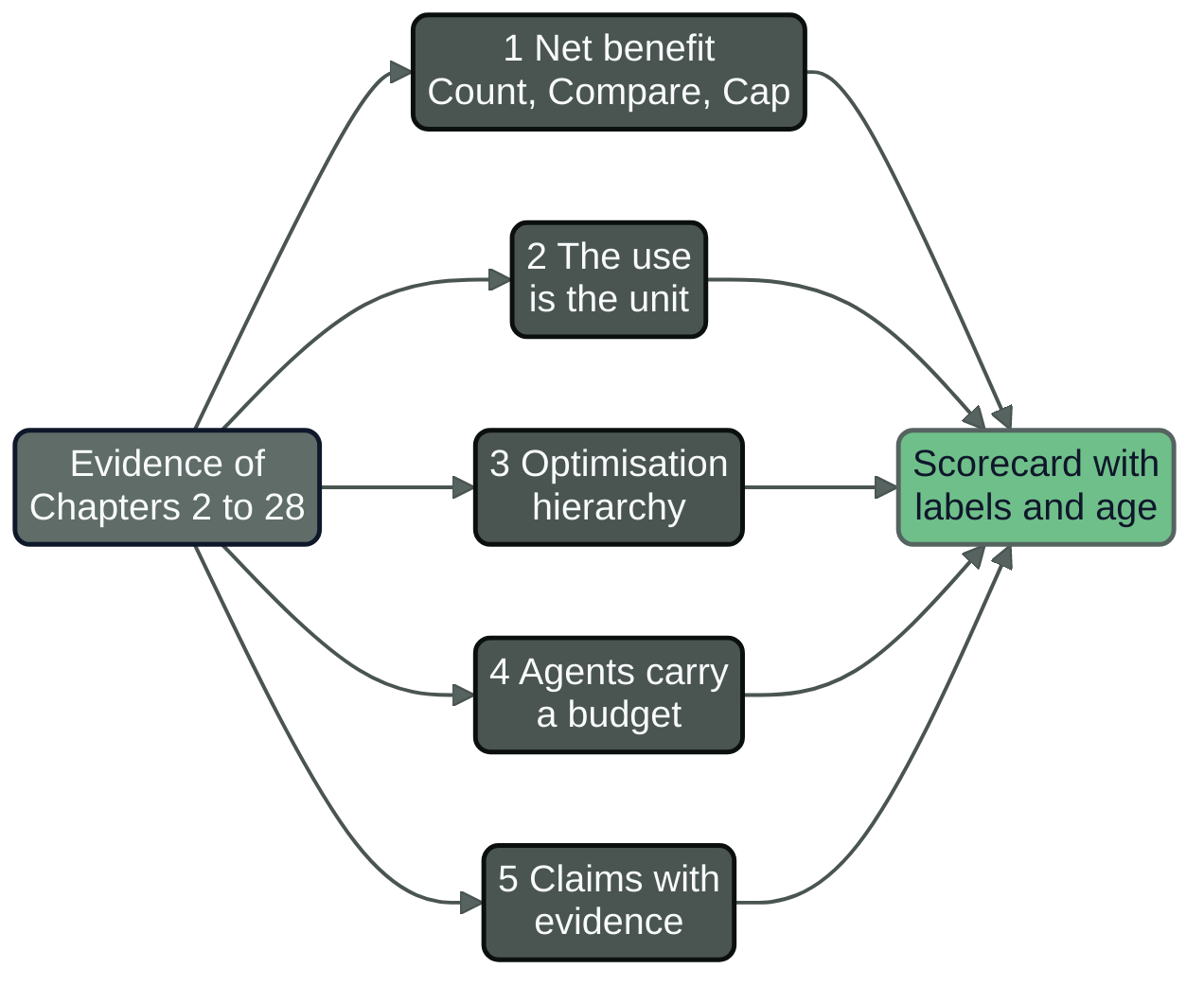
Figure 29.1: The thesis judged. Each of the five parts is read against the evidence of Chapters 2 to 28 and entered in a scorecard with a label and an evidence age. All figures of Nordvik Region and Hansa Mutual in this chapter are illustrative.
Figure 29.1 shows the method. The chapter judges the thesis part by part, lists what the book could not establish, says what would show the thesis wrong and gives the author's labelled projections. It then gives three things to do on Monday, a list of what is expected to change before 2027 is over, the scorecard as a record, and the one decision with which each organisation closes. It adds no new evidence. Every claim in it points to the chapter that carries the evidence or is the book's own conclusion, drawn here.
How the judgement is made
The book uses three labels for every statement about the future, taken from AI Governance, Chapter 22 (26, Nordqvist, 2026). A statement is observable when it describes something happening now and documented in a source the book opened, expected when it follows from a stated trend or from an instrument that has been decided, and speculation when it is plausible and unevidenced. Chapters 2 to 28 applied the labels to their outlooks. This chapter applies them to the thesis itself, which is a statement about what works, not only about what will happen.
Two disciplines go with the labels. The first is a narrow use of the word "established". It is used here only for what is both observable and in force: a measurement with its boundary, a duty written in an instrument, a documented failure of method. No part of the thesis as a whole is established in that sense. The evidence supports mechanisms and premises more than it supports outcomes, and an outcome claim (that organisations which count, compare and cap will end with a lower footprint for the benefit they obtain) has no measured test behind it in any source the book read.
The second discipline concerns the book's own conventions. The evidence ages of the method (90 days for a measured footprint of a running use and for a stop drill, 180 days for a benefit record, 12 months for a supplier disclosure), the starting levels of the delegation profiles and the thresholds of the tiers in Chapter 24 are recommendations, chosen so that they can be reviewed. No study measured them.
The book's evidence also has an age. Every dated figure was retrieved in November 2026, in a field that moved during 2026, and the conclusions below are as of 16 November 2026. The refresh list near the end says which are expected to change.
The thesis, part by part
The thesis of the book has five parts (Chapter 1 states them and Chapter 4 defines the method that carries them). Each is judged below in the same form: the claim, what is established, what is expected, what is speculation, where the evidence is thin, and a verdict.
Part 1: the net-benefit principle
The claim is that a use of AI is justified only when its benefit per unit of environmental cost is shown with evidence, by three tests: Count (the footprint at a stated boundary, year and method), Compare (the benefit against the non-AI alternative and against the rebound the use causes) and Cap (a budget set by someone other than the agent, measured outside the system it limits and enforced by a stop path outside the system it stops). Neither side pays for the other: an unproven benefit does not offset a measured footprint, and a purchased offset does not replace a reduction.
What is established. Count can be passed only where the boundary is chosen, and the evidence for that is the spread of honest figures: per-prompt energy for one median prompt differs by a factor that the provider's own two boundaries produce, location-based and market-based Scope 2 differ severalfold for one large provider, and the cause of the difference is almost always a boundary (Chapters 2, 6 and 22). That the benefit side is thinly evidenced is also established. The projection of 3.2 to 5.4 gigatonnes of CO2e a year avoided in three sectors by 2035 excludes rebound (61, Stern et al., 2025), a general-equilibrium model finds that AI productivity gains in fossil supply raise net CO2 by 0.47 to 1.8 gigatonnes a year (62, Alpine et al., 2026), and an audit of 154 claims found that 26 per cent cited published academic papers and 36 per cent cited no evidence, a publication of advocacy organisations (63, Joshi, 2026). None of the three measures the net effect of deployed AI (Chapter 3). The rule that neither side pays for the other follows from that state of the evidence and does not wait for it to improve.
What is expected. That Compare becomes easier to pass as measured-deployment studies accumulate (Chapter 3), and that rebound at the level of one organisation can be measured by anyone who keeps three series per use (Chapter 10).
What is speculation. That organisations which apply the three tests will have lower totals than those which do not. The book found no comparison of the two groups, and its two organisations are illustrations, not a sample.
Where the evidence is thin. Cap is the book's design judgement. A budget with an outside stop path is the observer and independence principles of the series applied to resources (34, Nordqvist, 2026), and the drills of Chapters 15 and 20 are illustrative. No study measures whether an environmental budget reduces consumption.
Verdict. The principle is sound as a method, because each test asks for something that can be checked and refuses a claim that cannot be. As a claim about outcomes it is untested. Count is passable where the boundary is chosen, Compare is passable for the cases Chapter 9 worked through and not for the domains that have no measured deployment, and Cap is a design that holds by construction wherever the stop path has been drilled.
Part 2: the use is the unit
The claim is that models are shared and decisions are made per use, so that what an organisation manages is the footprint per unit of work times the volume of units, and that efficiency per unit which is outrun by volume is not progress.
What is established. The arithmetic is established, and so is the reason a model-level figure cannot stand in for a use: the allocation of shared training and fixed costs to a use is a decision that moves the per-use share by orders of magnitude (Chapter 5), and the multipliers of reasoning, output length, calls, tools, retries and context separate a query from an outcome by factors that Chapter 6 measures where it can and says it cannot where it cannot. That unit figures fall while totals rise is documented for one provider by its own report (43, Google, 2026), which is vendor-reported and compares a per-prompt median with a company total, so that it is consistent with volume outrunning efficiency and does not demonstrate it.
What is expected. That gateways, tags and customer tools will let more organisations count units per use, which Chapter 8 shows is already possible for the gateway and not for the supplier's hardware.
What is speculation. That managing per use bends the total. The book could not test it at any scale larger than one organisation's register.
Where the evidence is thin. No measured series of total tokens against total energy was found (Chapter 10), no operator publishes the electricity of AI as distinct from all data-centre electricity (Chapter 2), and for a hosted use the organisation can usually count volume and not energy (Chapter 8).
Verdict. This is the best supported part as a method and an unsupported one as a prediction. The unit is right because decisions are made per use. Whether the sum of good per-use decisions is a small total is the open question of the book.
Part 3: the optimisation hierarchy
The claim is that the levers have an order of size and of cost: necessity, then sufficiency of model, then efficient serving, then place and time, then hardware and lifecycle, and that a saving at a lower level is not a reason to skip a higher one.
What is established. Each level has a size at its own boundary. Task-specific fine-tuned models used 15 to 50 times less energy than a general 8 billion parameter baseline in an independent study, with performance that fell on a slightly varied dataset of the same task (129, UNESCO, 2025). Reasoning effort is the largest measured serving lever and the one a buyer can pull with a request parameter, though the benchmark that sized it did not measure the quality it buys (Chapters 12 and 13). Carbon-aware shifting saves something real and bounded, with every figure an upper bound, and placement in a clean region is worth more than timing (Chapter 17). Utilisation is the cheapest hardware lever because it needs no purchase, at an illustrative idle fraction (Chapter 16). The first level, necessity, has no measured saving in any source read. Its size is a matter of logic: a use that is not run costs nothing, and the benefit forgone is the thing the Compare test counts.
What is expected. That the sizes change as models, serving stacks and grids change, so that the order is rechecked at each renewal, which is why the record of every choice carries an expiry.
What is speculation. That the order holds for every workload and every grid. On the Swedish grid, Chapter 17 finds that timing buys little and that the scarce resource is the connection, which is a reminder that the order is a default and not a law.
Where the evidence is thin. The levels were sized in separate studies at separate boundaries, and figures with different boundaries are not compared (Chapter 4). The order of the levels is therefore the book's own reasoning from sizes read in each chapter. It is not a ranking measured on one workload.
Verdict. The hierarchy holds as a design rule that tells a practitioner where to look first, and each lever is booked at the level at which it was measured, tokens counted or energy metered, never one reported as the other. As a claim that the largest saving always sits at the top it is not demonstrated.
Part 4: agents carry a budget
The claim is that an agent that can start work can spend resources, so that its mandate includes a resource budget set by someone other than the agent, measured outside it, with a stop path outside the system it stops, and that Level 4 Autonomous is never used for an agent that provisions or scales its own compute or starts work beyond a budget set by someone else.
What is established. The premise has support. Three preprints of 2026 report an overhead from below 1 to 26.5 times a linear run on local hardware, about twofold understatement when only the processor is measured, and a near-tripling of carbon from iteration with a cheap model (Chapter 15). The mechanism, loops, retries, tool calls, parallel calls, sub-agents and idle polling, is documented. A budget per call, per run and per period in the manifest is established practice in cost engineering (AI Governance, Chapter 4 (26, Nordqvist, 2026)), and the case that a check must be independent of what it checks is made in AI Operations (34, Nordqvist, 2026), AI Leader (35, Nordqvist, 2026) and AI Developer (36, Nordqvist, 2026).
What is expected. That agents and reasoning will make up a growing share of an organisation's AI energy where they are allowed to start work, so that the first breach of an environmental budget concerns an agent and not a chat assistant (see also Table 25.5).
What is speculation. That budgets keep the total of agent use inside a limit that matters outside the organisation.
Where the evidence is thin. None of the three preprints is a production-scale study. That budgets reduce the footprint of agents is the book's design judgement, and the two first drills that failed in the worked examples, on the provider-held key of the burst route of Hansa Mutual's claims-triage agent and on the route-table permission of Nordvik Region's on-call role, are illustrative. They show what a drill is for and not how often drills fail.
Verdict. The premise is observable at small scale, and the remedy rests on a principle the series has defended in four earlier domains. The Level 4 ceilings are firm where the series has argued them and are the author's design where the book applied them to resources.
Part 5: claims need evidence, and evidence expires
The claim is that provider figures, supplier disclosures, footprint estimates and benefit claims are claims, that each has a boundary, a date and an independent check or is labelled vendor-reported or as an estimate, and that the book's own statements about the future carry a label.
What is established. This part has the firmest footing. The boundary spread of Part 1 is evidence for it. The law is silent where a deployer would need it: no instrument in force asks a deployer to measure or publish the footprint of an AI use, and energy disclosure to a buyer is a matter of contract (Chapters 5, 21 and 23). Directive (EU) 2024/825 prohibits generic, whole-from-part and offset-based environmental claims in consumer-facing practices from 27 September 2026 (94, European Union, 2024), and its four prohibitions describe the failure modes of an AI claim whether or not the claim reaches consumers (Chapter 22).
What is expected. That the standards on which carbon claims rest will change: a consolidated consultation draft of the revised GHG Protocol standard is planned for the second quarter of 2027 and a revised standard for the fourth quarter of 2028, both estimates of the plan itself (105, GHG Protocol, 2026).
What is speculation. That a Union-level rule on substantiating footprint figures will be adopted in the next five years (Chapter 22).
Where the evidence is thin. The evidence ages are conventions, not findings. That a claim record reduces misleading statements is the book's judgement, tested in two illustrative cases: Nordvik Region's withdrawal of a 1.90 g figure and Hansa Mutual's narrowing of a board sentence to one use at one boundary.
Verdict. This part is observable in its premises and conventional in its numbers. It is also the part an organisation can act on soonest, because it needs no measurement the organisation does not already have, only a record that refuses the sentence the figure cannot carry.
The scorecard
Table 29.1 collects the judgements. The label in the second column is the label of the part's core claim, a method or a premise, as the evidence supports it. The claim about outcomes is the part's speculation paragraph above, and the thinnest point of each part is in its own column, in the spirit of the grading rule of Chapter 3 that a grade is no better than its lowest link. Chapter 26 lists the ways in which each part is skipped in practice; Table 29.1 judges the parts and not the failures.
Table 29.1: The scorecard of the thesis. The labels and verdicts are the book's own judgement from the evidence of Chapters 2 to 28, as of November 2026.
| Part | Label | Best evidence | Thinnest point | Verdict |
|---|---|---|---|---|
| 1 Net benefit (Count, Compare, Cap) | Expected | Boundary spread; thin benefit evidence | No outcome study; Cap is a design | Sound method, untested outcome |
| 2 The use is the unit | Observable (arithmetic) | Allocation and multipliers; unit and total move apart | No total series; hosted use not metered | Right unit, open total |
| 3 Optimisation hierarchy | Expected | Level sizes at their own boundaries | Sizes not measured on one workload | A rule for where to look first |
| 4 Agents carry a budget | Expected | Three preprints; mechanism documented | No production-scale study | Premise supported, remedy a design |
| 5 Claims with evidence | Observable | Law silent for deployers; claim rules in force | Evidence ages are conventions | Firmest, soonest to act on |
What the book could not establish
A book that asks for claims with evidence owes its readers a list of the claims it could not support. Table 29.2 lists the gaps as the chapters state them, with the chapter that states each and what would count as evidence. Each is a finding of a search made in November 2026 and not a proof that nothing exists, and the chapters say so where they state it.
Table 29.2: What the book could not establish, as the chapters state it, as of November 2026.
| Gap | Where stated | What would count as evidence |
|---|---|---|
| No measured series of total tokens against total energy | Chapter 10 | One provider or fleet, one boundary, volume and energy over several periods |
| Electricity of AI as distinct from all data-centre electricity unpublished; no total inference energy of a service over time | Chapter 2 | An audited series at one boundary |
| No 2026 per-query disclosure from other large providers found; no water by workload; no European provider figure per request with a water boundary | Chapters 2 and 7 | A disclosure with boundary, year and independent check |
| No independent lifecycle data for current accelerators; embodied impact known to a factor of two or three for assessed cards and not for servers | Chapters 2 and 5 | An assessed server with a stated boundary |
| No independent comparison of hyperscale, sovereign and on-premises AI at a common boundary | Chapter 19 | A peer-reviewed or regulator-published comparison with measured on-premises estates |
| No measured energy comparison of caching against its alternative; no baseline for context length; quality bought by reasoning effort unmeasured | Chapter 13 | Energy of the cache against the inference it replaces |
| No like-for-like energy comparison of retrieval and fine-tuning; no verified figure for embedding, indexing or data preparation | Chapter 14 | The same task at the same quality, both rungs metered |
| No measured-deployment study read for grid operation, industry, logistics, agriculture, monitoring or materials; the text of the IEA's 2025 chapter on AI and climate could not be retrieved | Chapter 3 | A deployment with baseline and independent check |
| No measured displacement for heat reuse; independent evidence on real utilisation scarce; accelerator service lives known only as accounting lives | Chapters 16 and 18 | Metered heat delivered and avoided; utilisation by independent audit |
| Agent overhead known from preprints on small hardware only | Chapters 6 and 15 | A production-scale measurement per run |
| Reports of cooling failures in the summer 2026 heatwave unverified and not used | Chapters 7 and 18 | A primary statement by the operator or the authority |
Three of the gaps matter more than the others for decisions. The first is rebound. Without a total series the book can say that unit energy falls where providers report it, that volume and totals rise where providers and the International Energy Agency report them, and that the pattern is consistent with Jevons' paradox and with simpler explanations, and it can say nothing about which holds (Chapter 10). The second is the comparison of hosting options. The evidence published so far does not rank cloud, sovereign and on-premises capacity, and a buyer who excludes an option by its label before the answers are in has no evidence for the exclusion (Chapter 19). The third is the benefit side outside the cases Chapter 3 could grade. An organisation that claims a benefit in an ungraded domain starts from the same five questions and the same four grades and does not borrow the standing of a case that was graded.
The gaps also have a use. Each is a clause the buyer can write into a contract, a series the organisation can start to keep, or a question the supplier can be asked (Chapters 8, 20 and 23).
The book's own production is a small case of the same gaps. Chapter 8 counted the inference energy of the agents that produced this manuscript, from their recorded token usage on 16 November 2026: between 6.3 and 1,930 kWh, with a central value of 8.1 kWh, the width of the range being the unknown energy of a cached token and the energy per token of the proxy. The record passes the Count test in part and fails the Cap test, because no budget or stop path was defined before the work, and it makes no claim on the benefit side. The lesson is the book's own conclusion: a footprint counted afterwards describes the work and governs nothing. Expected (author's projection): an organisation that starts agents without per-use tags, a budget and a stop path will hold a range as wide as this one when it first needs the figure.
What would show the thesis wrong
A thesis that nothing could refute would not be a thesis. Table 29.3 names, for each part, an observation that would change the verdict and says what the book would then do. The thresholds are the author's judgement and are chosen to be observable.
Table 29.3: What would change the verdicts.
| Part | Observation that would change the verdict | What the book would then do |
|---|---|---|
| 1 | A measured deployment, with baseline and independent check, of a use whose net environmental effect is large and positive and whose footprint was never counted | Keep the tests, grade the benefit higher and state that Count was the cheaper test |
| 2 | A total series that shows total energy flat or falling while volume rises | Weaken the case for volume caps on chat uses and keep them for agents |
| 3 | A measurement that puts two levels on one workload and finds a different order | Reorder the hierarchy for that class of workload |
| 4 | A production-scale study of agents that finds small overhead without budgets | Weaken the premise and keep the stop path for its other reasons |
| 5 | A binding instrument that prescribes one boundary for AI figures | Treat the boundary rule as compliance and not as discipline |
The watch list of Chapter 11 is the organisational counterpart of the table. It names five markers, disclosure coverage, outside demand, own rebound, benefit evidence and regulation, each with a trigger in each direction, and an organisation that keeps it will see most of these observations before the book's readers hear of them.
The author's projections
This section and Chapter 25 are the only places in the book where the author goes beyond the evidence. Chapter 25 holds six projections about efficiency, sufficiency and the totals (Table 25.5). The six below are about the evidence and the law, and they are the author's judgement, written on 16 November 2026 and offered so that they can be refuted. Each carries one of the three labels of AI Governance, Chapter 22 (26, Nordqvist, 2026) and a basis, so that a reader who disagrees can see where.
R1 (author's projection, expected). No instrument in force before 2028 will oblige a deployer to measure the footprint of an AI use. The basis is Chapter 21: the AI Act's energy provisions address providers and authorities, the Omnibus made no energy amendment, the rating act and the planned minimum performance standards address facilities, and the review of the AI Act is due on 2 August 2028 (Article 112(6)). What would change it: a Commission proposal addressed to deployers.
R2 (author's projection, expected). Until then the evidence will reach deployers by contract. Tender annexes and contract clauses, as Chapter 23 describes them, will be the channel through which per-use and per-site figures arrive, and they will arrive at the supplier's boundary and not at a common one. What would change it: a standard that fixes the boundary for a use and a provider that publishes against it.
R3 (author's projection, speculation). The first independent series that joins the volume of inference work to its total energy will come from a regulator's reporting or an audited provider disclosure and not from academic measurement, will cover one provider at one boundary and will settle the question of rebound for that provider only. The date is not known. What would change it: the publication of any such series, from any source.
R4 (author's projection, speculation). The first action by a regulator or a court in the Union about an AI environmental claim will turn on the boundary and not on the truth of a figure: a number true at one boundary, read by its audience at another. The basis is Directive (EU) 2024/825 from 27 September 2026 and the patterns of Chapter 22. No such case was found. What would change it: a case that turns on something else.
R5 (author's projection, expected). An organisation that keeps dated footprint and benefit records from 2027 will hold, within two years, evidence that does not exist elsewhere, because the gaps of Table 29.2 are gaps in everyone's data and the record is the organisation's own. What would change it: a provider or a regulator that publishes the same series.
R6 (author's projection, speculation). By 2030 an energy figure per request, at a stated boundary and with its year, will be a common term in European public procurement of hosted AI services. The basis is only that the clauses are in this book, that French frameworks for digital purchasing point the same way (Chapter 25; they report no outcome), and that the draft public criteria read for Chapter 23 ask for no figure per use. What would change it: a published final criterion that does or does not ask for one.
The author sets the review of these projections and of Table 29.3 for 16 November 2027, one year after this chapter was written, and will record at that date which have been refuted. If by the end of 2028 a measured series shows that total inference energy follows unit energy down while volume rises, the author will withdraw R3's framing and the case for volume caps on chat uses in Part 2.
Three things to do on Monday
The book's method has three tests and each has a first action that needs records an organisation already has and takes under an hour to begin. Table 29.4 says who is best placed to start with which.
1. Count (E1 Measure). Choose the AI use with the largest volume. Write its functional unit, one query, one task or one run, and the boundary at which you can count it. Write one row of the environmental register: the owner, the volume of the last month, the footprint per unit with its boundary, year and kind (vendor-reported, independent or estimate), and the evidence age. Write "missing" in every cell for which you have no figure, and say who could supply it. A register row with honest gaps is more useful than one without gaps (Chapters 4, 6 and 8).
2. Compare (E2 Justify). For the same use, write the non-AI alternative and the baseline against which the benefit is claimed, and set down the three series of Chapter 10 for the last twelve months: units, footprint per unit and total. Compute whether the total moved with the unit or with the volume. If the use has no benefit record, write the date by which it will have one, and remember that a benefit record expires after 180 days (Chapters 9 and 10).
3. Cap (E3 Design, E4 Operate and E5 Account). For one agent or one use, write a budget in a unit you can count (calls, tokens, cost or energy), name the person who sets it, who is neither the agent nor the service owner, say where it is metered outside the use, and name who can stop the use and by which path outside it. Then run the stop once, and write the date and the result. A budget that has not been drilled is proposed and not a cap (Chapters 15, 20 and 24).
Table 29.4: Who starts where. Each cell is a first question to ask or a first action to take.
| Reader | Count | Compare | Cap |
|---|---|---|---|
| Sustainability lead | Ask for the register row of the largest use | Ask for its benefit record and age | Ask who can stop it |
| Head of IT and cloud | Tag the gateway by use | Pull the three series from invoices | Set the first budget |
| Platform and FinOps practitioner | Add an energy conversion factor with a date | Put the unit and the total side by side | Enforce at the gateway and drill |
| Procurement officer | Send the supplier record to the host | Ask for the baseline in the tender | Write the stop and the notice period |
| Board member or council member | Ask what the group can prove | Ask what was forgone by declining | Ask when the stop was last drilled |
| Auditor | Read the evidence ages | Read the benefit grade | Read the drill record |
Any of the three can be started this week, and none needs the evidence of Table 29.2 to begin.
The refresh list
The book's dated snapshots are the part of it that will age first. Table 29.5 lists what is expected to change before 2027 is over and in the following year, with the chapters that depend on each item. The status column is the status on 16 November 2026. Each row belongs in the regulatory register of Chapter 21, with an as_of date and an expiry trigger, so that no statement of compliance rests on a status that has changed.
Table 29.5: What is expected to change, with the state in November 2026 and the label of the outlook.
| Item | State in November 2026 | Next event | Chapters | Label |
|---|---|---|---|---|
| Data-centre rating scheme, C(2026) 3472 | Adopted by the Commission on 21 September 2026, not published in the Official Journal; in force 20 days after publication (15, European Commission, 2026) | Publication; first labels due 15 August 2027 | 18, 21 | Expected |
| Minimum performance standards | Consultation closes 14 December 2026; proposal planned for the second quarter of 2027 (11, European Commission, 2026) | The proposal | 18, 21 | Expected |
| GHG Protocol Scope 2 and Scope 3 | Standard Development Plan of 29 July 2026; draft for consultation estimated for the second quarter of 2027, revised standard for the fourth quarter of 2028 (105, GHG Protocol, 2026) | The consultation draft; dates are estimates | 8, 22 | Expected |
| CSRD after the first Omnibus | Directive (EU) 2026/470 in force; Member States transpose Articles 1 to 3 by 19 March 2027 (95, European Union, 2026); revised ESRS from the financial year 2027 | National laws; the form that applies to each reporting entity | 21, 22 | Expected |
| Cloud and AI Development Act | A proposal, COM(2026) 502 of 3 June 2026 (10, European Commission, 2026); procedure 2026/0138(COD) (103, European Parliament, 2026) | Readings; the final text of Articles 11 and 32 | 18, 19, 21 | Speculation (content) |
| Green Claims proposal | Listed as one the Commission intends to withdraw within six months in its 2027 work programme (93, European Commission, 2026); announced, not formal | Formal withdrawal | 21, 22 | Expected |
| Directive (EU) 2024/825 | Applies from 27 September 2026 where transposed; transposition differs by Member State | National transposition, including Sweden's | 21, 22 | Observable |
| AI Act energy provisions | Unchanged by Regulation (EU) 2026/1744; review due under Article 112(6) by 2 August 2028 | Standardisation deliverables; the 2028 review | 5, 21 | Expected |
| Demand and grid figures | IEA Base Case for 2030 about 950 TWh (38, IEA, 2026); Svenska kraftnät queue 8,200 MW on 1 November 2026 | Next IEA update; next queue statistics | 2, 11, 17, 18 | Observable |
| Provider disclosures and independent scores | Per-prompt figures at stated boundaries; 2026 figures of other providers not verified | New disclosures; supersession of 2025 figures | 6, 12, 13 | Observable |
The practical rule for the refresh is the book's own. Re-read each row at its review date, record the new retrieval month, mark any figure that has been superseded, and change a stance by decision in a new AI Decision Record and not by drift (Chapters 11 and 24).
The thesis scorecard as a record
The scorecard belongs in version control as the other records of the book do. It says, for each part of the thesis, what is claimed, on what evidence, how old the evidence is and when it is next read. The example is Nordvik Region's, written by the CIO for the regional director. It is illustrative, and its register snapshot is the one of Chapter 24.
# register/scorecard-nr-0001.yaml  (illustrative; Nordvik Region)
id: AIDR-1329
kind: thesis-scorecard
status: illustrative
decided_by: {role: regional director, name: Elisabet Holmgren}
recorded_by: {role: CIO, name: Henrik Dahl}
reviewers: [Astrid Nyberg, Maria Åkesson]
as_of: 2032-12-14
register_snapshot: {date: 2032-12-13, rows: 6, complete: 1, chapter: 24}
next_review: 2032-12-19          # earliest expiry (FPR-NR-0001, 2033-01-02) minus 14 days
parts:
  - part: 1-net-benefit
    label: expected
    evidence: {record: BEN-NR-0001, age_days_limit: 180, recheck: 2033-03-31}
    thinnest_point: "hosted route of the assistant has no footprint figure"
  - part: 2-use-is-the-unit
    label: observable
    evidence: {record: FPR-NR-0001, age_days_limit: 90}
    thinnest_point: "volume 168,000 enquiries a month against 71,000 in 2026"
  - part: 3-hierarchy
    label: expected
    evidence: {record: MCR-NR-0001, measured: 2032-10-11}
    thinnest_point: "placement buys little on this grid (PLC-NR-0001)"
  - part: 4-agents-carry-a-budget
    label: expected
    evidence: {record: EBG-NR-0001, drilled: 2032-12-07}
    thinnest_point: "EBG-NR-0002 has no stop drill and counts as proposed"
  - part: 5-claims-with-evidence
    label: observable
    evidence: {record: CLM-NR-0001, decision: AIDR-1322, state: withdrawn}
    thinnest_point: "no environmental statement until the footprint is inside its age"
first_decision: "write FPR-NR-0001 and BEN-NR-0001 as one reading by 2033-03-31"
The record is checked in the pipeline outside any agent, like the register of Chapter 24: a part without a label, an evidence age past its limit or a next_review later than the earliest expiry minus fourteen days fails the check.
Across the modes and the organisations
Across the usage modes and the degrees of delegation
Table 29.6 sets the conclusions against the usage modes of the series, named as in AI Governance, Chapter 2, and says for each what the organisation can count, which test it can pass and where the evidence ends.
Table 29.6: The conclusions across the usage modes.
| Mode | What the organisation can count | Tests it can pass | Where the evidence ends |
|---|---|---|---|
| Mode 0 Ambient AI | Nothing; the supplier's figure, if any | Count by the supplier's rung only | The supplier's boundary |
| Mode 1 Conversational assistants | Seats; sometimes usage | Compare by who receives a seat | Energy per session |
| Mode 2 Embedded workplace assistants | Seats and requests where supplied | Compare by seat and by outcome | The supplier's disclosure |
| Mode 3 Agentic work tools | Tokens and calls at the gateway; sandbox compute | Count and Cap by a budget in the mandate | Energy per session |
| Mode 4 Built AI applications | Request, per route, at the gateway | All three, with own metering where hosted | Hosted routes outside the gateway |
| Mode 5 Autonomous production agents | Tokens, calls and cost per run | Cap first, then Count | Production-scale overhead |
The degrees of delegation carry four ceilings through the whole book. Level 4 Autonomous is never used for an agent that provisions or scales its own compute, or starts work, beyond a budget set by someone else; for an action that disables the measurement, the budget or the stop path itself; for the publication of an environmental claim; or for a decision about a named person's access to work. Below Level 4 the book's default is that measuring, recommending and scheduling within a policy can reach Level 3 Bounded, provisioning stays at Level 2 Supervised within a budget, and raising a cap stays at Level 0 Advisory with a named person deciding (Chapter 25). A conclusion that depended on the ceilings being raised would be a conclusion the book could not support.
Nordvik Region and Hansa Mutual
The two organisations close the book with the one decision each would take first. All figures are illustrative.
Nordvik Region. At the snapshot of Chapter 24, one of six register rows has complete evidence. The first decision of the regional director, recorded as AIDR-1329 on 14 December 2032, is not to start a new measurement but to join two that exist. The Region writes the footprint record of the open-weight route of the citizen-service assistant (FPR-NR-0001) and the recheck of the benefit record (BEN-NR-0001, due 31 March 2033) as one reading, so that Count and Compare are read together for the one use whose footprint the Region has measured and whose volume has more than doubled. It publishes no environmental statement about the assistant until that reading is inside its evidence age, which follows from its withdrawal of the 1.90 g figure (AIDR-1322). The hosted route has no figure, and the tender annex TA-NR-ENV-01, with the ten questions of AIDR-1318, is the way it will get one. The record is public under the Swedish public-access rules, and the Region writes it to be read by a councillor who disagrees with it.
Hansa Mutual. The group's register has a larger gap that is a finding and not an error: the footprint of the claims-triage agent (FPR-HM-0002) is about thirteen times higher counted top-down than bottom-up when both are put at one boundary, the facility's (about nine times as first quoted in Wh at two boundaries, Chapter 20), and the likely cause, idle capacity held for the agent, is not measured. The first decision of the group AI governance board, chaired by Dr. Annette Krämer and recorded as AIDR-1379 on 14 December 2032, is to reconcile the two figures by a metered fortnight on the Frankfurt rack before any statement about the agent is made, with the budget view EBG-HM-0001 and its stop path unchanged. Dr. Verena Lindner owns the reconciliation. The decision of AIDR-1376 stands: the benefit record BEN-HM-0001 for the claims assistant is due on 31 March 2033. The board's efficiency statement (CLM-HM-0001, revision 1) stays held, and only the narrow test-pool claim of revision 2, approved the day before (AIDR-1372), stands.
Observable, expected, speculation
Observable. The evidence base has the gaps of Table 29.2, the law reaches providers and facility operators and not the deployer of a use, and the boundary of a figure explains most differences between honest figures.
Expected. The dated snapshots of Table 29.5 will change in 2027 and 2028, and evidence will reach deployers by contract before it reaches them by law.
Speculation. Whether efficiency alone keeps the world total inside any limit, whether sufficiency is needed at that level, and whether managing the footprint use by use bends the total. The operational answer is that of Chapter 25: hold a use that has not passed Count and Compare under a cap, and record what is forgone.
The series' argument, closed for the environment
The series has made one argument in different domains: AI may draft, generate, recommend and, within a mandate, execute, but a named person stands behind every consequence, and what verifies an action is independent of what performed it. This book applied the argument to a resource. An agent that can start work can spend energy, so a person who is not the agent sets what it may spend, something outside it measures the spend, and someone outside it can stop it. A claim that an AI use is green or net-positive is a statement that a named person answers for, with a boundary, a year and a check that someone else made.
The last word of the book is the rule that holds the others in place. Neither side pays for the other. An unproven benefit does not offset a measured footprint, a purchased offset does not replace a reduction, and a figure at one boundary does not stand for a figure at another. On present evidence the environmental cost of AI cannot be called a crisis or a manageable cost for the world, and the book labels any firm answer speculation. For an organisation the answer is within reach: an AI use is a manageable cost when it has been counted, compared and capped, and an unmanaged one when it has not.
Summary
The thesis has five parts and the evidence supports them unequally. The net-benefit principle is sound as a method and untested as a claim about outcomes. The use is the right unit, and whether good decisions per use add up to a small total is the open question, because no series of total inference energy against volume was found. The optimisation hierarchy is a rule for where to look first, sized lever by lever at separate boundaries and not measured on one workload. The premise of the agent budget is observable at small scale and its remedy is a design resting on the series' independence principles. The claims discipline has the firmest footing, because the law is silent where the deployer needs evidence and the rules on environmental claims already describe the failure modes.
The book could not establish eleven things, listed in Table 29.2 with the chapters that state them and what would count as evidence. The author's six projections are labelled, with their bases and what would change them. What is expected to change before 2027 is over is in Table 29.5.
The reader can start on Monday with one action for each test: write the register row of the largest AI use with an honest "missing" where there is no figure (E1 Measure), set the unit and the total side by side with the alternative and the age of the benefit record (E2 Justify), and write one budget with a stop path outside the use and drill it once (E3 Design, E4 Operate and E5 Account). Nordvik Region and Hansa Mutual each close with one decision: to read two records as one, and to reconcile two figures about thirteen times apart. The book ends here, and its records begin.
Sources
- Nordqvist, G. (2026). AI Governance: Governing Artificial Intelligence in European Enterprises and Public Authorities. The Transformed Architecture, Book 2, published at aig.geon.se. Available at: https://aig.geon.se/ (accessed 2026-11-01). Conceived and directed by Nordqvist; text written by AI agents. (26, Nordqvist, 2026)
- Nordqvist, G. (2026). AI Operations: How Artificial Intelligence Transforms IT Operations in European Enterprises and Public Authorities. The Transformed Architecture, Book 10, published at aiops.geon.se. Available at: https://aiops.geon.se/ (accessed 2026-11-11). Conceived and directed by Nordqvist; text written by AI agents. (34, Nordqvist, 2026)
- Nordqvist, G. (2026). AI Leader: How Leadership Roles Change When AI Is Used Broadly in European Enterprises and Public Authorities. The Transformed Architecture, Book 11, published at leader.geon.se. Available at: https://leader.geon.se/ (accessed 2026-11-11). Conceived and directed by Nordqvist; text written by AI agents. (35, Nordqvist, 2026)
- Nordqvist, G. (2026). AI Developer: How the Developer Role Changes When AI Is Used Broadly in European Enterprises and Public Authorities. The Transformed Architecture, Book 12, published at developer.geon.se. Available at: https://developer.geon.se/ (accessed 2026-11-14). Conceived and directed by Nordqvist; text written by AI agents. (36, Nordqvist, 2026)
- European Commission (2026). Proposal for a Cloud and AI Development Act (CADA). COM(2026) 502, 3 June 2026. Available at: https://digital-strategy.ec.europa.eu/en/library/proposal-cloud-and-ai-development-act-cada (accessed 2026-11-01). (10, European Commission, 2026)
- International Energy Agency (2026). Key Questions on Energy and AI. World Energy Outlook Special Report, April 2026. Available at: https://www.iea.org/reports/key-questions-on-energy-and-ai (accessed 2026-11; PDF read from the IEA's publication server). Independent; modelled and projected figures. (38, IEA, 2026)
- European Commission (2026). Report on the energy efficiency of data centres in the EU. COM(2026) 500 final, 21 September 2026. Available at: https://build-up.ec.europa.eu/system/files/2026-10/39-2026-48_Report%20on%20the%20energy%20efficiency%20of%20data%20centres%20in%20the%20EU.pdf (accessed 2026-11). The planning of the minimum performance standards proposal is as read in Chapter 21. (11, European Commission, 2026)
- Google (2026). 2026 Environmental Report. Google LLC, 30 June 2026. Available at: https://sustainability.google/files/google-2026-environmental-report.pdf (accessed 2026-11). Vendor-reported; endnotes state that the data and claims have not been independently verified. (43, Google, 2026)
- Stern, N., Romani, M., Pierfederici, R., Braun, M., Barraclough, D., Lingeswaran, S., Weirich-Benet, E. and Niemann, N. (2025). Green and intelligent: the role of AI in the climate transition. npj Climate Action 4, 56, 23 June 2025. Available at: https://doi.org/10.1038/s44168-025-00252-3 (accessed 2026-11-16). (61, Stern et al., 2025)
- Alpine, W., Geldner, N., Alpine, H. and Chepeliev, M. G. (2026). AI-driven productivity gains enable more CO2 emissions than they avoid in a global energy-economy model. npj Climate Action 5, 71, 4 August 2026. Available at: https://doi.org/10.1038/s44168-026-00411-0 (accessed 2026-11-16). (62, Alpine et al., 2026)
- Joshi, K. (2026). The AI Climate Hoax. Beyond Fossil Fuels with Friends of the Earth US, Stand.earth, Green Screen Coalition, Green Web Foundation and Climate Action Against Disinformation, February 2026. Available at: https://beyondfossilfuels.org/wp-content/uploads/2026/02/AI-for-climate-claims-Report_FEB-2026_FINAL-2-16.pdf (accessed 2026-11-16). Publication of advocacy organisations. (63, Joshi, 2026)
- UNESCO and University College London (2025). Smarter, Smaller, Stronger: Resource-Efficient Generative AI and the Future of Digital Transformation. UNESCO, Paris, 2025 (press page 8 July 2025, updated 10 April 2026). Available at: https://unesdoc.unesco.org/ark:/48223/pf0000394521 (accessed 2026-11-16). Independent; experiments on Llama 3.1 8B Instruct and fine-tuned task models on one RTX 3090 Ti. (129, UNESCO, 2025)
- European Commission (2026). Commission Delegated Regulation supplementing Directive (EU) 2023/1791 as regards the establishment of a common Union rating scheme for data centres and amending Delegated Regulation (EU) 2024/1364. C(2026) 3472 final, 21 September 2026; Council document ST 13444/26. Adopted by the Commission, not yet published in the Official Journal. Available at: https://data.consilium.europa.eu/doc/document/ST-13444-2026-INIT/en/pdf (accessed 2026-11-16). (15, European Commission, 2026)
- European Commission (2026). Commission work programme 2027. COM(2026) 710 final, 4 November 2026, Annex III. Available at: https://eur-lex.europa.eu/legal-content/EN/TXT/HTML/?uri=CELEX:52026DC0710 (accessed 2026-11-16). (93, European Commission, 2026)
- European Parliament and Council of the European Union (2024). Directive (EU) 2024/825 amending Directives 2005/29/EC and 2011/83/EU as regards empowering consumers for the green transition through better protection against unfair practices and through better information. Official Journal of the European Union, 6 March 2024. Available at: https://publications.europa.eu/resource/celex/32024L0825 (accessed 2026-11-16). (94, European Union, 2024)
- European Parliament and Council of the European Union (2026). Directive (EU) 2026/470 amending Directives 2006/43/EC, 2013/34/EU, (EU) 2022/2464 and (EU) 2024/1760 as regards certain corporate sustainability reporting and due diligence requirements. Official Journal of the European Union. Available at: https://publications.europa.eu/resource/celex/32026L0470 (accessed 2026-11-16). (95, European Union, 2026)
- European Parliament (2026). Procedure file 2026/0138(COD): Cloud and AI Development Act. Legislative Observatory. Available at: https://oeil.europarl.europa.eu/oeil/en/procedure-file?reference=2026/0138(COD) (accessed 2026-11-16). (103, European Parliament, 2026)
- GHG Protocol (2026). Corporate Standard, Standard Development Plan, Version 2.0, 29 July 2026. Available at: https://ghgprotocol.org/sites/default/files/2026-07/Consolidated-StandardDevelopmentPlan(SDP)-2026.07.29.pdf (accessed 2026-11-16). Dates in the plan are estimates. (105, GHG Protocol, 2026)