Regulation: What Applies to AI and the Environment in 2026
Chapter 20 closed the operating loop of E4 Operate. This chapter opens Part VI and asks what the law already requires, instrument by instrument, with the status and dates that hold in November 2026. It concerns E5 Account, the function that complies, reports, claims, procures and holds to account. It serves the Count test of the net-benefit principle (Chapter 4), because it shows how evidence about a footprint reaches, or fails to reach, the organisation that has to count it.
The chapter maps the law that bears on AI and the environment, says who each instrument binds and which record shows compliance. Statements about law are attributed to the instrument and article and framed as organisational and architectural implications, not as legal advice.
The short answer is that no instrument in force asks a deployer of AI to measure or publish the energy, carbon or water of an AI use. The AI Act's energy text reaches providers of general-purpose AI models and runs mainly to authorities. The Energy Efficiency Directive reaches the data-centre building, not the workload in it. Corporate reporting reaches large undertakings and names cloud services in one disclosure point. Consumer law reaches claims made to consumers. Almost everything else is adopted but not in force, proposed, consulted on or announced as withdrawn. The evidence a buyer needs about AI therefore has to be written into contracts and tender annexes, because the law does not yet deliver it.
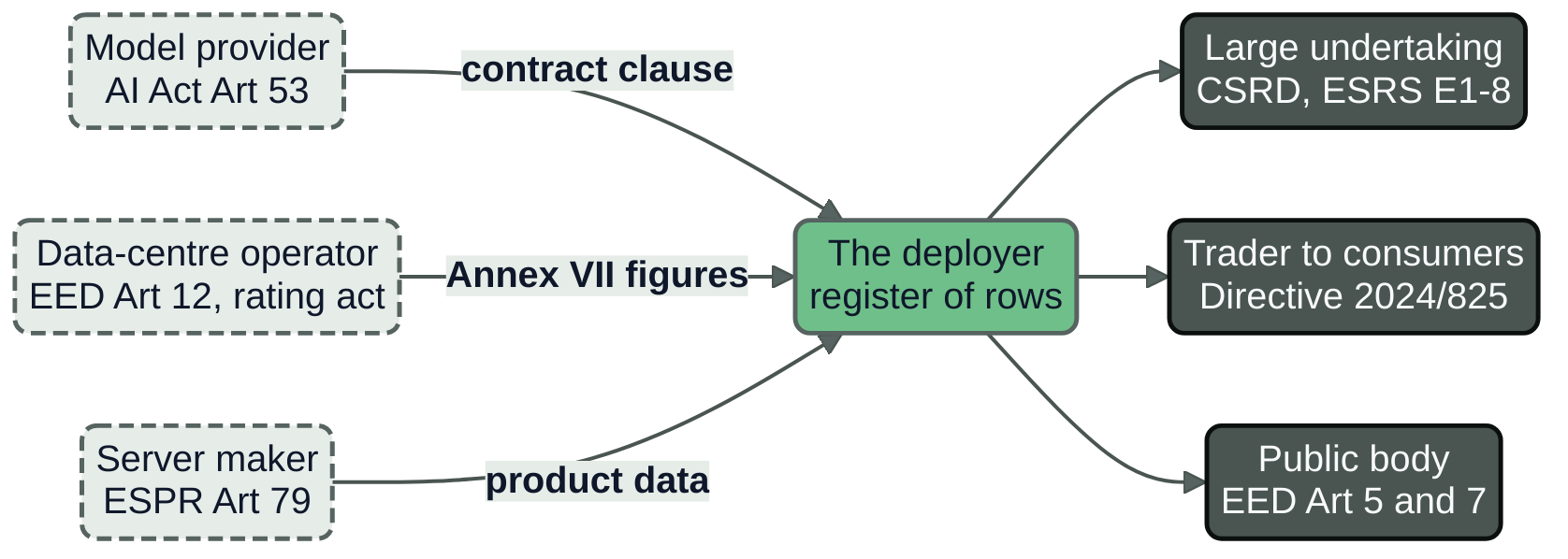
Figure 21.1: The regulatory map of November 2026. Three parties (model provider, data-centre operator, server maker) hold evidence the deployer needs and reach it by contract or by public figures; three duties (large undertaking, trader to consumers, public body) fall on the deployer itself.
A date in the calendar
Henrik Dahl, Nordvik Region's Head of IT and Digitalisation, keeps a compliance calendar for the Region's AI estate (illustrative). It must sort entries by what they are: a rule in force, an adopted but unpublished Commission act, a proposal, an announced withdrawal. Table 21.1 sorts the dates that matter in the next two years.
Table 21.1: Dates in the calendar, status on 16 November 2026 (retrieved November 2026; all primary texts unless noted).
| Date | Event | Instrument and article | Status | Label |
|---|---|---|---|---|
| 2 Aug 2025 | Chapter V obligations for general-purpose AI model providers apply | AI Act, Art. 113(b) (1, European Union, 2024) | in force | observable |
| 2 Aug 2026 | The Commission's power to fine providers of general-purpose AI models applies | AI Act, Arts. 101 and 113 | in force | observable |
| 27 Sep 2026 | Member States apply the measures that transpose the consumer-claims rules | Directive (EU) 2024/825, Art. 4(1) (94, European Union, 2024) | applies where transposed | observable |
| 10 Nov 2026 | Revised ESRS enter into force | Delegated Regulation (EU) 2026/1563, Art. 3 (96, European Commission, 2026) | in force | observable |
| 14 Dec 2026 | Consultation on minimum performance standards for data centres closes | Commission page (16, European Commission, 2026) | open | observable |
| 31 Dec 2026 | End of the period in which earlier ecodesign provisions continue for servers | Regulation (EU) 2024/1781, Art. 79(1)(a)(i) (154, European Union, 2024) | in force | observable |
| 1 Jan 2027 | Revised ESRS apply to financial years starting on or after this date | Delegated Regulation (EU) 2026/1563, Art. 3 | decided | expected |
| 19 Mar 2027 | Transposition deadline for the Omnibus I amendments to the reporting directives | Directive (EU) 2026/470, Art. 5(1) (95, European Union, 2026) | decided | expected |
| Q2 2027 | Commission proposal on minimum performance standards planned | Commission page (16, European Commission, 2026) | planned | expected |
| 15 Aug 2027 | First data-centre labels generated | Rating act C(2026) 3472 final, Art. 3 (15, European Commission, 2026) | adopted, not in force | expected |
| 2 Dec 2027 | High-risk obligations for Annex III systems apply | AI Act, Art. 113(c)(i) | decided | expected |
| 2 Aug 2028 | Commission report on energy-efficient development of general-purpose AI models | AI Act, Art. 112(6) | decided | expected |
The first labels depend on the rating act entering into force on the twentieth day after publication in the Official Journal (Art. 7 of the act); it had not been published when this chapter was written. A Parliament or Council objection within the scrutiny period would stop it: the Energy Efficiency Directive gives two months from notification, extendable by two months (Art. 34(6)) (5, European Union, 2023).
The Council received the act on 21 September 2026, so the initial period runs to about 21 November 2026 and an extension to about 21 January 2027 (the book's own arithmetic). A report that Parliament asked for the extension was not confirmed at a primary source and is treated as expected.
How to read a status
Five words are used, each in one sense. Adopted: the legislature or the Commission has adopted the text. In force: the text has entered into force, though it may apply only from a later date. Applicable from: that later date. Proposed: the Commission has put a text to the legislators, who may change or drop it. Announced: an institution has said what it intends to do, as in a work programme. They map onto the book's labels: what is in force is observable; what a decided instrument will do on a stated date is expected; what depends on a proposal, a draft or an intention is speculation.
The AI Act and the environment
The AI Act is Regulation (EU) 2024/1689 (1, European Union, 2024), read here in the consolidated text of 27 July 2026 that includes Regulation (EU) 2026/1744 (2, European Union, 2026). AI Governance, Chapter 3 gives the regulatory landscape as a whole (26, Nordqvist, 2026); this section reads only the provisions that mention energy or the environment. Searching the consolidated articles and annexes for the word "energy" finds six places: Articles 40(2), 59(1)(a)(iii), 95(2)(b) and 112(6), Annex XI Section 1 and Annex XIII. Article 59 names energy sustainability among the public-interest areas for processing personal data in a regulatory sandbox, which is not an environmental duty. Recitals are not counted.
What the text says
Article 40(2) says that when the Commission prepares a standardisation request it shall also ask for deliverables on reporting and documentation processes to improve AI systems' resource performance, such as reducing a high-risk AI system's consumption of energy and other resources during its lifecycle, and on the energy-efficient development of general-purpose AI models. Regulation (EU) 2026/1744 added a further subparagraph to Article 40(2) on deliverables for the requirements of Chapter III, Sections 2 and 3; it left the energy sentence unchanged. The Omnibus therefore made no energy amendment.
Article 53(1)(a) requires a provider of a general-purpose AI model to keep technical documentation with at least the information of Annex XI, for providing to the AI Office and the national competent authorities on request. Annex XI, Section 1, point 2 asks, under (d), for the computational resources used to train the model (for example the number of floating-point operations) and the training time, and under (e) for the "known or estimated energy consumption of the model"; where it is unknown, it may be based on information about the computational resources used. Article 53(5) empowers the Commission to adopt delegated acts to detail measurement and calculation methodologies for points 2(d) and (e) so that documentation is comparable and verifiable. No such act was found; Chapter 5 treats the consequence for model-level figures.
Annex XIII lists criteria for designating a model as one with systemic risk; training computation, which may be indicated by "estimated energy consumption for the training", is one. Energy there is a proxy for scale, not a duty to reduce it.
Article 95(2)(b) asks the AI Office and the Member States to facilitate codes of conduct, for voluntary application "including by deployers", on assessing and minimising the impact of AI systems on environmental sustainability, including energy-efficient programming and techniques for the efficient design, training and use of AI. It is the only provision that mentions deployers and the environment together, and it is voluntary.
Article 112(6) sets the review: by 2 August 2028 and every four years thereafter, the Commission reports on the progress of the standardisation deliverables on the energy-efficient development of general-purpose AI models and assesses the need for further measures, "including binding measures or actions". The report is public. This is the legal route by which a binding energy rule for general-purpose models could arrive, in 2028 at the earliest.
Who is bound, and who is not
The provisions above bind providers of general-purpose AI models and, through the standardisation request, shape standards for providers of high-risk systems. A deployer has no direct energy or resource duty under the Act. The deployer articles carry none: the obligations of deployers of high-risk systems in Article 26 contain no energy provision, and neither do the transparency duties of Article 50 or the systemic-risk duties of Article 55. A deployer still owes everything else the Act asks of it (AI Governance, Chapters 3 and 17) (26, Nordqvist, 2026), including, from 2 December 2027, the obligations for the Annex III systems that Nordvik Region's benefits-triage ranking and Hansa Mutual's underwriting-support model fall under (Art. 113(c)(i)). None concerns energy.
The documentation that exists is not written for the deployer. Annex XI documentation goes to the AI Office and national authorities on request, and the information given to downstream providers is the content of Annex XII, in which a search of the consolidated text finds no energy item. A deployer has no legal right to the training energy of the model it uses; it has what the provider agrees to disclose.
What the Model Documentation Form asks
The General-Purpose AI Code of Practice (July 2025) (9, European Commission, 2025) contains a Model Documentation Form that gives providers a standard way to meet Annex XI (74, European Commission, 2025). Its energy section is headed "Energy consumption (during training and inference)". It asks for the amount of energy used for training, measured or estimated, in megawatt-hours with at least two significant figures, with "N/A" allowed where a compute or hardware provider's information is lacking, and for the measurement methodology. It asks for the benchmarked amount of computation used for inference in floating-point operations, with a description of a computational task (the example is generating 100,000 tokens) and the hardware. It does not ask for an inference energy value. The form marks these fields as for the AI Office and the national authorities; the column for downstream providers is not ticked.
The heading promises more than the fields deliver. Training energy is a model-level, one-off figure, and inference computation in floating-point operations is not energy. Nothing asks for energy per request, the site, the grid or the water. A buyer who needs those for a footprint record (Chapter 6) must write the disclosure into the contract (Chapter 23), and a record of what the provider declined to give is itself evidence under the Count test.
What it means for the architecture
Three implications follow. First, a hosted model route enters the footprint record with the provider's disclosure, if any, labelled vendor-reported, and otherwise at the fallback rung of Chapter 8. Second, voluntary codes under Article 95(2)(b) can be recorded in the register ("adopted", "not adopted", with a reason). Third, the review of Article 112(6) is a dated trigger: the register row for the AI Act should name 2 August 2028 and the delegated act under Article 53(5) as events that expire it.
The Energy Efficiency Directive and the data centre
Chapter 18 treats data centres; this section places the instruments. Directive (EU) 2023/1791, the recast Energy Efficiency Directive (5, European Union, 2023), contains five provisions that matter to an AI deployer.
Article 12 requires Member States to require owners and operators of data centres with installed information technology power of at least 500 kW to make the information in Annex VII public, by 15 May 2024 and every year thereafter, except for trade secrets and confidential information. Defence and civil-protection data centres are excluded. The Commission keeps a European database, public at aggregated level. Article 12(5) required the Commission to assess the data and report, with legislative proposals where appropriate, on further measures "including establishing minimum performance standards". Commission Delegated Regulation (EU) 2024/1364 (6, European Commission, 2024) sets out the indicators and the reporting mechanism; its Article 3 has operators communicate the information to the European database by 15 May each year, covering the previous calendar year.
Article 11 concerns the enterprise, not the data centre. An enterprise with an average annual energy consumption above 85 TJ (23.6 GWh) over the previous three years, all carriers together, must have an energy management system certified by an independent body by 11 October 2027; one above 10 TJ (2.78 GWh) without such a system must have an energy audit, the first by 11 October 2026, a date now past, and then at least every four years (Art. 11(1) and (2)). An enterprise with a certified environmental management system is exempt if it includes an energy audit on the Annex VI criteria (Art. 11(11)). The gigawatt-hour figures are the book's own conversion. The article counts all energy and asks nothing about an AI use, and whether a public body is an enterprise was not examined. Chapter 24 shows how an environmental management system takes in the register of AI uses.
Article 26(7) requires a cost-benefit analysis of using waste heat when a data centre with total rated energy input above 1 MW is newly planned or substantially refurbished (Art. 26(6) requires waste-heat use unless it is shown not to be feasible), and Article 5 sets an annual reduction of final energy consumption of all public bodies combined of at least 1.9 per cent compared with 2021, indicative during a transitional period ending 11 October 2027, a Member State obligation and not an organisation's own. Article 7 requires Member States to ensure that contracting authorities, above the thresholds, purchase only products, services, buildings and works with high energy-efficiency performance and apply the energy-efficiency-first principle, and allows them to require environmental aspects and green public procurement criteria.
The rating act
On 21 September 2026 the Commission adopted a delegated regulation (reference C(2026) 3472 final) that supplements the Directive and amends Delegated Regulation (EU) 2024/1364 to establish a common Union scheme for rating data centres (15, European Commission, 2026). The act is adopted by the Commission and not in force; the number "2026/7000" in the Commission's footnote is a placeholder, not an Official Journal number. Under Article 3, from 15 August 2027 and every year after, an electronic label is generated automatically by the European database for data centres that have reported; it is valid from 15 August to the next 15 August, with validity extended until a Member State confirms that reporting is complete and at the latest to 31 December. Annex I grades energy by power usage effectiveness (PUE, the ratio of a facility's total energy to the energy of its IT equipment) from class A (at most 1.15) to G (above 1.9) and water by water usage effectiveness (WUE) from A (at most 0.1 litres per kilowatt-hour) to G (above 1.0). Operators may not produce or display labels that mimic the official one (Art. 4(2)). Individual indicators remain confidential except what is on the label (Art. 5).
The first review is due by 31 December 2028 and may add indicators on the energy use of ICT equipment (Art. 6(d)), a first step from the building towards the equipment.
For an AI deployer the act is useful and limited. It makes the hosting site's PUE and WUE classes visible and creates no new reporting duty for AI users. It grades the facility, not the use: a class A site can host a wasteful use. The label is a procurement input (Chapter 23) and a placement input (Chapter 17), and a label that has not been issued cannot be asked for.
Minimum performance standards
A separate instrument is in preparation. The Commission opened an open public consultation and call for evidence on 21 September 2026 on minimum performance standards for data centres, for 12 weeks, closing on 14 December 2026, with a legislative proposal planned for the second quarter of 2027 (16, European Commission, 2026). The consultation and the rating act are two instruments; a register that merges them misleads.
The Cloud and AI Development Act
The Cloud and AI Development Act is a proposal: COM(2026) 502 final of 3 June 2026 (10, European Commission, 2026). Parliament's procedure file shows it awaiting a committee decision, with the Industry, Research and Energy committee in the lead and no vote or plenary date listed on 16 November 2026 (103, European Parliament, 2026).
Two articles bear on this book. Article 11(1) says that when Member States set sustainability requirements for data centres in acceleration zones they shall use the key performance indicators of Delegated Regulation (EU) 2024/1364, so that the reporting indicators would become the permitting yardstick. Article 32 requires contracting authorities to add non-price award criteria on a tenderer's contribution to a European cloud and AI ecosystem, which must be ancillary and not decisive (a recital suggests at most 15 out of 120 points). Those criteria concern the European supply chain and not environmental performance, so a contracting authority gets no environmental criterion from Article 32 and still draws its environmental criteria from Articles 67 and 68 of Directive 2014/24/EU (7, European Union, 2014). Article numbers are those of the proposal and may change.
CSRD and ESRS after the Omnibus
The Corporate Sustainability Reporting Directive, Directive (EU) 2022/2464 (97, European Union, 2022), amended the Accounting Directive so that large undertakings report on sustainability. It applies to the types of undertaking that the Accounting Directive covers: the legal forms listed in its Annexes I and II (Directive 2013/34/EU, Art. 1) (98, European Union, 2013). A regional authority is not an undertaking of those forms, which is why the profile treats Nordvik Region as not a reporting entity; the status of any company the Region owns would need its own check and was not examined.
Directive (EU) 2026/470, the first Omnibus directive on the reporting rules (95, European Union, 2026), changed the scope. In Articles 2 and 3 it sets the scope of reporting, in Directive 2013/34/EU and in the application dates of Article 5(2) of the CSRD, at undertakings that exceed both a net turnover of EUR 450,000,000 and an average of 1,000 employees during the financial year, and at parent undertakings of groups that exceed both on a consolidated basis. It allows Member States to exempt undertakings below those thresholds for financial years starting between 1 January 2025 and 31 December 2026. Member States must transpose Articles 1 to 3 by 19 March 2027 (Art. 5(1)). Until national laws are in force, the form in which a group is bound depends on its Member State; for Sweden the Government's legislative proposal of 27 October 2026 (a lagrådsremiss) proposes higher thresholds, an exemption for small and medium-sized listed companies, protection for value-chain undertakings and entry into force on 19 March 2027, and it is not law (101, Regeringskansliet, 2026). Germany's transposition was not examined.
Commission Delegated Regulation (EU) 2026/1563 (96, European Commission, 2026) revises the European Sustainability Reporting Standards. It entered into force on 10 November 2026 and applies to financial years beginning on or after 1 January 2027 (Art. 3). The revised standard on climate (disclosure requirement E1-8, application requirement 24 for paragraph 30(c), point (g)) says that, if applicable, the undertaking shall disclose greenhouse-gas emissions from purchased cloud computing and data-centre services as a subset of the overarching Scope 3, category 1, "upstream purchased goods and services". The E1-8 table gives that subset a row of its own. The disclosure is conditional ("if applicable"), and its boundary is the GHG Protocol's, a subset of an existing category and not AI as such. The same disclosure asks for Scope 2 both location-based and market-based.
For an AI estate the consequence is limited. A group in scope can be asked to separate the emissions of cloud and data-centre services, and can do so only if suppliers give it figures (Chapters 8 and 23). The standards do not require AI to be separated inside that subset. The GHG Protocol's consolidated standard development plan (version 2.0, 29 July 2026) estimates a consolidated draft for public consultation in the second quarter of 2027 and a published revised standard in the fourth quarter of 2028, and it contains no item specific to cloud or AI (105, GHG Protocol, 2026); Chapter 22 treats the methods.
The Taxonomy and ecodesign
The Taxonomy
The Taxonomy Regulation, Regulation (EU) 2020/852 (104, European Union, 2020), requires an undertaking that has to publish sustainability information under Articles 19a or 29a of the Accounting Directive to disclose how far its activities qualify as environmentally sustainable (Art. 8(1)); non-financial undertakings disclose the proportion of turnover, capital expenditure and operating expenditure (Art. 8(2)). Two activities of the climate delegated act, read in the consolidated version of 1 January 2026 (20, European Commission, 2021), are relevant. Activity 8.1, "Data processing, hosting and related activities", is a transitional activity. Its criteria for substantial contribution to climate change mitigation are that the activity has implemented all relevant "expected practices" of the European Code of Conduct on Data Centre Energy Efficiency or of CLC TR 50600-99-1, verified by an independent third party and audited at least every three years; and that the refrigerants used in cooling have a global warming potential of at most 675. Its do-no-significant-harm criteria include equipment that meets the Ecodesign Directive's requirements for servers and data storage products. Activity 8.2, "Data-driven solutions for GHG emissions reductions", is an enabling activity for ICT solutions predominantly used to provide data and analytics for emission reductions; where an alternative exists, it must show substantial life-cycle savings against the best one.
Both are criteria for an activity of an undertaking, not for an AI use. Activity 8.1 concerns the operator of a data centre. Activity 8.2 requires a life-cycle comparison with the best alternative, which is the Compare test. Drafts of revisions to the climate delegated act were published in March 2026; the adoption of a revised act was not found, and the criteria above are those of the consolidated text of 1 January 2026. For an insurer such as Hansa Mutual the Taxonomy indicators concern underwriting and investment and are fixed in a delegated act that was not read for this book, so the point is left open.
Ecodesign
Regulation (EU) 2024/1781, the Ecodesign for Sustainable Products Regulation (154, European Union, 2024), repealed the Ecodesign Directive with exceptions. Article 79(1)(a)(i) keeps certain articles of the Directive in application until 31 December 2026 for a list of product groups that includes computers, servers and data storage products. The date is the end of that transitional route for these groups. It is not the end of Commission Regulation (EU) 2019/424, which sets ecodesign requirements for servers and online data storage products, excluding among others small-scale servers, servers with more than four processor sockets, large servers and fully fault-tolerant servers (99, European Commission, 2019), and which stays in force until repealed. No ecodesign requirement written for AI accelerators was found. Chapter 16 treats hardware; here, product data on servers reaches a buyer through existing server rules, and anything for accelerators is speculation.
Claims law
Directive (EU) 2024/825, on empowering consumers for the green transition (94, European Union, 2024), amends the Unfair Commercial Practices Directive. Member States had to adopt the measures by 27 March 2026 and apply them from 27 September 2026 (Art. 4(1)). It adds to the list of practices prohibited in all circumstances: displaying a sustainability label that is not based on a certification scheme or not established by public authorities (point 2a); making a generic environmental claim for which the trader cannot demonstrate recognised excellent environmental performance relevant to the claim (4a); making a claim about the whole product or business when it concerns only an aspect (4b); and claiming, based on the offsetting of greenhouse-gas emissions, that a product has a neutral, reduced or positive impact in terms of greenhouse-gas emissions (4c). Its recitals give "energy efficient" as an example of a generic claim.
The Directive concerns commercial practices towards consumers, so it reaches Hansa Mutual only where a claim is made in marketing to policyholders, and not a statement to investors or an authority's annual report. It remains a benchmark for the claim record of Chapter 22: its prohibitions describe the failure modes of an AI claim (an unsupported label, a generic word, a part for the whole, an offset for a reduction). Sweden had not transposed the Directive when a law-firm tracker was last updated on 17 April 2026; a government inquiry had proposed entry into force on 1 January 2027 (102, CMS, 2026). That source is secondary and old; check the Swedish status at the Riksdag before relying on it.
The proposal for a Green Claims Directive (COM(2023) 166 final) is not law and may not become law. The Commission's work programme for 2027 (COM(2026) 710 final of 4 November 2026) lists it in Annex III among pending proposals that the Commission "intends to withdraw within six months", on the ground that the file has been pending more than three years and the Council has not agreed a negotiating mandate (93, European Commission, 2026). The withdrawal is announced, not completed; a formal notice was not found.
National rules
Supervision, enforcement and much of the energy policy are national. The cases below are those the book can support.
Sweden. Lag (2025:570) om offentliggörande av information om datacenters energiprestanda applies the reporting duty of Article 12 of the Directive: under 3 § the owner or manager of a data centre with installed IT power of at least 500 kW reports annually to the European database, under the delegated regulation; 4 § exempts security-sensitive, defence and civil-preparedness data centres; 5 § leaves supervision to the authority the Government designates and 7 § allows orders with fines (100, Sveriges riksdag, 2025). The reporting duty does not apply to information covered by secrecy under the Public Access to Information and Secrecy Act (2009:400), a point that matters for a public authority that is both operator and subject to public-access rules. Grid connection and the queue are treated in Chapter 18. For Article 11 only a proposal exists: a lagrådsremiss of 20 August 2026 would introduce an act on energy management systems and audits in enterprises from 1 January 2027, with a certified system above 23.6 GWh and an audit above 2.78 GWh, as read in the bill on the Government's website (164, Regeringen, 2026). It is not law.
Germany. The Federal Government's bill to speed up implementation of the Energy Efficiency Directive (Bundestag document 21/8027, 16 September 2026) would replace section 11 of the Energy Efficiency Act (17, Deutscher Bundestag, 2026). As drafted, data centres that began operation before 1 July 2026 would have to reach a PUE of at most 1.6 as an annual average from 1 July 2027 and at most 1.4 from 1 July 2030; data centres starting from 1 July 2026 would have to reach at most 1.2 and an energy reuse factor of at least 10 per cent (15 per cent from 1 July 2027 and 20 per cent from 1 July 2028 as a planned share), at the latest four years after commissioning; and operators would cover their electricity consumption on a balance-sheet basis with 50 per cent renewable electricity from 1 January 2024 and 100 per cent from 1 January 2030. It is a bill: the law in force was not read, and passage and amendments were not followed, so the figures are speculation until enacted.
Ireland. The Commission for Regulation of Utilities decided on 12 December 2025 that new data centres must provide generation or storage capacity that matches their requested maximum import capacity, on site or nearby and taking part in the wholesale market, and must meet at least 80 per cent of annual demand with additional renewable electricity generating in the Republic of Ireland, with a six-year glide path (18, Commission for Regulation of Utilities (Ireland), 2025). It is a regulator's decision on connection policy, not a statute.
The Netherlands and France. Both have national measures on data centres that the book could not verify against a government source; the chapter states no rule for either, and an organisation with sites there needs a local check.
What is likely to change before 2027 and in 2027
Table 21.2 lists what may move in the next twelve months. It is the book's own assessment, labelled; each row names the event that would change the register.
Table 21.2: Open items and the event that changes the register (status 16 November 2026).
| Item | Today | Event to watch | Label |
|---|---|---|---|
| Rating act | Adopted by the Commission, not published | Scrutiny ends or an objection; Official Journal publication; entry 20 days later | expected |
| Labels | None issued | 15 August 2027 under Art. 3, if in force | expected |
| Minimum performance standards | Consultation to 14 December 2026 | Commission proposal planned for Q2 2027 | expected |
| Cloud and AI Development Act | Proposal, in committee | Committee vote; Council position | speculation |
| AI Act energy text | Unchanged by the Omnibus | Delegated act under Art. 53(5); report under Art. 112(6) in 2028 | speculation |
| Green Claims | Announced withdrawal | Formal withdrawal notice | expected |
| Swedish reporting and claims rules | Proposals | Enactment and entry into force | expected |
| Swedish energy management and audit act (EED Art. 11) | Lagrådsremiss of 20 Aug 2026 | Bill to the Riksdag; proposed entry into force 1 Jan 2027 | expected |
| German data-centre requirements | Bill | Enactment, with or without the 1.6 and 1.4 figures | speculation |
Two items deserve a standing watch: the rating act and the minimum standards, which would turn the hosting site's PUE and WUE into public classes and perhaps thresholds. Both are about the building. A rule that makes a deployer report the energy of its AI use is not in any text read for this chapter, and the book does not forecast one.
Implications for the architecture
The law of November 2026 yields four conclusions of the book's own.
First, evidence reaches the deployer by contract, because the law delivers it to someone else. Annex XI goes to authorities, Annex XII has no energy item, and a Commission label grades a building. A deployer that wants model energy, inference energy, site, grid mix or water by workload must ask for it in the tender annex (Chapter 23).
Second, the building is regulated and the use is not. An organisation that runs a data centre (Nordvik Region at about 640 kW, Hansa Mutual at about 2.8 MW, both illustrative) is directly bound as an operator and holds the facility figures that the footprint records need; one that does not is bound only through its supplier.
Third, claims have a legal edge wider than greenwashing law. A claim record (Chapter 22) that states audience, boundary, year and evidence answers both the consumer-claims prohibitions and the reporting boundary of the revised ESRS.
Fourth, legal status is a claim with a date. About half of the dated items in Table 21.1 are not yet in force. The register's rows must say which, carry the date they were checked and expire on the events of Table 21.2, so that an expired row never supports a statement of compliance.
Practical guide: a regulatory register for AI and the environment
Purpose. Keep one list of the instruments that bear on the AI estate, with status, whom they bind, the record that carries the evidence and the date each row was last read at the source.
Roles. Legal counsel reviews each row (Maria Åkesson, Ulf Zimmermann); the register owner owns the register (Henrik Dahl, Anja Weiß); the data-centre or property manager owns facility rows (Mats Öberg, Katja Neumann); procurement owns procurement rows (Ida Pettersson, Stefan Wiedemann).
Inputs. The authentic text of each instrument; the environmental register; the footprint, supplier disclosure and claim records; the contracts and tender annexes.
Steps.
- For each instrument, write the instrument, the article and the status in the five words above, with the date the text was read.
- Write whom it binds and whether it reaches the organisation directly, through a contract, or not at all; write "not at all" where that is the answer.
- Name the record that carries the evidence (Table 21.3) and its owner. A row with no record is a gap, shown as an empty list.
- Write the events that expire the row, from Table 21.2.
- Review every 180 days and on any trigger. A row not reviewed within its interval is expired; a script checks.
- Record the adoption as an AI Decision Record that names the owner and the review interval.
Artefact. A register in version control, one file per organisation. The Nordvik Region register below holds three rows and carries the Count rule of the book into law: each row has an as_of date.
# register/regulation-nr.yaml (illustrative, Nordvik Region)
register: regulation
owner: henrik-dahl
legal_review: maria-akesson
as_of: 2026-11-16            # the state of law of this edition
review_every_days: 180
rows:
  - id: LGL-NR-0001
    instrument: Directive (EU) 2023/1791, Art. 12; Lag (2025:570), 3 §
    status: in-force
    binds: operator of nordvik-dc (about 640 kW installed IT power)
    reaches_us: direct
    evidence: []  # Annex VII facility figures signed by mats-oberg; no footprint record of the facility exists yet
    owner: mats-oberg
    reviewed: 2026-11-16
    trigger: [rating-act-published-in-oj]
  - id: LGL-NR-0002
    instrument: Regulation (EU) 2024/1689, Art. 53(1)(a), Annex XI
    status: applicable-from-2025-08-02
    binds: provider of the hosted model, not the Region
    reaches_us: through-contract
    evidence: [SDR-NR-0002]  # tender annex TA-NR-ENV-01 asks for training energy
    owner: ida-pettersson
    reviewed: 2026-11-16
    trigger: [delegated-act-art-53-5, provider-change]
  - id: LGL-NR-0003
    instrument: Commission Delegated Regulation C(2026) 3472 final
    status: adopted-not-in-force
    binds: operator of nordvik-dc
    reaches_us: direct-when-in-force
    evidence: []
    owner: mats-oberg
    reviewed: 2026-11-16
    trigger: [oj-publication, label-issued-2027-08-15]
A short script reads the register and reports expired rows and fired triggers. An agent at Level 3 may run it on a schedule and report; it does not decide on compliance (Table 21.5).
import sys
from datetime import date, timedelta
import yaml

def stale(path, today, events=()):
    reg = yaml.safe_load(open(path, encoding="utf-8"))
    limit = timedelta(days=reg["review_every_days"])
    out = []
    for row in reg["rows"]:
        age = today - row["reviewed"]
        if age > limit:
            out.append((row["id"], f"review is {age.days} days old"))
        for t in row.get("trigger", []):
            if t in events:
                out.append((row["id"], f"trigger fired: {t}"))
    return out

if __name__ == "__main__":
    for rid, why in stale(sys.argv[1], date(2027, 8, 20), {"label-issued-2027-08-15"}):
        print(rid, why)
Run against the register above with the date set to 20 August 2027 and the label event, it prints that all three rows are 277 days old and that LGL-NR-0003 has a fired trigger. Nobody read the sources again in this example, so every row is expired and the status of the third has to change. The example freezes the law at the date of this edition; in the organisations' own timeline the first review would already have replaced these rows.
Which record carries which evidence
Table 21.3: From instrument to record (status as in Table 21.1).
| Instrument and article | Binds | Record | What the record must show | Status |
|---|---|---|---|---|
| AI Act Art. 53(1)(a), Annex XI 2(e) | Model provider | SDR-* |
Training energy or compute as disclosed, boundary and date; "not disclosed" when refused | in force |
| AI Act Art. 95(2)(b) | AI Office, Member States; deployers may apply | Register row | Code adopted or not, and why | voluntary |
| EED Art. 12; 2024/1364 Art. 3 | Data-centre operator, 500 kW or more | FPR-* facility fields; SDR-* for hosting |
PUE, WUE, water input, energy by source, reporting year, signature | in force |
| Rating act Arts. 3 and 4 | Data-centre operator | SDR-*; PLC-* |
Label class and validity of the site | adopted, not in force |
| EED Art. 11 | Enterprise above 10 TJ or 85 TJ a year | Regulatory register row; FPR-* energy fields |
Threshold test on all energy; audit or certified system; exemption route | in force; Swedish act not enacted |
| EMAS Regulation (170, European Union, 2009); ISO 14001 | Organisation that adopts them | Register as aspects register (Chapter 24) | Aspects, indirect aspects, evidence age | voluntary |
| EED Art. 7; Directive 2014/24/EU Arts. 67, 68 | Contracting authority | TA-NR-ENV-01; SDR-* |
Criteria, weights, figures required of tenderers | in force |
| ESRS E1-8, AR 24(g) | Undertaking in scope | FPR-*; group method note; CLM-* |
Cloud and data-centre emissions as a Scope 3 subset; both Scope 2 methods | applies from FY 2027 |
| Directive 2024/825, Annex I | Trader towards consumers | CLM-* |
Claim text, boundary, year, audience, evidence, approver | applies where transposed |
| Taxonomy activity 8.1 | The data-centre activity | SDR-* |
Independent verification of expected practices, refrigerant GWP | in force, transitional |
Worked example (illustrative): the same assistant under both regimes
Both organisations run a retrieval assistant: Nordvik Region's citizen-service assistant (FPR-NR-0001, FPR-NR-0002) and Hansa Mutual's claims assistant (FPR-HM-0001). Table 21.4 maps the obligations that reach each, with the status of November 2026.
Table 21.4: The assistant and the obligations that reach each organisation (illustrative; law as of 16 November 2026).
| Question | Nordvik Region (public authority) | Hansa Mutual (insurer) |
|---|---|---|
| Does the AI Act ask for the use's energy? | No energy duty for a deployer; the provider documents training energy to authorities only | No; same. Underwriting-support model is high-risk from 2 Dec 2027, with no energy obligation |
| Which facility duty applies? | nordvik-dc (about 640 kW): Art. 12 through Lag (2025:570), annual report |
hansa-dc-frankfurt (about 2.8 MW): Art. 12; German bill: PUE 1.6, then 1.4 |
| Is it a corporate reporting entity? | No (profile); a regional company would need a check | Yes, group, from the form in force in 2026; revised ESRS from FY 2027 |
| What of the use enters reporting? | Annual report and public-access requests; no CSRD item | Cloud and data-centre emissions as a Scope 3 subset, if material |
| Which procurement rule matters? | EED Art. 7 and Directive 2014/24/EU Arts. 67, 68: TA-NR-ENV-01 |
Contract clauses HM-PROC-ENV-*; no award-criteria rule |
| Which claim rule matters? | Public statement on energy per enquiry: CLM-NR-0001; no consumer-claims duty |
Board statement on efficiency: CLM-HM-0001; consumer-facing use only |
For Hansa Mutual, the profile's illustrative PUE of 1.38 would meet both the 1.6 limit of July 2027 and the 1.4 limit of July 2030 as drafted, with 0.02 of margin against the second, which a cooling failure like the one the profile records for 2027 could erase. Nordvik Region's illustrative PUE of 1.55 at nordvik-dc has no Swedish limit to meet in the sources read; its duty is the annual Annex VII report, not a threshold.
An AI Decision Record fixes the discipline.
id: AIDR-1321                 # illustrative, Nordvik Region
date: 2032-11-29
decision: adopt the regulatory register register/regulation-nr.yaml
owner: henrik-dahl
legal_review: maria-akesson
rule: a row older than 180 days or with a fired trigger is expired
expired_row_effect: no statement of compliance rests on it
Hansa Mutual's matching record, AIDR-1371 (30 November 2032, illustrative; owner Anja Weiß, legal review Ulf Zimmermann, approved by the group AI governance board under Dr. Annette Krämer), adds that a row concerning the group sustainability statement is read by Dr. Verena Lindner before each reporting cycle.
Across the modes and the organisations
Across the degrees of delegation
An AI agent can help to watch the law and draft a mapping; it does not decide that the organisation complies and does not publish a regulatory report or an environmental claim. Level 4 is never used for publishing an environmental claim, for disabling the measurement or the stop path, or for scaling compute beyond a budget set by someone else (Chapter 4).
Table 21.5: What each degree of delegation means for the regulatory register.
| Level | What an agent may do | Condition |
|---|---|---|
| 0 Advisory | Summarise a new instrument or a consultation for the register owner | A person reads the source text |
| 1 Assisted | Draft a row and a mapping to records | The counsel reviews and signs |
| 2 Supervised | Run the expiry script and open review tasks | A person decides each status change |
| 3 Bounded | Monitor named sources for triggers and report them on a schedule | Read-only; reports to the owner; no edits to rows |
| 4 Autonomous | Never for publishing a claim or a regulatory report, and never for declaring compliance | Prohibited by Chapter 4 |
Nordvik Region and Hansa Mutual
Nordvik Region is a public authority. It is not a CSRD reporting entity; it operates a data centre above 500 kW and so reports under Article 12 through the Swedish law; it is a contracting authority subject to Directive 2014/24/EU and, through the Member State, to Articles 5 and 7 of the Energy Efficiency Directive (the Swedish transposition was not read). Its records are public-access records unless secrecy applies, so each register row is written to be read in public. The next hosting re-tender (NR-2026-031) makes the law's gap a contract term: TA-NR-ENV-01 asks for the model provider's Annex XI training energy, the site, grid and per-request energy, and the facility's Annex VII figures and rating label when issued. Astrid Nyberg reviews rows that concern climate claims, and Maria Åkesson every public statement of a claim.
Hansa Mutual is a group of EU entities in scope of corporate reporting in the form that applies to it, plus a United Kingdom and a Swiss subsidiary that sit outside EU law and follow their own regimes (not examined here). For the EU entities the points of attention are the form that national transposition of Directive (EU) 2026/470 will fix by 19 March 2027, and the revised ESRS from the financial year 2027, where the cloud-services subset needs figures that suppliers give only in part (Chapter 8). The board's efficiency statement (CLM-HM-0001) stays unpublishable until the claim record of Chapter 22 is complete.
Observable, expected, speculation
Observable. The items marked observable in Table 21.1, and that the Omnibus made no energy amendment, that the Model Documentation Form marks its energy fields for authorities, and that the Commission has adopted the rating act and opened the minimum-standards consultation.
Expected. The rating act in force and the first labels on 15 August 2027, if no objection is raised and the act is published; a proposal on minimum performance standards in the second quarter of 2027; the revised ESRS from the financial year 2027; transposition of Directive (EU) 2026/470 by 19 March 2027; the formal withdrawal of the Green Claims proposal; the AI Act review in 2028.
Speculation. The content of any binding energy measure for general-purpose models; the fate of the Cloud and AI Development Act; the German bill's final figures; a requirement that deployers report the energy of AI uses; ecodesign requirements for accelerators; whether the Netherlands and France adopt measures like those of Germany or Ireland. The evidence for each is a proposal, a draft or the absence of a text.
Summary
This chapter concerned E5 Account and served the Count test. It read the instruments that bear on AI and the environment in November 2026, from the AI Act's energy provisions to national rules in Sweden, Germany and Ireland. No instrument in force asks a deployer to measure or publish the footprint of an AI use; the law reaches the model provider and the data-centre operator and leaves the deployer to ask them for evidence.
The consequence follows from the book's method. Put the evidence the law does not deliver into contracts and tender annexes; hold the facility figures if the organisation operates a data centre; keep claim records; and keep a regulatory register whose rows carry an as_of date, a binding party, a record and an expiry trigger, so that a statement of compliance never rests on a status that has changed. Table 21.3 ties each instrument to the record that carries its evidence. Nordvik Region's AIDR-1321 and Hansa Mutual's AIDR-1371 adopt the register; the reader can start by writing the first three rows for the instruments that bind the organisation directly.
Chapter 22 turns to reporting and claims, and Chapter 23 puts the evidence that the law does not deliver into procurement.
Sources
- European Parliament and Council of the European Union (2024). Regulation (EU) 2024/1689 laying down harmonised rules on artificial intelligence (Artificial Intelligence Act). Articles 40, 50, 53, 55, 95, 101, 111, 112 and 113 and Annexes XI, XII and XIII read in the consolidated text of 27 July 2026. (1, European Union, 2024)
- European Parliament and Council of the European Union (2026). Regulation (EU) 2026/1744 (Digital Omnibus on AI). Article 1 read for amendments to Article 40(2). (2, European Union, 2026)
- European Parliament and Council of the European Union (2023). Directive (EU) 2023/1791 on energy efficiency (recast). Articles 5, 7, 11, 12, 26, 33 and 34 read. (5, European Union, 2023)
- European Commission (2024). Commission Delegated Regulation (EU) 2024/1364 on the first phase of the establishment of a common Union rating scheme for data centres. Article 3 read. (6, European Commission, 2024)
- European Parliament and Council of the European Union (2014). Directive 2014/24/EU on public procurement. Articles 67 and 68. (7, European Union, 2014)
- European Commission (2025). The General-Purpose AI Code of Practice. European AI Office, 10 July 2025. (9, European Commission, 2025)
- European Commission (2026). Proposal for a Cloud and AI Development Act (CADA). COM(2026) 502, 3 June 2026. Articles 11, 32 and 48 and recital 67 read in the EUR-Lex text, retrieved November 2026. (10, European Commission, 2026)
- Nordqvist, G. (2026). AI Governance. The Transformed Architecture, Book 2 (Chapters 3 and 17). (26, Nordqvist, 2026)
- European Commission (2026). Commission Delegated Regulation (EU) .../... supplementing Directive (EU) 2023/1791 as regards the establishment of a common Union rating scheme for data centres and amending Delegated Regulation (EU) 2024/1364. C(2026) 3472 final, 21 September 2026; Council document ST 13444/26 and Annexes (ST 13444/26 ADD 1). Adopted by the Commission, not yet published in the Official Journal. Available at: https://data.consilium.europa.eu/doc/document/ST-13444-2026-INIT/en/pdf (retrieved November 2026). (15, European Commission, 2026)
- European Commission (2026). Minimum performance standards for data centres in Europe: public consultation launched. Commission energy news page, 21 September 2026. Available at: https://energy.ec.europa.eu/news/minimum-performance-standards-data-centres-europe-public-consultation-launched-2026-09-21_en (retrieved November 2026). (16, European Commission, 2026)
- European Commission (2026). Commission work programme 2027. COM(2026) 710 final, 4 November 2026, Annex III item 4. Available at: https://eur-lex.europa.eu/legal-content/EN/TXT/HTML/?uri=CELEX:52026DC0710 (retrieved November 2026). (93, European Commission, 2026)
- European Parliament and Council of the European Union (2024). Directive (EU) 2024/825 as regards empowering consumers for the green transition through better protection against unfair practices and through better information. Article 4 and Annex I points read. Available at: https://publications.europa.eu/resource/celex/32024L0825 (retrieved November 2026). (94, European Union, 2024)
- European Parliament and Council of the European Union (2026). Directive (EU) 2026/470 amending Directives 2006/43/EC, 2013/34/EU, (EU) 2022/2464 and (EU) 2024/1760 as regards certain corporate sustainability reporting and due diligence requirements. Articles 3 and 5 read. Available at: https://publications.europa.eu/resource/celex/32026L0470 (retrieved November 2026). (95, European Union, 2026)
- European Commission (2026). Commission Delegated Regulation (EU) 2026/1563 amending Delegated Regulation (EU) 2023/2772 (revised European Sustainability Reporting Standards). Article 3 and Disclosure Requirement E1-8 read. Available at: https://publications.europa.eu/resource/celex/32026R1563 (retrieved November 2026). (96, European Commission, 2026)
- European Parliament and Council of the European Union (2022). Directive (EU) 2022/2464 as regards corporate sustainability reporting (CSRD). Available at: https://publications.europa.eu/resource/celex/32022L2464 (retrieved November 2026). (97, European Union, 2022)
- European Parliament and Council of the European Union (2013). Directive 2013/34/EU on the annual financial statements, consolidated financial statements and related reports of certain types of undertakings. Article 1 read. Available at: https://publications.europa.eu/resource/celex/32013L0034 (retrieved November 2026). (98, European Union, 2013)
- European Commission (2021). Commission Delegated Regulation (EU) 2021/2139 supplementing Regulation (EU) 2020/852 (climate delegated act), consolidated version of 1 January 2026. Activities 8.1 and 8.2 read. Available at: https://publications.europa.eu/resource/celex/02021R2139-20260101 (retrieved November 2026). (20, European Commission, 2021)
- European Parliament and Council of the European Union (2024). Regulation (EU) 2024/1781 establishing a framework for the setting of ecodesign requirements for sustainable products (ESPR). Article 79 read. Available at: https://publications.europa.eu/resource/celex/32024R1781 (retrieved November 2026). (154, European Union, 2024)
- European Commission (2019). Commission Regulation (EU) 2019/424 laying down ecodesign requirements for servers and data storage products. Article 1 read. Available at: https://publications.europa.eu/resource/celex/32019R0424 (retrieved November 2026). (99, European Commission, 2019)
- European Commission (2025). Model Documentation Form, Transparency chapter of the General-Purpose AI Code of Practice. Official .docx, energy section read. Available at: https://ec.europa.eu/newsroom/dae/redirection/document/118118 (retrieved November 2026). (74, European Commission, 2025)
- Sveriges riksdag (2025). Lag (2025:570) om offentliggörande av information om datacenters energiprestanda. Available at: https://data.riksdagen.se/dokument/sfs-2025-570.html (retrieved November 2026). (100, Sveriges riksdag, 2025)
- Regeringskansliet (2026). Nya EU-regler ska förenkla hållbarhetsrapporteringen för fler företag. Government press release, 27 October 2026. Available at: https://www.regeringen.se/pressmeddelanden/2026/10/nya-eu-regler-ska-forenkla-hallbarhetsrapporteringen-for-fler-foretag/ (retrieved November 2026; the thresholds are not given on the page). (101, Regeringskansliet, 2026)
- Deutscher Bundestag (2026). Entwurf eines Gesetzes zur Beschleunigung der Umsetzung der Energieeffizienzrichtlinie. Gesetzentwurf der Bundesregierung, Drucksache 21/8027, 16 September 2026. Section 11 of the Energy Efficiency Act as drafted. Available at: https://dserver.bundestag.de/btd/21/080/2108027.pdf (retrieved November 2026; a bill, not law). (17, Deutscher Bundestag, 2026)
- Commission for Regulation of Utilities, Ireland (2025). The CRU publishes its decision on new electricity connection policy for data centres. News release, 12 December 2025. Available at: https://www.cru.ie/about-us/news/the-cru-publishes-its-decision-on-new-electricity-connection-policy-for-data-centres/ (retrieved November 2026; decision paper not opened). (18, Commission for Regulation of Utilities (Ireland), 2025)
- CMS (2026). CMS implementation tracker for the EmpCo Directive: Sweden. Last updated 17 April 2026. Available at: https://cms.law/en/int/expert-guides/cms-implementation-tracker-for-the-empco-directive/sweden (retrieved November 2026; secondary source, law-firm tracker). (102, CMS, 2026)
- GHG Protocol (2026). Corporate Standard Standard Development Plan, version 2.0. 29 July 2026. Available at: https://ghgprotocol.org/sites/default/files/2026-07/Consolidated-StandardDevelopmentPlan(SDP)-2026.07.29.pdf (retrieved November 2026). (105, GHG Protocol, 2026)
- European Parliament (2026). Procedure file 2026/0138(COD): Cloud and AI Development Act. Legislative Observatory. Available at: https://oeil.europarl.europa.eu/oeil/en/procedure-file?reference=2026/0138(COD) (retrieved November 2026; status as shown on 16 November 2026). (103, European Parliament, 2026)
- European Parliament and Council of the European Union (2020). Regulation (EU) 2020/852 on the establishment of a framework to facilitate sustainable investment (Taxonomy Regulation). Articles 8 and 10 read. Available at: https://publications.europa.eu/resource/celex/32020R0852 (retrieved November 2026). (104, European Union, 2020)
- European Parliament and Council of the European Union (2009). Regulation (EC) No 1221/2009 (EMAS). Cited for the voluntary scheme only; read in Chapter 24. (170, European Union, 2009)
- Regeringen (2026). Energieffektivitet i företag och i fjärrvärme- och fjärrkylesektorn. Lagrådsremiss, 20 August 2026 (KN2026/01667); PDF on regeringen.se, read in November 2026; a proposal, not law. (164, Regeringen, 2026)