Nordvik Region and Hansa Mutual: Conclusions for Two Organisations
Chapters 5 to 25 gave each organisation a method, a set of records and a dozen decisions, and Chapter 27 told the year in which they were used. This chapter does something narrower. It stops the story and asks, for each organisation, what follows: what to keep, what to change, what to stop, what to ask of suppliers, who answers for each decision and what evidence would reverse it. It concerns all five environmental functions, E1 Measure, E2 Justify, E3 Design, E4 Operate and E5 Account, because a conclusion for an organisation is the sum of the five, and it closes with the reader's own case: an organisation that is neither Nordvik Region nor Hansa Mutual.
Every conclusion in this chapter is the book's own. It is drawn from the records of Chapters 9 to 25, it adds no external source, and it is labelled as a conclusion where it is drawn. The figures of the two organisations are illustrative, as they are everywhere in the book, and are never presented as data. The conclusions are drawn at the register snapshot of 13 December 2032 (Chapter 24). Figure 28.1 shows how each is drawn. Where Chapter 27 tells what happened to a decision afterwards, the text says so and points to it, and the chapter does not retell the year. A date in the calendar below is the date the record carried, and the next date follows from the validity values of Chapter 24.
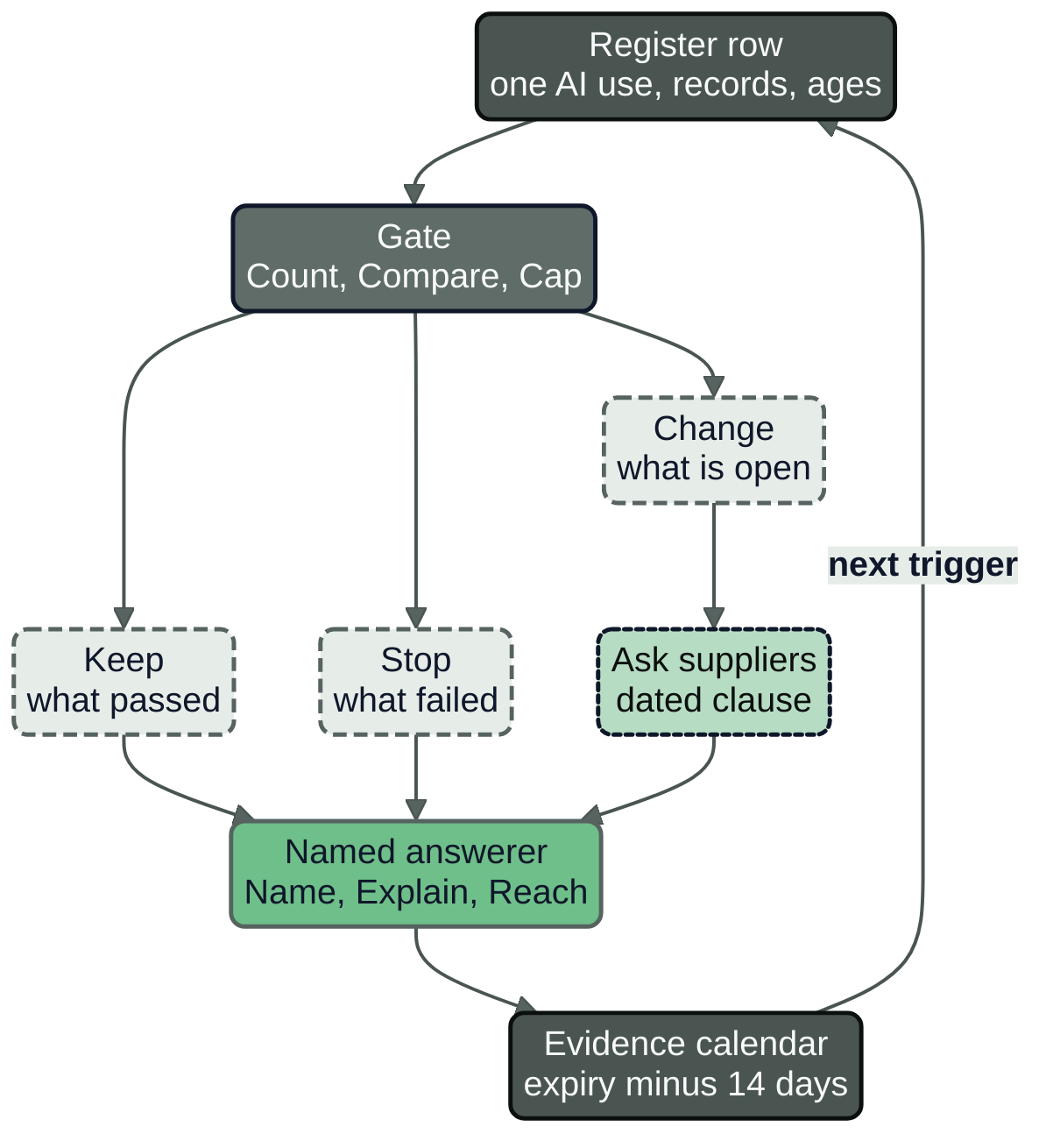
Figure 28.1: How a conclusion is drawn for one use. The gate of Chapter 24 sorts the row into keep, change or stop; only a change reaches suppliers; every outcome ends with a named person and a date. All identifiers illustrative.
How the conclusions are drawn
Each conclusion answers six questions about one use, in this order. The order matters, because the optimisation hierarchy of Chapter 4 puts necessity first and the later levers after it, and a conclusion that begins with a lever skips the question of whether the use should run at all.
- Keep. Which decisions already rest on evidence that passed the relevant test at its boundary, and should therefore be left alone. A conclusion that changes nothing is a result, and it is recorded as one.
- Change. Which decisions rest on a test that is open, or on evidence that has aged, and what the next record to write is.
- Stop. Which statements, uses, extensions or purchases failed a test, or have no test behind them, and should end or not begin. Chapter 25's rule applies: a use that has not passed Count and Compare at its present volume is held under a cap, and a use whose benefit is nil against the alternative is declined, with what is forgone and what would reopen it written down.
- Ask suppliers. Which missing evidence only a supplier can give, as a dated clause with a boundary and an age limit and not as a favour (Chapter 23). A supplier ask follows only from a change, because an organisation that has not decided what it will do with a figure has no reason to buy it.
- Who answers. A named person who passes the three tests of the answerability principle of AI Leader, Chapter 4 (35, Nordqvist, 2026): Name (the person is identifiable in the record), Explain (the person can give the reasons without the system that proposed the decision) and Reach (the person has the authority, the time and the information to change or stop the decision, outside the system that proposed it). Delegation moves work and never answerability. Chapter 24 assembled this into roles and tiers; this chapter applies it to the decisions that remain.
- What would change it. Evidence, dated, whose arrival would reverse the decision. It is the evidence-age calendar of the next sections, together with the watch lists
WCH-NR-0001andWCH-HM-0001of Chapter 11.
The method does not allocate a new AI Decision Record. Every decision below is already recorded, and the conclusions point to the number. The ranges are as Chapter 4 fixed them: Nordvik Region AIDR-1300 to 1349 and Hansa Mutual AIDR-1350 to 1399.
Nordvik Region
The Region is a public authority with a citizen-facing assistant whose volume grew from 71,000 resolved enquiries in October 2026 to about 168,000 a month, a hosting contract due for re-tender, a data centre it operates, and a register in which one of six uses had complete evidence on 13 December 2032. The conclusions are therefore mostly about evidence and contracts. The Region has no Mode 5 agent, so the largest agent risks of Chapter 15 are small here, and the largest levers are the ones a buyer pulls: what it asks for, what it caps and what it declines.
What to keep
Keep five things, each because it passed a test and not because it was started first.
The open-weight route of the citizen-service assistant (FPR-NR-0001) runs under its budget EBG-NR-0001, with a stop path, STOP-NR-ENV-01, that has been drilled twice and failed once: the drill of 16 November 2032 took 14 minutes against a target of 10, the drill of 7 December 2032 took 6 minutes 20 seconds. That sequence is the result worth keeping, not the pass. A first drill that fails and is repeated is the evidence that the drill measures something. In January 2033, as Chapter 27 tells, the stop acted automatically (INC-NR-2033-0007, AIDR-1320) and the Region decided, with the cap holding, to allow a conditional 10 per cent for February and to set weekly sub-quotas.
The tuned small model for the correspondence classifier (MCR-NR-0001, AIDR-1312; FPR-NR-0005) stays. At the node boundary its measured energy was 0.004 Wh per item against 0.12 Wh and 0.80 Wh for the two general models of the comparison (measured 2032-10-11, illustrative, operational, reserved pool), and it met the accuracy threshold on the independent test set. The retraining policy of AIDR-1314 stays with it: an adapter fine-tune, a measured trigger and a 900 kWh training budget.
The environmental register and the Count rule (AIDR-1300) stay, with the gate of AIDR-1324 and the claim path. The refusal to make a claim from an unmeasured use (AIDR-1309) also stays: the Region proceeds with the assistant on service and cost benefit and makes no environmental claim from it.
The sufficiency rule of AIDR-1325 stays, including its cap of 25,000 explanations a month on the hosted eligibility-explanation route. And the decision not to exclude any hosting option on environmental grounds before the tender answers are in (AIDR-1319) stays, because an exclusion by label is a decision without a Count.
What to change
Change four things, in this order.
First, refresh the one complete row. The footprint of FPR-NR-0001 is valid for 90 days from 4 October 2032, to 2 January 2033, and the register is only as good as its one complete row. Chapter 24 put the review at 19 December 2032. The refresh is also the place to settle the two labelled values of the record. Revision 1 of Chapter 6 gives 16.3 Wh per resolved enquiry at the facility boundary (0.52 g CO2e, location-based, September 2032). The draft revision 2 of Chapter 8 gives 30.5 Wh at the same boundary (0.98 g). They differ in three inputs and not in the boundary. The register carries revision 1 at the snapshot of 13 December, and Chapter 27 shows the review of 19 December replacing it with revision 2. The conclusion is that no claim and no relaxation of the budget rests on either until an independent check of the pool share and the power draw has been recorded, and that the Region says in public that the hosted route is outside the figure.
Second, write the five missing footprint records. The staff assistant (FPR-NR-0003), the benefits-triage ranking (FPR-NR-0004), the builder workspace assistant (FPR-NR-0006) and the platform team's agentic tools (FPR-NR-0008) have no measured footprint, and the hosted route (FPR-NR-0002) has only a rung 5 reading. The order follows volume and risk. The staff assistant, with about 410,000 requests a month, is first, and it is already conditional: AIDR-1326 declined to extend it from about 3,200 to about 4,400 users until a footprint record exists by 28 February 2033, an environmental budget with a drilled stop by 14 March 2033 and a benefit record from a comparison on a sample of work, not on usage, by 29 April 2033. The triage ranking comes next, and it needs one thing before a record can exist: meter the AI share of nordvik-dc. The data centre's PUE of about 1.55 is a site figure, and until the AI share is metered the ranking's footprint is an allocation from a ratio nobody measured.
Third, give the correspondence classifier's budget a drill. EBG-NR-0002 has no stop drill, and a budget without a drill is proposed, not active (Chapter 15). The same applies to the placement budget EBG-NR-0003 for nightly indexing, proposed under AIDR-1317.
Fourth, carry the evidence into the contract. The re-tender of NR-2026-031 is where the Region's gaps become requirements: TA-NR-ENV-01, issued on 14 February 2033 in the illustrative timeline, weights environmental disclosure at 12 of 100 quality points. The hardware record HWL-NR-0001 shows the other side: 24 reserved accelerators at a utilisation of 0.58, of which four are idle by plan at about EUR 65,000 a year. The re-tender should buy an option to shrink the reservation, because the conclusion of Chapter 16 is that utilisation is the cheapest lever and a reserved pool turns it into a contract term.
What to stop
Stop three things. The first has been done and the other two have not.
The Region has stopped using its public figure of 1.90 g CO2e per resolved enquiry (CLM-NR-0001, revision 2, AIDR-1322 of 13 December 2032). The figure dated from October 2026, was 2,235 days old at the withdrawal, covered one route and excluded the hosted one. The correction is published, two claims are declined, and the record says what would allow a republication: an independent check of FPR-NR-0001 and a stated gap for the hosted route.
The second is the use of BEN-NR-0006, a one-month comparison with no comparison group (41 calls in August 2031, 17 in January 2032), as evidence of a benefit. It was measured on 31 January 2032, so its 180 days ended on 29 July 2032 and it was 317 days old at the snapshot of 13 December 2032, and it was never a measurement of effect. The builder workspace assistant continues in its sandbox, and nothing is claimed for it. A new record may be written, and it will be tested against a comparison, not against the same month a year earlier.
The third is any extension of a hosted route without a figure. The eligibility-explanation route stays capped at 25,000 explanations a month (AIDR-1325), because it is the one route with no energy figure, a rung 5 supplier record (SDR-NR-0002) and, in the sufficiency rule's terms, a benefit that has not passed Compare at its present volume.
What to ask suppliers
The Region has three suppliers whose silence limits it, and each ask comes from a gap in a record (Table 28.1).
Table 28.1: Nordvik Region: the gap in each supplier's record and the ask, as a dated clause (illustrative).
| Supplier | Gap in the record | The ask, as a dated clause |
|---|---|---|
Hosting provider (NR-2026-031) |
SDR-NR-0001: no energy, grid mix, embodied or water by customer; SDR-NR-0003: generator hours refused; WUE, refrigerant, label class null |
Facility-level annex figures yearly; monthly metered energy of the reserved pool; water by customer; a shrink option |
| Hosted model provider (eligibility route) | FPR-NR-0007: one of eight fields given, six missing; site, grid and per-request energy undisclosed |
Per-request energy or a documented method; region of execution; notice of model change; valid 12 months |
| Application provider of the triage system | FPR-NR-0004: retraining compute (four retrainings a year) not reported |
Compute and energy of each retraining on the Region's platform, from the Region's own meters where possible |
The third row is a conclusion of this chapter and is not recorded elsewhere. It follows the pattern of the first: where the application runs in the buyer's halls, the buyer can read the meter, and the clause should say so.
Who answers
Elisabet Holmgren, the regional director, answers for the decisions the Region's thresholds send to her: a budget above 4,000 kWh a month, which EBG-NR-0001 is at 4,450 kWh, an agent that can start work, and the publication of any environmental claim. She passes Name because each such decision is in an AI Decision Record under her name, Explain because the record states the three tests and their results and the reasons, and Reach because the stop for the citizen assistant is held by Henrik Dahl and the platform on-call, outside the assistant, and she can order it.
The regional AI board decides budgets of 1,000 to 4,000 kWh a month and every gate with an open or failed test, which is the staff assistant's AIDR-1326. Henrik Dahl owns the register and decides up to 1,000 kWh. The use owners, Sara Ekdahl, Gunilla Roos and Maja Lindqvist, answer for the records of their uses, and the service desk manager, outside the sponsor line, answers for the benefit record BEN-NR-0001, so that the person who wants the use to look good is not the person who measures its benefit. The award of the re-tender stays with a named official under procurement law. An AI system may help to draft the annex and to read the supplier's schedules, at Level 1 or 2, and does not award, exclude, terminate or publish.
What would change the decisions
The conclusions above change on dated evidence. Table 28.2 is the Region's decision table for the six uses and the contract; the calendar in the next section carries the dates.
Table 28.2: Nordvik Region, decisions at the records of Chapters 9 to 25 (illustrative).
| Use or object | Decision | Answers | Next record | Evidence that would change it |
|---|---|---|---|---|
Citizen assistant, open weight (FPR-NR-0001) |
Keep under EBG-NR-0001; refresh and settle revisions |
Sara Ekdahl; Henrik Dahl | Footprint by 2033-01-02; drill by 2033-03-07 | Rebound alert at 20 per cent over 146,000; BEN-NR-0001 expiry 2033-05-07 |
Citizen assistant, hosted route (FPR-NR-0002) |
Hold at cap 25,000 a month | Sara Ekdahl | Sheet FPR-NR-0007 answered |
A rung 4 estimate and a benefit record that passes Compare |
Staff assistant (FPR-NR-0003) |
Not extended; conditions | Gunilla Roos; regional AI board | Footprint 2033-02-28; budget 2033-03-14; benefit 2033-04-29 | All three conditions met, and Compare passed on work, not usage |
Triage ranking (FPR-NR-0004) |
Meter the AI share of nordvik-dc; write record |
Head of the Benefits Unit | Metering plan | A measured share; retraining energy from the supplier |
Classifier (FPR-NR-0005) |
Keep tuned model; drill the budget | Maja Lindqvist | Footprint by 2033-01-09 | Accuracy on the shifted set below 0.90, or a retraining trigger |
Hosting contract and claim (NR-2026-031, CLM-NR-0001) |
Re-tender with TA-NR-ENV-01; no claim until checked |
Ida Pettersson; Henrik Dahl | Annex 2033-02-14 | Tender answers; independent check of FPR-NR-0001 |
Hansa Mutual
The group is a large undertaking with a CSRD duty, its own 2.8 MW data centre in Frankfurt, burst capacity in two clouds and hosted providers on different boundaries. Its largest uses are agents: a Mode 5 claims-triage agent with an average of nine model calls per claim and an IT-operations agent with write access to production. Its conclusions are therefore mostly about budgets, boundaries and one board statement, and the cost of a wrong figure is higher because the figure goes into an audited statement.
What to keep
Keep six things.
The claims assistant's cascade (MCR-HM-0001, AIDR-1362) stays: at the node boundary on the evaluation set it used 0.996 Wh per query at an escalation rate of 22 per cent, with a cascade quality of 96.8 per cent against a requirement of 96.0, and its budget EBG-HM-0002 is active with a drill on 27 October 2032. The serving budget of AIDR-1363 (EBG-HM-0003, 2,900 kWh a month at the rack IT boundary) and its levers stay as the design of the serving path, with their status as proposed until a drill exists. The two figures of this use, 0.996 Wh at the node boundary and 3.91 falling to 2.42 Wh at the rack boundary of the sentinel pool, are different set-ups and are never added or compared.
The decision to keep the claims assistant at the retrieval rung (AIDR-1364) stays, with the fine-tune re-examined after two months. The group's decision to redesign the claims-triage agent (AIDR-1359) stays: rules for structured claims, the agent for free text. The comparison with the rule router found 93.5 per cent correct routes for the agent against 91.8 per cent for rules (eight weeks to 31 October 2032, 6,000 claims), and the benefit lies in the free-text claims. That decision holds at both values of FPR-HM-0002, the bottom-up 2.3 Wh per claim at the facility boundary (0.81 g CO2e) and the top-down 21 Wh per claim at the IT boundary (10.3 g CO2e), which are about thirteen times apart in carbon once both are put on the facility boundary (Chapters 6, 8 and 20) and are never merged into one number.
Frankfurt stays as the baseline for the platform, with Cloud A for burst only under EBG-HM-0006 (AIDR-1369), because the group has the strongest metering there and the least where it is not. The held board statement (AIDR-1361) stays held.
What to change
First, meter the burst route. The first stop drill of the triage agent's budget EBG-HM-0001, on 15 November 2032, failed on the unmetered burst route to Cloud A, and the second, on 29 November 2032, took 2 minutes 10 seconds. The conclusion is that no agent budget is active until every route to a model has been drilled, and that the group's largest unknown, the energy of Cloud A burst, needs a measure outside the cloud: the invoiced accelerator-hours that EBG-HM-0006 already uses, converted at a stated factor, with the supplier's own report as a check.
Second, close the two open benefit records. BEN-HM-0001 for the claims assistant is due by 31 March 2033 (a condition of AIDR-1376), and until it exists the extension to the UK and Swiss entities, about 140 further handlers, may not grow beyond the budget's volume trigger of 1,210,000 queries a month. BEN-HM-0002 for the triage agent has a result that matters for Compare: 48 g CO2e per correct route on the bottom-up footprint and about 600 g on the top-down one, for about 2,380 extra correct routes a month, and Compare fails. The 90-day retest of the redesign falls on 13 February 2033.
Third, write footprint records for the uses that have none. The underwriting-support model (FPR-HM-0004) has rack-level energy only, and the IT-operations agent (FPR-HM-0005) has a cost cap of EUR 6,000 a month and nothing else. A cost cap is not an energy budget, and the IT-operations agent has write access to production, so it needs the environmental budget and the stop drill of a Mode 5 agent before it needs the footprint figure.
Fourth, finish the facility. The cooling controller's budget EBG-HM-0005 is proposed, with no drill. Its stop is a switch to the fixed profile SP-SAFE, held by Tobias Richter, and it counts as a stop only after it has been drilled. The district-heating connection study is open, and no benefit is claimed for heat reuse until a heat user, a temperature and a contract exist (Chapter 18). The GPU pool is consolidated from twelve servers to nine and nothing is ordered before a benchmark on the group's own workload (AIDR-1366), an action that Chapter 16 priced at 41 tonnes of CO2e a year at the Frankfurt location-based factor, with nothing bought.
Fifth, put an AI memo line in the group statement. The group cannot separate AI inside Scope 2 and Scope 3. The conclusion of Chapter 22 is a labelled memo line, with location-based and market-based figures side by side, owned by Dr. Verena Lindner, and not a restated inventory.
What to stop
Stop four things.
Stop the board's statement that AI work at the group "became more efficient" until CLM-HM-0001 supports it. Revision 2, narrowed to one use, one pool and one boundary (the claims assistant, the test pool, rack IT energy, 3.9 to 2.4 Wh per query, minus 38 per cent), was approved on 13 December 2032 and lapsed on 26 January 2033. A lapsed narrow claim is not a licence to restate the broad one.
Stop reading a supplier tool as if it were the group's own method. For a re-scoring batch of about 9,500 accelerator-hours, Cloud A's tool reported 0.41 t CO2e market-based and the group's own estimate was 2.2 t location-based. The two are not a disagreement; they are different bases. The record carries both, labelled, and neither is compared with the other.
Stop growth of the engineering tools. The doubling of licences from about 700 to about 1,400 was declined (AIDR-1375, FPR-HM-0006, 38,000 sessions a month), because no measured effect of the tools is recorded and the footprint record has seats and tokens only.
Stop ordering hardware ahead of the benchmark (AIDR-1366).
What to ask suppliers
Table 28.3 gives the group's asks in the same form.
Table 28.3: Hansa Mutual: the gap in each supplier's record and the ask, as a dated clause (illustrative).
| Supplier | Gap in the record | The ask, as a dated clause |
|---|---|---|
Cloud A (SDR-HM-0002) |
3 of 10 questions answered; account-level, market-based, monthly with a lag | Location-based and market-based figures side by side; facility PUE and WUE; region and hour of execution; clause family HM-PROC-ENV from renewal |
Regional provider with a Nordic site (SDR-HM-0003) |
6 of 10 answered; site PUE 1.25 and 60 g/kWh assumed, not measured | Measured values, with boundary and year, before the 90-day pilot ends |
| Hosted model providers (correspondence and engineering routes) | Annex XI estimates and per-request figures partial and on different boundaries | Per-request energy with its method, or a stated rung 4 estimate; notice of change of model |
The first row follows Chapter 23: the clause family attaches at each renewal, so the first renewal is the first ask. A 90-day pilot (AIDR-1369) that starts at the decision ends on 13 February 2033, and it is the occasion on which the regional provider's assumed values are either measured or marked as assumptions in the comparison sheet HCS-HM-2032-11.
Who answers
Dr. Annette Krämer, the chief risk officer, chairs the group AI governance board, which approves budgets above 2,500 kWh a month, every Mode 5 budget, every facility budget and every claim before publication. For the triage agent she passes Name (the budget and mandate are in AIDR-1365 and MND-HM-ENV-0001), Explain (the record gives the call, tool-call, time and energy ceilings and why) and Reach (the gateway stops the route at the cap, and the holders of the stop need no meeting). Dorothea Keil is the claimant of the board's statement and does not approve it, and the claim is approved by Dr. Krämer after review by Dr. Lindner and Ulf Zimmermann. Anja Weiß owns the register and sets budgets, and she does not approve the ones she sets above the threshold. Katrin Ohlsen owns the business outcomes of the three claims uses, and the head of claims operations at the Polish service centre, outside the sponsor line, owns BEN-HM-0002.
What would change the decisions
Table 28.4 is the group's decision table, in the same form as the Region's.
Table 28.4: Hansa Mutual, decisions at the records of Chapters 9 to 25 (illustrative).
| Use or object | Decision | Answers | Next record | Evidence that would change it |
|---|---|---|---|---|
Claims assistant (FPR-HM-0001) |
Keep cascade; extension inside 1,210,000 queries | Katrin Ohlsen; Anja Weiß | Re-measure and drill by 2033-01-16; BEN-HM-0001 by 2033-03-31 |
Escalation above 0.35; quality below 0.96; no benefit record |
Triage agent (FPR-HM-0002) |
Redesign; rules for structured claims | Katrin Ohlsen; Dr. Verena Lindner | Retest 2033-02-13; drill by 2033-02-27 | Idle-capacity attribution measured; a retest that changes the route split |
Correspondence assistant (FPR-HM-0003) |
Ask providers; no change of route | Katrin Ohlsen | Provider answers | A provider figure on a stated boundary |
Underwriting and IT-operations (FPR-HM-0004, 0005) |
Write records; budget and drill for the agent | Head of underwriting; Tobias Richter | Footprint record; EBG for the agent |
A rack-level share per use |
Engineering tools (FPR-HM-0006) |
Hold at 700 licences | Dr. Philipp Reinhardt | Benefit record | A measured effect on engineering work |
Frankfurt pool and hosting (HWL-HM-0001, AIDR-1369) |
Consolidate to nine; burst capped; pilot | Anja Weiß; Stefan Wiedemann | Hardware record 2033-02-06; pilot 2033-02-13 | Benchmark result; pilot measurements; Cloud A answers |
The evidence-age calendar
A decision is only as current as the evidence under it. The calendar turns the validity values of Chapter 24 (90 days for a running footprint, a stop drill and a hardware utilisation, 180 days for a benefit record, counted from its decision date as in Chapter 9, 12 months for a supplier disclosure and the reporting year at most for a claim) into the dates on which each decision can be reopened. For each item the review date is the expiry minus 14 days, and a row with a missing item is reviewed now. The calendar is a file in version control, checked by a script that runs outside any agent, in the form of the register of Chapter 24.
# register/evidence-calendar-hm.yaml  (illustrative; Hansa Mutual, records as written to 2032-12-13)
calendar: ECAL-HM-0001
owner: anja-weiss                 # register owner, ROLE-HM-ENV-02
lead_days: 14                     # review date = expiry minus lead_days
items:
  - {record: FPR-HM-0002, item: footprint, expires: 2033-01-04, reviewer: katrin-ohlsen, can_change: AIDR-1359}
  - {record: FPR-HM-0001, item: footprint, expires: 2033-01-16, reviewer: katrin-ohlsen, can_change: AIDR-1376}
  - {record: EBG-HM-0002, item: stop drill, expires: 2033-01-25, reviewer: anja-weiss, can_change: AIDR-1362}
  - {record: CLM-HM-0001, item: claim rev 2, expires: 2033-01-26, reviewer: dr-verena-lindner, can_change: AIDR-1372}
  - {record: HWL-HM-0001, item: hardware record, expires: 2033-02-06, reviewer: katja-neumann, can_change: AIDR-1366}
  - {record: EBG-HM-0001, item: stop drill, expires: 2033-02-27, reviewer: anja-weiss, can_change: AIDR-1365}
  - {record: BEN-HM-0001, item: benefit record due, expires: 2033-03-31, reviewer: head-of-claims-operations, can_change: AIDR-1376}
  - {record: BEN-HM-0002, item: benefit, expires: 2033-05-14, reviewer: anja-weiss, can_change: AIDR-1359}
  - {record: SDR-HM-0002, item: supplier disclosure, expires: 2033-11-08, reviewer: stefan-wiedemann, can_change: AIDR-1369}
labels: [illustrative]
The script below derives the review dates and prints them in order. It reads the file above and needs only PyYAML.
import sys
from datetime import timedelta
import yaml

with open(sys.argv[1], encoding="utf-8") as f:
    cal = yaml.safe_load(f)
lead = timedelta(days=cal["lead_days"])
for it in sorted(cal["items"], key=lambda i: i["expires"]):
    print(f"{it['expires'] - lead}  {it['record']:<12} {it['item']:<22} {it['reviewer']}")
Run on the file, it prints first 2032-12-21 FPR-HM-0002 footprint katrin-ohlsen and last 2033-10-25 SDR-HM-0002 supplier disclosure stefan-wiedemann. The first date agrees with Table 24.7. The seventh row (BEN-HM-0001) is a deadline and not an expiry, and the file keeps one field for both because the review is the same act: someone reads the date and decides whether the decision stands.
Tables 28.5 and 28.6 give the two calendars in the form a forum reads. Dates are those the records carry; the Region's rows derive from the same validity values.
Table 28.5: Evidence-age calendar, Nordvik Region, from the records (illustrative).
| Date | Record and item | What falls due | Owner | Decision it can change |
|---|---|---|---|---|
| 2033-01-02 | FPR-NR-0001 footprint |
Refresh and settle revisions 1 and 2 | Sara Ekdahl with Astrid Nyberg | AIDR-1309; claim republication |
| 2033-01-09 | FPR-NR-0005 footprint |
Refresh; drill the budget | Maja Lindqvist | AIDR-1312, AIDR-1314 |
| 2033-01-16 | WCH-NR-0001 first 90-day review |
Five markers read | Henrik Dahl with Astrid Nyberg | Stance of AIDR-1311 |
| 2033-02-13 | HWL-NR-0001 hardware record |
Utilisation; idle four | Ida Pettersson | Shrink option in the tender |
| 2033-03-07 | EBG-NR-0001 stop drill |
Repeat the drill | Maja Lindqvist | The cap of AIDR-1320 |
| 2033-03-14 | FPR-NR-0003 budget and review |
Budget with a drilled stop | Gunilla Roos | AIDR-1326 |
| 2033-05-07 | BEN-NR-0001 benefit |
Fresh comparison | Service desk manager | AIDR-1309, AIDR-1325 |
| 2033-05-15 | SDR-NR-0001 disclosure |
Annex VII figures | Ida Pettersson | Contract and tender scoring |
Table 28.6: Evidence-age calendar, Hansa Mutual, from the records (illustrative).
| Date | Record and item | What falls due | Owner | Decision it can change |
|---|---|---|---|---|
| 2033-01-04 | FPR-HM-0002 footprint |
Re-measure at both boundaries | Katrin Ohlsen with Dr. Verena Lindner | AIDR-1359, AIDR-1365 |
| 2033-01-16 | FPR-HM-0001 footprint |
Re-measure; repeat the drill | Katrin Ohlsen | AIDR-1376 |
| 2033-01-26 | CLM-HM-0001 revision 2 |
Lapses; renew or let go | Dr. Verena Lindner | AIDR-1361, AIDR-1372 |
| 2033-02-06 | HWL-HM-0001 hardware record |
Utilisation after consolidation | Katja Neumann | AIDR-1366 |
| 2033-02-13 | Retest and pilot | 90 days from the decisions | Anja Weiß; Stefan Wiedemann | AIDR-1359, AIDR-1369 |
| 2033-02-27 | EBG-HM-0001 stop drill |
Repeat on every route | Anja Weiß | AIDR-1365 |
| 2033-03-31 | BEN-HM-0001 |
Benefit record due | Head of claims operations | AIDR-1376 |
| 2033-11-08 | SDR-HM-0001, 0002, HCS-HM-2032-11 |
Disclosures expire | Stefan Wiedemann | AIDR-1369 |
Two outside dates sit on top of both calendars, and both are labelled by their status. The rating act for data centres, C(2026) 3472 final, was adopted by the Commission on 21 September 2026 and is not yet in force; its first labels are due on 15 August 2027, so the facility rows of both organisations may gain a rating then (expected). The Commission has planned a proposal on minimum performance standards for data centres for the second quarter of 2027 (expected). Neither date changes a decision before it arrives, the regulatory register of Chapter 21 carries the trigger for each, and Chapter 18 carries the sources.
What is common and what differs
Four things are common because they are the method, and four differ because the setting differs.
The register, the gate, the budget and the stop path are common. Each organisation holds a row per use, applies Count, Compare and Cap at proposal, scale-up and renewal, sets a budget that a person other than the user of the use has set, and drills a stop that sits outside the system it stops. In both, the faults the registers record are of the same three kinds: a figure that has aged, a budget without a drilled route, and a claim without a record.
What differs is, first, what each can control. The Region buys its capacity and so its lever is the contract; the group owns racks and so its levers are the budget and the meter. Second, the legal regime: the Region is a public authority whose records are public under Swedish access rules, so every claim is written to be read in public, and the group is under a corporate reporting duty with limited assurance, so every figure is written to be audited. Third, the grid: 32 g CO2e per kWh in the Region's profile and 350 g in Frankfurt (location-based, illustrative) mean that the same saving is worth about eleven times as much at Frankfurt, and that embodied emissions weigh more in the Region's case (Chapter 16). Fourth, the agents: the Region has none at Mode 5 and the group has two, so the group's budgets are about runs and its board approves every one of them.
What this means for an organisation that is neither of them
Most readers run neither a regional authority with a data centre nor a group with its own racks. The conclusions above scale down, and what scales is the order, not the size. This section is the book's own advice for two common cases. Neither is a case study, and every number in it is a default to be replaced by the reader's own.
A small public body
A small public body, a municipality or an agency with a few hundred staff, typically buys AI as a service, runs no data centre and has one or two uses: an assistant in the office suite, perhaps a chatbot or a transcription tool. The conclusions are three, and they take about two and a half working weeks a year for one use (author's estimate, Chapter 20).
- Write the list. One row per AI use, including the ones bought inside licensed software: owner by name, supplier, volume per month, what the use is for and the date the row was last read. Do this in the first two weeks. Most small bodies find a use nobody owned.
- Cap the use and name the person who can switch it off. A licence cap or a gateway quota is enough, and so is a named person with the authority to cancel the licence. Test the switch once and write down the date. A stop that has not been tried is a hope.
- Put three questions into the next contract or renewal, with a date. What is the energy of the service per unit of use, and at which boundary? In which region does it run? What notice will you give of a change of model? A supplier that cannot answer is recorded at its rung of the ladder of Chapter 8 (the buyer's own estimate, with a range, or "not disclosed"), and the body decides at renewal whether to weigh that in its award criteria, as Chapter 23 shows a public authority may.
Stop any public statement about the environmental benefit of AI until a record exists: the statement, the boundary, the baseline and who approved it. Public bodies have the Region's reason: the records are public.
A mid-sized company
A mid-sized company, a few thousand staff and a mix of cloud services and hosted models, may fall inside reporting duties or may be asked by its customers for figures. It does not need the group's metering to start, and it should not start with it.
- Start with the largest use by volume and the one with an agent. Count it once, at a stated boundary and year, with a range, and label it an estimate with the method. For a hosted model, record the rung, not a guess dressed as a measurement.
- Give every agent a budget set by someone else. Per run and per month, on a credential the agent cannot widen, with a person who can stop it outside the agent. This is the cheapest control in the book and the one the triage agent in Chapter 15 failed its first drill on a route it had not metered.
- Ask the cloud suppliers for both carbon bases. Location-based and market-based, side by side, and keep the two apart. When customers ask for figures, give the one use, the boundary and the date, not a company-wide statement.
- Keep a claim record and a calendar. Footprint 90 days, benefit 180, disclosure 12 months. Put the calendar in a file, have a script read it and let the owner see the dates.
Both cases share one rule that the two organisations learned the same way: a figure without a date is a figure the organisation will defend after it has stopped being true. The cheapest improvement available to a reader of this book is to add an owner's name and a date to every row of the list of AI uses the organisation already has.
Across the modes and the organisations
Across the degrees of delegation
Table 28.7 gives the target ceiling for each class of action for each organisation, from the delegation table of Chapter 15. Both organisations take the ceilings of Chapter 4 as maxima. Raising a degree is a decision with a record, and lowering it is immediate.
Table 28.7: Target ceilings by class of action at Nordvik Region and Hansa Mutual, and whether Level 4 applies (illustrative).
| Class of action | Nordvik Region | Hansa Mutual | Level 4? |
|---|---|---|---|
| Measure and report a use's own run | Level 3 Bounded (Mode 3 tools) | Level 3 Bounded (Modes 3 to 5) | Not needed |
| Start a run on a registered trigger | Not used (no Mode 5) | Level 3 Bounded, inside per-run, daily and monthly limits | Never beyond the budget |
| Provision or scale up its own compute | Level 2 Supervised within budget; above it, Level 1 | Level 2 Supervised within budget; above it, Level 1 | Never |
| Change its own limits, meter, credential or stop path | Level 0 Advisory | Level 0 Advisory | Never |
| Stop at the budget | Gateway control, not a delegated act; the agent may request a stop of its own run at Level 3 | Gateway control, not a delegated act; the agent may request a stop of its own run at Level 3 | Not applicable |
| Publish an environmental claim | Level 1 Assisted (drafts) | Level 1 Assisted (drafts) | Never |
| Award or terminate a tender, or decide about a named person's access to work | Level 0 or 1; a named official acts | Level 0 or 1; a named person acts | Never |
Nordvik Region and Hansa Mutual
The chapter is about the two organisations throughout, and this subsection records how its conclusions depend on the profiles in docs/EXAMPLE_ORGANISATIONS.md. Every figure of both organisations is illustrative: the Region's 32 g CO2e per kWh, the group's 350 g CO2e per kWh, the PUE values of 1.55 and 1.38, the utilisation of 0.58 and 0.52, the volumes and the records. None is data about a real body. The conclusions would hold in direction at other values, as Chapter 16's break-even shows for the grid factor, and they would not hold at all without the records.
Summary
This chapter concerned all five environmental functions: E1 Measure, E2 Justify, E3 Design, E4 Operate and E5 Account. It drew the book's conclusions for the two organisations. For each use it answered six questions: what to keep, what to change, what to stop, what to ask suppliers, who answers and what evidence would change the decision. The answers rest on the identifiers and decisions of Chapters 9 to 25 and add no external evidence.
For Nordvik Region the conclusion is to keep the budgeted and drilled open-weight route, the tuned classifier and the register. It should refresh its one complete row and write the five missing records. It should carry the missing evidence into the re-tender of NR-2026-031 through TA-NR-ENV-01. And it should stop relying on a withdrawn figure, an expired benefit record and any growth of a route without an energy figure.
For Hansa Mutual the conclusion is to keep the cascade, the redesign of the triage agent and the Frankfurt baseline, and to meter the burst route and close the benefit records. It should stop the board's statement, the growth of the engineering tools and orders ahead of a benchmark. And it should ask Cloud A, the regional provider and the hosted model providers for evidence on a stated boundary.
In both organisations a named person answers for each decision, and the evidence-age calendar says when it can be reopened. The same method scales to a small public body and a mid-sized company, and what it needs of them is a list, a cap with a tested stop and three dated questions. Chapter 29 draws the book's conclusion for every reader and states the author's own projections, labelled as such.
Sources
- Nordqvist, G. (2026). AI Leader: How Leadership Roles Change When AI Is Used Broadly in European Enterprises and Public Authorities. The Transformed Architecture, Book 11, Chapters 4, 12 and 13 (the answerability principle: Name, Explain, Reach). (35, Nordqvist, 2026)