Reporting and Claims: Accounting Methods and How to Avoid Greenwashing
Chapter 21 showed that the law delivers little evidence about an AI use to the organisation that deploys it. This chapter turns to what that organisation then says. It concerns E5 Account, the function in which an organisation states its footprint or its benefit to someone who cannot check it: the board, the auditor, the citizen, the customer, the regulator. It serves the Count test, because a figure needs a stated method, and the Compare test, because a benefit claim needs a baseline (Chapter 4). It covers the accounting methods that decide which number is reported, how AI enters reporting, the European rules on environmental claims, the patterns that make a claim misleading, and the record, CLM-*, that keeps a claim honest.
A figure is true under a method, and the method is a choice. A claim is a sentence built on a figure, and usually says more than the figure can carry. Greenwashing is seldom a lie about a number; it is a gap between what the number covers and what the sentence implies. The cheapest way to close the gap is to write the boundary, the method, the baseline, the age and the name of the person who answers into a record before the sentence is published.
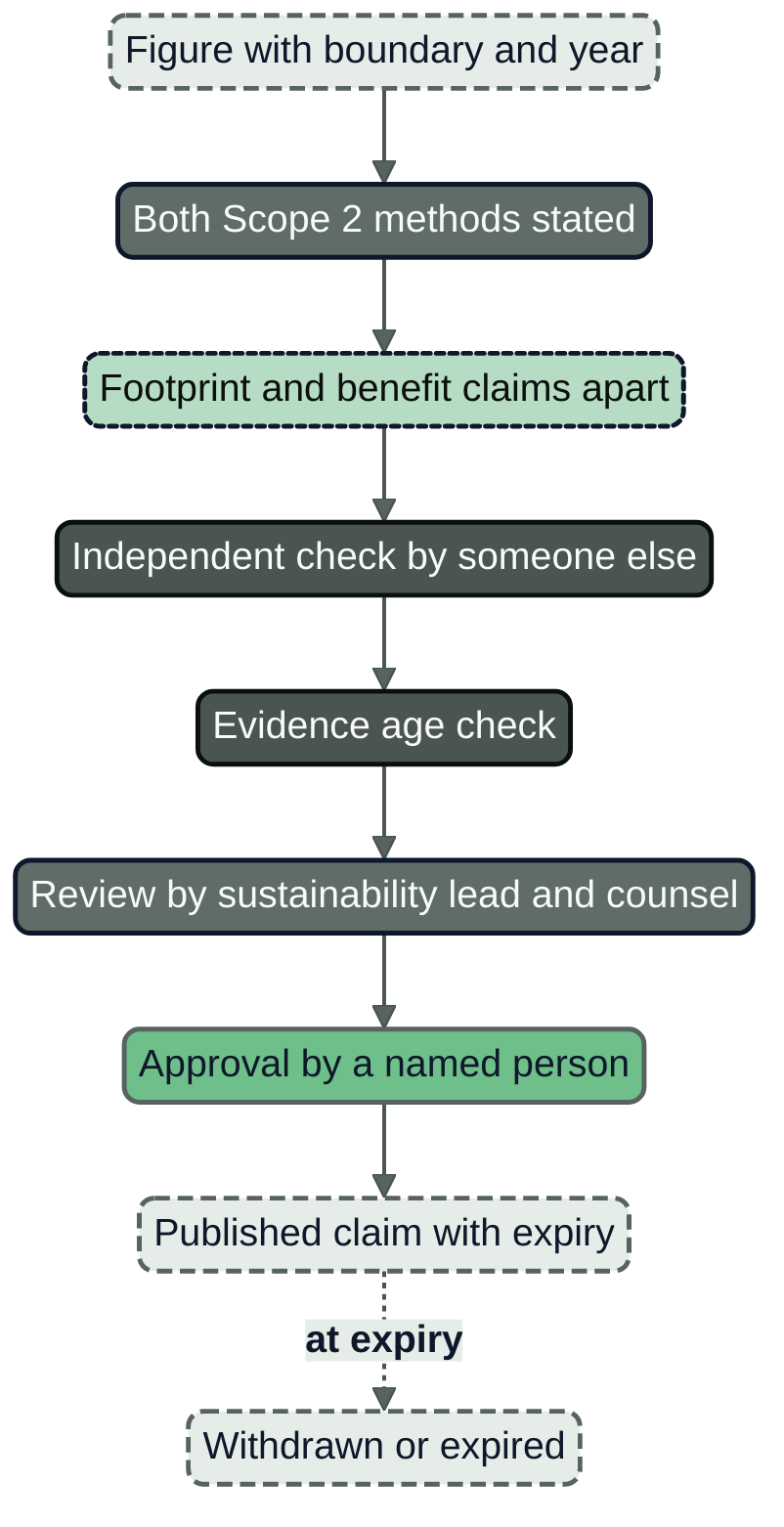
Figure 22.1: A claim from figure to publication. Every step is a field in the claim record; a claim whose evidence expires is withdrawn.
A statement that was true and misleading
A draft for the group sustainability statement of Hansa Mutual (illustrative) carries this proposal from the communications team: "Our AI platform runs on 100 per cent renewable electricity and is carbon neutral." Every word can be defended. The Frankfurt data centre buys its electricity with guarantees of origin on an annual basis (a guarantee of origin is an electronic certificate that one megawatt-hour was generated from a stated source). Under the market-based method of the Greenhouse Gas Protocol that purchase gives the covered electricity an emission factor of about zero, so the sentence is arithmetic.
The same month, the platform racks at the site used about 62 MWh of electricity, about 85.6 MWh at the facility boundary with a power usage effectiveness of 1.38, and the German grid has a location-based factor that the profile takes as 350 g CO2e per kWh. The location-based figure for the month is about 30 t CO2e (illustrative, September 2032; Chapter 11). The burst capacity in Cloud A is not metered. A reader who later learns that the platform was responsible for tens of tonnes a month on the grid that supplied it will call "carbon neutral" greenwashing, and will be partly right.
The sentence fails three tests at once. It uses one of two methods without saying so. It implies that the whole platform is covered when a burst route is unmetered. And it uses the words "carbon neutral", which Union consumer-protection law treats as described below. The chapter takes the three failures in turn and then shows the record that would have stopped the sentence.
Location-based and market-based
The two methods
The Greenhouse Gas Protocol, the accounting standard on which almost all corporate carbon reporting rests, divides an organisation's emissions into scopes. Scope 1 is what the organisation burns or releases itself, Scope 2 is the emissions from the electricity, steam, heat and cooling it buys, and Scope 3 is everything else in its value chain, including what its suppliers emit on its behalf. The Scope 2 Guidance of 2015 defines two ways to calculate Scope 2 (24, World Resources Institute and World Business Council for Sustainable Development, 2015).
A location-based method "reflects the average emissions intensity of grids on which energy consumption occurs", using mostly grid-average emission factors. A market-based method "reflects emissions from electricity that companies have purposefully chosen (or their lack of choice)", and it derives its factors from contractual instruments: energy attribute certificates such as guarantees of origin, direct contracts and power purchase agreements, supplier-specific emission rates, and a residual mix for electricity that nobody has claimed. The Guidance requires that a company with operations in markets that offer such instruments report Scope 2 "in two ways" and label each result by method. This dual reporting distinguishes changes in the company's choices from changes in the emissions intensity of the grid and gives stakeholders more of the picture (24, World Resources Institute and World Business Council for Sustainable Development, 2015).
The location-based figure asks what the grid on which the consumption happened emitted; the market-based figure asks what the organisation has bought, and what it has not. Neither is wrong; a figure without its method is unusable.
Why the gap is large for AI
Electricity is the dominant input of AI in operation, so the methods can differ as widely for AI as for any workload in large data centres. Table 22.1 gives published examples with their boundaries (Chapter 2 carries the Google table and Chapter 5 the Llama card).
Table 22.1: Published examples of the two Scope 2 bases, retrieved November 2026. The Google Scope 2 row is company-wide, not AI alone. Sources: (156, Google, 2026) (157, Meta, 2024) (51, Elsworth et al., 2025).
| Figure | Basis | Boundary and year | Value | Kind |
|---|---|---|---|---|
| Google Scope 2 | Location-based and market-based | Whole company, 2025 | Ratio about 5.4 to 1, moving in opposite directions; values in Chapter 2 | Vendor-reported; independent review stated |
| Llama 3.1 405B training | Location-based and market-based | Training only, 30.84 million GPU hours, model card | A positive location-based figure and 0 t market-based; values in Chapter 5 | Vendor-reported |
| Median Gemini Apps text prompt | Market-based | Full serving stack, May 2025, 2024 fleet factor | 0.03 g CO2e (0.24 Wh) per prompt | Vendor-reported; not independently verified |
Google's 2026 environmental report gives the two Scope 2 figures for 2025 that Chapter 2 sets out. The two moved in opposite directions: the location-based figure rose 37 per cent on 2024 while the market-based figure fell 3 per cent. The report describes the location-based figure as the emissions the company "would have reported if we didn't use any market-based interventions" such as power purchase agreements and other clean energy agreements, and it states that both Scope 2 figures were independently verified (156, Google, 2026). The figures concern the whole company, with its search, cloud and devices, and the book does not attribute them to AI. They show what a reader loses when a company reports one basis: a market-based series that fell, beside a location-based series that rose with the load.
The model card of Meta's Llama 3.1 gives the same pair for one training run (values in Chapter 5): a positive location-based figure for the 405-billion-parameter model and 0 t market-based, with the note that the company has matched 100 per cent of its electricity use with renewable energy (157, Meta, 2024). The card prints both. The risk lies downstream: a sentence that quotes the zero ("training the model emitted nothing") turns a purchasing fact into a physical one.
The third pair is a per-use figure. The Google paper on the energy of a median Gemini Apps prompt reports 0.24 Wh and 0.03 g CO2e per prompt for the full serving stack, and states that it considers market-based emissions "for all metrics presented", using the average factor of the previous year (51, Elsworth et al., 2025). The carbon figure inherits a method choice that a reader who sees only "0.03 g" cannot see; Chapter 6 gave the rule to compare only within a boundary and a basis.
What to do with the choice
The rule of this book is the dual-reporting rule applied to claims about AI. Where a figure is a carbon figure, both bases are shown, side by side, with the boundary and year of each, or the record says why one cannot be calculated. An energy figure in kilowatt-hours has no such choice and is the safer unit for a claim about a use (Chapter 6). Hansa Mutual's claim in the worked example below is therefore an energy claim.
The European Sustainability Reporting Standards take the same position. The revised standards, adopted as Delegated Regulation (EU) 2026/1563 (in force 10 November 2026, applying to financial years from 1 January 2027), require in disclosure requirement E1-8 that gross Scope 2 emissions are reported both location-based and market-based (96, European Commission, 2026). A claim that quotes one of the two is thinner than the statement it appears in.
Hourly and regional matching
A guarantee of origin or a power purchase agreement is bought for a period, usually a year, and for a market, usually a country or a bidding zone. The market-based method counts a megawatt-hour consumed on a windless winter night as renewable if a megawatt-hour of wind was certified on a windy spring afternoon in the same year and market. Annual matching is this accounting; hourly matching (also called 24/7 carbon-free energy) is its stricter alternative: electricity consumed in each hour is matched with carbon-free generation in the same hour, and often in the same grid region.
The Commission's report on the energy efficiency of data centres of 21 September 2026 states the position. Over 70 per cent of the sites that reported already match 100 per cent of their electricity consumption with renewable energy on an annual basis, but "a large degree of renewable energy is sourced by power purchase agreements (PPA) and guarantees of origin (GOO) that are not necessarily connected to local production or new additions of renewable production", and so attention should increasingly go to "the origin ..., the technology, the additionality of the renewables used as well as the temporal matching between supply and demand". The report ties this to "the ongoing discussion in the GHG Protocol" (11, European Commission, 2026). That is a statement of direction, not a rule.
Chapter 2 gives a vendor example of the stricter accounting, as a pattern and not a recommendation: Google's 2026 report prints a global hourly carbon-free share of about 65 per cent for 2025 beside a 100 per cent annual renewable match, because the two numbers answer different questions. The report adds that marketplace granular certificates were not counted and that interconnection waits create a lag of "often four to five years" between a contract and delivery (156, Google, 2026).
The Scope 2 Guidance of 2015 remains the GHG Protocol's standard. The Protocol consulted on revisions in October 2025, and its Standard Development Plan of 29 July 2026 consolidates the Corporate, Scope 2 and Scope 3 workplans into a single standard, with a consolidated draft for public consultation estimated for the second quarter of 2027 and a published revised standard estimated for the fourth quarter of 2028 (105, GHG Protocol, 2026). The dates are estimates. Whether the revised standard will require hourly or regional matching is speculation until a draft is published. What is observable is that the rules which govern a market-based claim are under review, so a claim record should name the version of the method it used.
A batch job that can run in any hour can be matched; an interactive assistant that must answer at nine cannot move (Chapter 17). A claim about placement ("our batch work runs on carbon-free energy") therefore needs the hours, the region and the matching rule, not the annual certificate.
AI in Scope 2 and Scope 3
Where a use of AI appears in the inventory depends on where it runs.
- Own data centre. The electricity is Scope 2 and any refrigerants or backup generators are Scope 1. Both methods apply. Hansa Mutual's Frankfurt data centre and Nordvik Region's
nordvik-dcare of this kind. - Cloud, hosting and hosted models. The provider's electricity is the provider's Scope 2. For the customer it enters as Scope 3, in purchased goods and services. The revised ESRS say so: if applicable, the undertaking discloses "GHG emissions from purchased cloud computing and data centre services as a subset of the overarching scope 3, category 1" (96, European Commission, 2026). The text names cloud and data-centre services, not AI; the customer's figure for a hosted model is whatever the provider's tool or disclosure allows.
- Reserved or leased capacity. Accelerators at a hosting provider, as in the Region's contract
NR-2026-031, are bought services. The Region has the provider's Article 12 report (5, European Union, 2023) but no figure by customer.
A supplier's choice of method becomes the buyer's number. Chapter 8 showed it at small scale: a cloud carbon tool returned 0.41 t CO2e for a re-scoring batch, market-based, while the group's own estimate from accelerator-hours, power and grid factor gave 2.2 t, location-based. Both were honest and not comparable. The buyer chooses what to ask for and what to write in the claim.
The standards also say little about AI as such. The GHG Protocol's plan of July 2026 contains no cloud or AI item (a search of its text for "cloud", "data cent" and "artificial" returns nothing), and it records that market-based approaches similar to the Scope 2 market-based method are not currently allowed under the Corporate Standard or the Scope 3 Standard for Scope 1 or Scope 3 emissions (105, GHG Protocol, 2026). In the sources read for this book, the ESRS sub-category for cloud and data-centre services is the only reporting text that names the category. The book's own conclusion is to report AI as a memo line, not a restatement: the group keeps its inventory under the standard it uses and adds a separately labelled line for the AI platform with the boundary, the metered and unmetered parts, both bases and the year. That makes AI visible without claiming a split by a method no standard defines.
Hansa Mutual's head of group sustainability, Dr. Verena Lindner, owns that method (AIDR-1350). The memo line for September 2032 reads (illustrative): platform racks at the Frankfurt site 62 MWh, facility boundary 85.6 MWh at a power usage effectiveness of 1.38; location-based 30.0 t CO2e at 350 g per kWh; market-based about 0 t on the assumption that guarantees of origin cover the full purchase; Cloud A burst capacity unmetered and therefore outside the line, with the gap stated. The market-based zero is seen to describe a purchase, and the line is seen to be incomplete.
Nordvik Region is not a reporting entity under the Corporate Sustainability Reporting Directive (Chapter 21). It reports energy and climate in its annual report and as a data-centre operator, and the same discipline applies; its records are requestable under the Swedish rules on public access.
What a claim is
An environmental claim, in the words of the Union's consumer-protection law, is "any message or representation which is not mandatory under Union or national law" that states or implies that a product, brand or trader "has a positive or zero impact on the environment or is less damaging to the environment than other products", or has improved its impact over time (94, European Union, 2024). The book uses the word for any statement about the footprint or benefit of an organisation's AI that a reader would take as fact. Three kinds recur, and a claim record holds one kind only.
- A footprint claim says what a use or a platform costs the environment, or that the cost fell: "0.98 g CO2e per resolved enquiry", "energy per query fell 38 per cent".
- A benefit claim says what a use does for the environment or the organisation's emissions: "route optimisation saved 4 per cent of fuel". Chapter 9 gives the benefit record and its tests.
- A commitment says what will be true later: "our AI platform will be carbon neutral by 2035".
The first rule is that a footprint claim and a benefit claim are separate and neither pays for the other. A statement that a use "saves more than it emits" joins a measured quantity to an asserted one. The net-benefit principle of Chapter 4 allows it only when the benefit has passed Compare, and even then the two are reported side by side, each at its own boundary or baseline.
The Union's consumer rules
Directive (EU) 2024/825 amends the Unfair Commercial Practices Directive (2005/29/EC) so that, among other things, the following practices are prohibited in all circumstances (they are added to Annex I of that Directive): making a generic environmental claim for which the trader cannot demonstrate recognised excellent environmental performance relevant to the claim (point 4a); making an environmental claim about the entire product or the trader's entire business when it concerns only a certain aspect (point 4b); and claiming, based on the offsetting of greenhouse gas emissions, that a product has a neutral, reduced or positive impact on the environment in terms of greenhouse gas emissions (point 4c).
The Directive defines a generic claim as one that is not included on a sustainability label and whose specification is not given "in clear and prominent terms on the same medium"; its recitals list "climate friendly", "carbon friendly" and "energy efficient" among examples. It also adds to the misleading actions an environmental claim about future performance made "without clear, objective, publicly available and verifiable commitments set out in a detailed and realistic implementation plan", regularly verified by an independent third-party expert (94, European Union, 2024). Member States were to adopt the national measures by 27 March 2026 and to apply them from 27 September 2026.
Three limits matter. First, the Directive concerns commercial practices of traders towards consumers; a public authority's annual report is not obviously a commercial communication, and an insurer's statement to investors differs from its advertising to policyholders, but a sentence reused in marketing or on a product page falls under the consumer rules. Second, national law is the binding instrument, and counsel confirms the position in each Member State (Maria Åkesson at the Region, Ulf Zimmermann at the group). Third, the Directive does not define sufficient substantiation for a footprint figure; that was the purpose of the Green Claims proposal of 2023 (COM(2023) 166), and the Commission's work programme for 2027, adopted on 4 November 2026, lists it among pending proposals that the Commission "intends to withdraw within six months", citing three years without a Council mandate (93, European Commission, 2026). That is an announced intention. It is expected that no Union-level substantiation rule will follow soon, and speculation what replaces it. The checklist therefore does not wait for one: it asks for what a regulator or a court would ask for.
This is an organisational implication, not legal advice; Chapter 21 gives the status of each instrument.
Patterns of greenwashing in AI claims
The best evidence on how AI claims fail is a report, to be read with its method. The AI Climate Hoax, by the analyst Ketan Joshi for Beyond Fossil Fuels with Friends of the Earth US, Stand.earth and other organisations, was published in February 2026 by a group of advocacy organisations (63, Joshi, 2026). Its method has four parts. It defined a climate claim as a statement from an institution on the public record that an AI technology will lead to a material net decrease in greenhouse gas emissions. It chose eight prominent sources, selected for prominence and for the time available (the report describes them as "reports published before 2025", although its source table dates most of them 2023 or 2025; among them chapters of the International Energy Agency's Energy and AI, the Stern and colleagues analysis, a Microsoft comment in Nature and a Microsoft sustainability playbook). It analysed them in September and October 2025 and coded each of 154 claims of climate benefit by the type of AI and the type of evidence. Modelling exercises were excluded, and the claims are in a public spreadsheet.
Its findings: 150 of the 154 claims (97 per cent) concerned traditional AI such as predictive models and computer vision and 4 concerned consumer generative AI; 26 per cent cited a published academic paper and 36 per cent no evidence at all. It traces Google's statement that AI could mitigate 5 to 10 per cent of global emissions by 2030 to a 2021 consulting-firm blog post that extrapolated from "experience with clients", and it says its results "do not suggest AI technologies will have no climate benefits" (63, Joshi, 2026). Chapter 3 weighs the report; here it serves for what it shows about claims.
Read with care, the report supports a narrow conclusion: in eight prominent sources, most written claims of climate benefit rested on weak or no evidence, and they mostly concerned a kind of AI other than the one in public discussion. It does not show that no benefit exists. Its limits are visible in its method: eight sources chosen for prominence and available by autumn 2025, modelling excluded, no second coder or inter-rater check described, and publication by advocacy organisations, so its framing is that of its authors.
Table 22.2 sets out the patterns with the check that removes each.
Table 22.2: Eight patterns of misleading environmental claims about AI and the check against each (the book's own classification).
| Pattern | What the claim does | The check |
|---|---|---|
| One method only | Quotes the market-based zero, or the location-based total, alone | Both bases, side by side (Table 22.1) |
| Selective boundary | Quotes accelerators only, or a test pool, as if it were the service | Boundary in the sentence; narrow and full-stack figures never mixed (Chapter 6) |
| Per unit, no volume | "Energy per query fell 33 times" while queries grew | Unit and total together; rebound stated (Chapter 10) |
| Benefit without baseline | "AI helps cut emissions" with no counterfactual | Benefit record with baseline and non-AI alternative (Chapter 9) |
| Netting | "The saving outweighs the footprint" | Two claims, never subtracted unless Compare is passed |
| Whole from part | A figure for one use presented as the organisation's AI work | Object named; Annex I point 4b logic |
| Aged evidence | A figure of 2026 repeated in 2032 | Valid-until date; expired claims withdrawn |
| Generic words | "Green", "climate friendly", "carbon neutral", "energy efficient" | A specified claim or no claim; no offset-based neutrality |
Two patterns have an instance in this book's evidence. Google's paper reports a 33-fold fall in energy and a 44-fold fall in carbon for the median prompt over twelve months, attributed to software efficiency and, for carbon, also clean-energy procurement, and Google's report says the estimates have not been independently verified (51, Elsworth et al., 2025) (156, Google, 2026). That is a fair vendor estimate with its limits stated. The per unit, no volume pattern begins when a customer repeats it as "AI is 33 times more efficient" for its own use, with volume out of sight. The whole from part pattern is the one Annex I point 4b describes and the one in the board's first statement.
Who may approve a claim
A claim that is wrong can meet a court, an auditor or a newspaper. The answerability principle of AI Leader, Chapters 4 and 12, applies: for a consequential decision a named leader passes three tests, Name (the person is identifiable), Explain (the person can say why the statement is true) and Reach (the person has the authority and information to withdraw it) (35, Nordqvist, 2026). AI Operations, Chapter 19 gives the companion rule for claims of recoverability: each carries what was tested, when and with what result (34, Nordqvist, 2026); AI Governance, Chapter 11 treats assurance for AI generally (26, Nordqvist, 2026).
The delegation ladder of the series applies with one fixed ceiling: an AI system may draft, check and prepare a claim but does not publish one. Level 4 Autonomous is never used for the publication of an environmental claim, whatever the past accuracy, because a claim's value is that a named person answers for it. The approver is named in the record, is not the producer of the figure and is not an agent. The producer, the independent checker and the approver are three roles, and where the organisation is small, two of them may not be the same person.
Table 22.3: The degrees of delegation for claims. Levels are the series' ladder (Level 0 Advisory to Level 4 Autonomous); the ceilings are the book's recommendation.
| Activity | Highest level | Condition |
|---|---|---|
| Draft claim wording from a footprint record | Level 2 Supervised | Reviewer reads against the record before it moves on |
| Check a draft against the checklist and the record schema | Level 3 Bounded | Checker is a script or agent that does not own the figures; failures go to a person |
| Recalculate a figure from the same meter data | Level 2 Supervised | Result compared with the record by someone other than the producer |
| Change a boundary, basis or baseline | Level 0 Advisory | Named method owner decides |
| Approve a claim for publication | Not delegable | Named person; never an agent |
| Publish a claim | Never Level 4 | Named person; a stop path that withdraws it outside the drafting system |
| Withdraw an expired claim | Level 3 Bounded | The record's withdraw_if conditions, with a person informed |
The claim record
The claim record is the shortest record of the book, and the one an auditor, a journalist or a citizen under public-access rules is most likely to read. Chapter 4 introduced it with an empty record. A published comparison of two products or services also needs the comparative-assertion rules of ISO 14044 (Chapter 5), and Chapter 24 shows the evidence that an environmental management system holds for such statements. The fields are:
- the statement, in the exact words to be published, and its kind (footprint, benefit or commitment);
- the object it concerns (a footprint record or a benefit record, never "AI" in general);
- the boundary, the period, the baseline, the unit and, for carbon, both bases;
- the evidence, its kind (measured, estimated, vendor-reported), the date, the validity in days and the date it expires;
- the independent check: who, what was checked and with what result;
- the claimed by, reviewed by and approved for publication by fields, the last a named person;
- the decision record (
AIDR-*), what is withheld, and the conditions under which the claim is withdrawn.
Evidence age follows Chapter 4: a claim is valid for the reporting year at most and never longer than the evidence under it, so a measured footprint of a running use that expires after 90 days limits the claim to that period unless it is re-measured.
Below is the revised record of Hansa Mutual, which replaces the empty record of Chapter 4. It is illustrative. The board's claim of group efficiency stays withheld; the record holds a smaller one that the evidence of Chapter 13 supports.
# claims/CLM-HM-0001.yaml (illustrative; revision 2 of 2032-12-06)
id: CLM-HM-0001
revision: 2
supersedes: {revision: 1, statement: "AI work at the group became more efficient in the year to August 2032", status: withheld}
statement: >-
  In October 2032 the claims assistant used 2.4 Wh of accelerator-rack energy per query on a
  metered test pool, against 3.9 Wh before the configuration changes (minus 38 per cent), with
  answer quality held within the agreed gate. Production measurement follows.
claim_kind: footprint            # footprint | benefit | commitment; one kind per record
object: FPR-HM-0001
boundary: {phase: operation, energy: IT energy of the accelerator racks, before facility overhead,
           site: test pool in the Frankfurt data centre, carbon: not claimed}
period: 2032-10
baseline: {what: same pool, same 400 sentinel queries, settings before the change, measured 2032-10}
unit: query
evidence:
  kind: measured                 # measured | estimated | vendor-reported
  measured_on: 2032-10-28
  valid_days: 90
  valid_until: 2033-01-26
independent_check:
  by: Katja Neumann              # meters the pool; did not make the change
  result: second run reproduced the readings within 2 per cent (2032-11-03)
claimed_by: Dorothea Keil
reviewed_by: [Dr. Verena Lindner, Ulf Zimmermann]
approved_for_publication_by: Dr. Annette Krämer   # a named person; never an agent
decision: {record: AIDR-1372, approved_on: 2032-12-13}
published: {where: group intranet note and sustainability statement draft, status: approved, withdraw_if: [evidence expires, model or routing changes]}
withheld: [AI work at the group became more efficient]
labels: [illustrative]
A short script refuses to call a record publishable when a field is empty, a date has passed, the claim kind is unknown, the approver is not a person or the wording contains a vague or offset-based phrase. It is a check, not an approval: it runs at Level 3 Bounded, a failure goes to a person, and a pass publishes nothing.
"""Check a claim record before publication (illustrative; Python 3.12, PyYAML)."""
import sys, datetime as dt, yaml

REQUIRED = ["id", "statement", "claim_kind", "object", "boundary", "period",
            "evidence", "independent_check", "claimed_by", "reviewed_by",
            "approved_for_publication_by"]
VAGUE = ["green", "eco-friendly", "carbon neutral", "climate neutral", "net zero",
         "sustainable", "offset"]

def check(rec: dict, today: dt.date) -> list[str]:
    problems = [f"missing {k}" for k in REQUIRED if not rec.get(k)]
    if rec.get("claim_kind") not in {"footprint", "benefit", "commitment"}:
        problems.append("claim_kind must be one of footprint, benefit, commitment")
    approver = str(rec.get("approved_for_publication_by") or "")
    if "agent" in approver.lower() or "ai" == approver.lower():
        problems.append("approver must be a named person")
    if approver and approver in (rec.get("reviewed_by") or []):
        problems.append("approver must not also be the only reviewer")
    until = (rec.get("evidence") or {}).get("valid_until")
    if until and dt.date.fromisoformat(str(until)) < today:
        problems.append(f"evidence expired on {until}")
    words = str(rec.get("statement", "")).lower()
    problems += [f"vague or offset wording: {w}" for w in VAGUE if w in words]
    return problems

if __name__ == "__main__":
    rec = yaml.safe_load(open(sys.argv[1], encoding="utf-8"))
    today = dt.date.fromisoformat(sys.argv[2])
    found = check(rec, today)
    print(rec["id"], "publishable" if not found else "NOT publishable")
    for p in found:
        print(" -", p)
    sys.exit(1 if found else 0)
Run on the record above on 13 December 2032, the script reports CLM-HM-0001 publishable; on 15 March 2033, when the group's statement would go to print, it reports NOT publishable with the line evidence expired on 2033-01-26: the sentence needs a production measurement taken before that date, or it leaves the statement. Run on the empty record of Chapter 4, it lists seven missing fields.
Practical guide: a claim review checklist
Purpose. To decide, before publication, whether an environmental statement about AI can be published, must be rewritten or must be dropped.
Roles. The claimant (the executive who wants the statement), the figure's producer (platform engineer, GreenOps practitioner, data-centre manager), the sustainability lead (method owner), counsel, an independent checker and the named approver (a board member, chief risk officer or regional director).
Inputs. The draft sentence; the footprint record FPR-* or benefit record BEN-* behind it; the register row; the supplier disclosure record SDR-* where a supplier's figure is used; the publication date and medium.
Steps. Ask seven questions in order; a "no" returns the draft to its author.
- What exactly is claimed, about what? One sentence, naming the object (a use, a service, a platform, the organisation) and the kind of claim. If the sentence says "AI" without an object, it is a generic claim.
- At what boundary and on what basis? Operational or lifecycle; accelerators only, whole system or whole facility; test pool or production; for carbon, both bases; the year. Narrow and full-stack figures are not mixed.
- Against what baseline? For a change or a benefit: the baseline, the non-AI alternative and the volume before and after. A per-unit fall without the total is incomplete (Chapter 10).
- What kind of evidence? Measured, estimated (with method and range) or vendor-reported, stated in the record. A supplier's figure is attributed to the supplier.
- Who outside the producer checked it, and with what result? A named person or body, what they checked, the date. "Partial" is written as partial.
- Is the evidence still valid on the day of publication? The expiry date is after the publication date, or the claim is re-measured. The period of the claim is stated.
- Does the claim avoid the four forbidden moves? It does not offset an unproven benefit against a measured footprint, claim neutrality through offsets, use a generic word without a specification, or promise future performance without a plan with measurable, time-bound targets and independent verification.
Then the sustainability lead and counsel review, and the named approver signs in the record and writes the withdrawal conditions: the events (expiry, change of model or region, a supplier correction) that pull the claim.
Artefact. A CLM-* record, status approved, declined or withdrawn, kept in version control and listed in the register. A claim without a record is not published. A declined claim is also recorded, with the reason.
Worked example: from asserted to defensible
Hansa Mutual
The board's statement was that AI work at the group "became more efficient" in the year to August 2032 (Chapter 4). The chief risk officer held it on 25 October 2032 (AIDR-1361). On 6 December the head of group sustainability, Dr. Verena Lindner, and the claimant, the chief financial officer Dorothea Keil, took it through the checklist, and it failed on every question. It had no object ("AI work at the group" covers six registered uses, supplier AI and unmetered burst capacity in Cloud A), no boundary or basis, no baseline, no independent check and no period of evidence, and "more efficient" is generic: an efficiency per unit can sit beside a rising total (Chapter 10).
The record above is what the group could defend instead. It concerns one use, the claims assistant (FPR-HM-0001), and one result from the work of Chapter 13: on a metered test pool, with a sentinel set of 400 labelled queries, configuration changes lowered IT energy per query from 3.9 Wh to 2.4 Wh while the quality gate held. The data-centre manager, Katja Neumann, whose team meters the pool, repeated the run; the platform team that made the change, led by Anja Weiß, did not. The claim is stated in energy, so that no carbon basis arises, and it says "test pool"; it does not say that production energy fell, because production has not been measured on the same boundary. The record gives its life in valid_until: 26 January 2033. The chief risk officer approved it on 13 December (AIDR-1372), and the group-level claim stays in withheld.
The carbon line is a separate disclosure, not part of the claim: the memo line of the section on Scope 2 and 3 (85.6 MWh at the facility boundary for September 2032, 30.0 t CO2e location-based, about 0 t market-based on the assumption of full guarantee-of-origin cover, Cloud A unmetered). It carries the sentence "The market-based figure reflects the purchase of guarantees of origin; the location-based figure reflects the German grid", and "Carbon neutral" does not appear.
Nordvik Region
The Region's annual report carries a statement about its citizen-service assistant: 1.90 g CO2e per resolved enquiry, the result of the October 2026 calculation (AI Platform and Security, Chapter 22) (27, Nordqvist, 2026). There has been no claim record behind it. The sustainability lead, Astrid Nyberg, and the Region's legal counsel, Maria Åkesson, run the checklist on 13 December 2032.
The figure is more than six years old, which fails question 6 on its own; it includes an allocation of embodied emissions that the later calculations of Chapters 6 and 8 do not (question 2); and it excludes the hosted explanation route, which handles 13 per cent of enquiries and has never been measured (question 1). The current draft, 0.98 g per resolved enquiry for the open-weight route, operational and location-based, September 2032, has only a partial independent check (Chapter 8) and cannot be published as a figure. The statement the Region might like to make, that energy per enquiry has fallen since 2026, fails on question 3: the two figures are on different boundaries, and the enquiry volume has grown 2.4 times in the same period.
The Region therefore does two things, recorded in CLM-NR-0001. It withdraws the 1.90 g figure and publishes a correction that says what is withdrawn, what is being measured and that the hosted route has not been measured. And it records the two claims it declines to make: that energy per enquiry fell and that the assistant is low-carbon. The regional director, Elisabet Holmgren, approved the correction on 13 December (AIDR-1322). The record is requestable under the Swedish rules on public access, and the correction is written to be read by a citizen.
# claims/CLM-NR-0001.yaml (illustrative; revision 2 of 2032-12-13)
id: CLM-NR-0001
revision: 2
supersedes:
  revision: 1
  statement: "The citizen-service assistant uses 1.90 g CO2e per resolved enquiry"
  status: withdrawn
  reason: figure of 2026-10, other boundary (embodied emissions included), more than six years old, hosted route excluded
statement: >-
  The figure of 1.90 g CO2e per resolved enquiry published for October 2026 is withdrawn. The
  Region is measuring the assistant again. The explanation route, which uses a hosted model,
  has never been measured.
claim_kind: footprint
object: [FPR-NR-0001, FPR-NR-0002]
boundary: {phase: not applicable, carbon: no figure is claimed}
period: 2032-12
evidence:
  kind: none                     # a correction states what is not known
  measured_on: null
independent_check: {by: Astrid Nyberg, result: wording checked against FPR-NR-0001 draft and FPR-NR-0002}
claimed_by: Henrik Dahl
reviewed_by: [Astrid Nyberg, Maria Åkesson]
approved_for_publication_by: Elisabet Holmgren
decision: {record: AIDR-1322, approved_on: 2032-12-13}
declined_claims: [energy per enquiry fell since 2026, the assistant is low-carbon]
republish_when: FPR-NR-0001 has an independent check and the hosted route has a figure or a stated gap
labels: [illustrative]
The correction costs the Region a sentence and gains a position that holds when a journalist asks.
Across the modes and the organisations
Across the usage modes and the degrees of delegation
What can be claimed differs by usage mode. Ambient AI (Mode 0) and embedded assistants (Mode 2) are supplier-reported rows in the register: the organisation can claim only what the supplier disclosed, attributed to the supplier. Modes 3 and 4 can have footprint records at the organisation's boundary and so be the object of a claim, valid 90 days for a running use. Mode 5 agents add the volume problem of Chapter 15: a claim per completed task needs the number of calls per task. The delegation ceilings are in Table 22.3; the one that never moves is that no AI system publishes an environmental claim.
Nordvik Region and Hansa Mutual
Hansa Mutual has a reporting regime and a board that wants to say something; its work is to shrink the statement to what the record supports and to put the unfavourable basis beside the favourable one. Nordvik Region has a public duty of transparency and an old figure; it must withdraw, say what is not known and wait for a checked measurement. In both, the claim record exists before the sentence and its expiry date decides how long the sentence stands (CLM-HM-0001, AIDR-1372; CLM-NR-0001, AIDR-1322). All figures of the two organisations are illustrative.
Observable, expected, speculation
- Observable. Market-based zero figures printed beside large location-based figures in provider documents (Table 22.1). Dual reporting is required by the Scope 2 Guidance of 2015 and the revised ESRS (E1-8). Directive (EU) 2024/825 applies from 27 September 2026 where transposed. The Commission has stated that annually matched renewable electricity is often not tied to local or new generation. A 2026 analysis found most of 154 AI-climate benefit claims weakly evidenced, within the limits of its method.
- Expected. A consolidated draft of the revised GHG Protocol standard for consultation in the second quarter of 2027 and publication in the fourth quarter of 2028, per the plan's own estimate. The withdrawal of the Green Claims proposal, announced in the 2027 work programme.
- Speculation. That the revised GHG Protocol standard will make hourly or regional matching mandatory for market-based claims; that a Union-level substantiation rule for footprint figures will be adopted in the next five years; that enforcement against generic and offset-based claims will increase.
Summary
This chapter concerned E5 Account and served the Count and Compare tests. A figure about AI is true under a method, and the method is a choice: location-based and market-based Scope 2 differed by a factor of about five for one large provider in 2025, and the gap can grow when load grows faster than matched supply. Both methods are shown, with boundary and year, wherever a carbon figure is claimed, and a claim names the method it used, because the GHG Protocol's revision may change the rules by the end of 2028.
AI enters corporate reporting as Scope 2 where the organisation runs it and as Scope 3, in purchased goods and services, where it buys it. No standard splits AI out, so the book's conclusion is to report it as a labelled memo line, not a restated inventory. A footprint claim and a benefit claim are separate and neither offsets the other; Directive (EU) 2024/825 prohibits generic, whole-from-part and offset-based neutrality claims in consumer-facing practices from 27 September 2026, and the checklist asks for the same discipline in every statement.
The claim record CLM-* holds the statement, kind, object, boundary, period, baseline, evidence and its expiry, the independent check, the reviewers, the named approver and the withdrawal conditions. A script checks it and a person publishes the claim; Level 4 Autonomous is never used for publication. Hansa Mutual shrinks the board's sentence to one use at one boundary; Nordvik Region withdraws a figure of 2026 and records what it declines to say. The reader can begin with one sentence: take the most favourable environmental statement your organisation has made about AI and run it through the seven questions. Chapter 23 takes the same evidence into procurement, where it becomes a clause that a supplier can be held to.
Sources
- GHG Protocol (2015). GHG Protocol Scope 2 Guidance: An amendment to the GHG Protocol Corporate Standard. World Resources Institute and World Business Council for Sustainable Development. Retrieved November 2026. https://ghgprotocol.org/scope_2_guidance (24, World Resources Institute and World Business Council for Sustainable Development, 2015)
- GHG Protocol (2026). Corporate Standard, Standard Development Plan, Version 2.0, 29 July 2026. Retrieved November 2026. https://ghgprotocol.org/sites/default/files/2026-07/Consolidated-StandardDevelopmentPlan(SDP-2026.07.29.pdf (105, GHG Protocol, 2026)
- Google (2026). Google 2026 Environmental Report (data for 2025), published 30 June 2026. Vendor-reported. Retrieved November 2026. https://sustainability.google/reports/google-2026-environmental-report/ (156, Google, 2026)
- Meta (2024). Llama 3.1 405B model card, training greenhouse gas emissions. Vendor-reported. Retrieved November 2026. https://huggingface.co/meta-llama/Llama-3.1-405B (157, Meta, 2024)
- Elsworth, C. et al. (2025). Measuring the environmental impact of delivering AI at Google Scale. arXiv:2508.15734, 21 August 2025. Vendor-reported. Retrieved November 2026. https://arxiv.org/abs/2508.15734 (51, Elsworth et al., 2025)
- European Parliament and Council (2024). Directive (EU) 2024/825 of 28 February 2024 amending Directives 2005/29/EC and 2011/83/EU as regards empowering consumers for the green transition. Official Journal L, 6 March 2024. Retrieved November 2026. https://publications.europa.eu/resource/celex/32024L0825 (94, European Union, 2024)
- European Commission (2026). Commission Delegated Regulation (EU) 2026/1563 of 3 July 2026 amending Delegated Regulation (EU) 2023/2772 as regards the simplification of certain sustainability reporting standards (revised ESRS). Official Journal, 21 September 2026. Retrieved November 2026. https://publications.europa.eu/resource/celex/32026R1563 (96, European Commission, 2026)
- European Commission (2026). Report on the energy efficiency of data centres in the EU. COM(2026) 500 final, 21 September 2026. Retrieved November 2026. https://publications.europa.eu/resource/celex/52026DC0500 (11, European Commission, 2026)
- Joshi, K. (2026). The AI Climate Hoax: Behind the Curtain of How Big Tech Greenwashes Impacts. Beyond Fossil Fuels with Friends of the Earth US, Stand.earth and others, February 2026. Publication of advocacy organisations. Retrieved November 2026. https://beyondfossilfuels.org/wp-content/uploads/2026/02/AI-for-climate-claims-Report_FEB-2026_FINAL-2-16.pdf (63, Joshi, 2026)
- European Commission (2026). Commission work programme 2027. COM(2026) 710 final, 4 November 2026, Annex III. Retrieved November 2026. https://eur-lex.europa.eu/legal-content/EN/TXT/HTML/?uri=CELEX:52026DC0710 (93, European Commission, 2026)
- European Parliament and Council (2023). Directive (EU) 2023/1791 on energy efficiency (recast). (5, European Union, 2023)
- Nordqvist, G. (2026). AI Governance: Governing Artificial Intelligence in European Enterprises and Public Authorities. (26, Nordqvist, 2026)
- Nordqvist, G. (2026). AI Platform and Security: Building and Securing AI Platforms in European Enterprises and Public Authorities. (27, Nordqvist, 2026)
- Nordqvist, G. (2026). AI Operations: How Artificial Intelligence Transforms IT Operations in European Enterprises and Public Authorities. (34, Nordqvist, 2026)
- Nordqvist, G. (2026). AI Leader: How Leadership Roles Change When AI Is Used Broadly in European Enterprises and Public Authorities. (35, Nordqvist, 2026)